Old State House in Boston, Massachusetts
Boston is one of those cities where you can see an impressive amount without ever getting into a car. The historic core is compact, many of the major sights are connected by the Freedom Trail, and there are plenty of places to stop for lunch along the way.
On my most recent visit, I spent a day exploring central Boston on foot, combining the Freedom Trail with a self-guided walking tour using the GPSMyCity app. If you have only one day in Boston, this itinerary gives you Revolutionary War history, some of the city’s oldest buildings, Boston Common, Faneuil Hall, the North End, and some food stops in Quincy Market and Chinatown.
You will walk several miles, so comfortable shoes are essential.
Table of contents: ()
- Boston One-Day Itinerary at a Glance
- Start at Boston Common
- Using GPSMyCity for a Self-Guided Boston Walking Tour
- Robert Gould Shaw and the 54th Massachusetts Regiment Memorial
- Massachusetts State House
- Granary Burying Ground
- King’s Chapel and King’s Chapel Burying Ground
- Old State House
- Faneuil Hall
- Lunch Option: Quincy Market
- Continue Into the North End
- Paul Revere House
- Old North Church
- Should You Continue to Bunker Hill?
- Dinner Option: Chinatown
- Where to Stay in Boston
- Tips for a One-Day Boston Walking Tour
- Is One Day Enough for Boston?
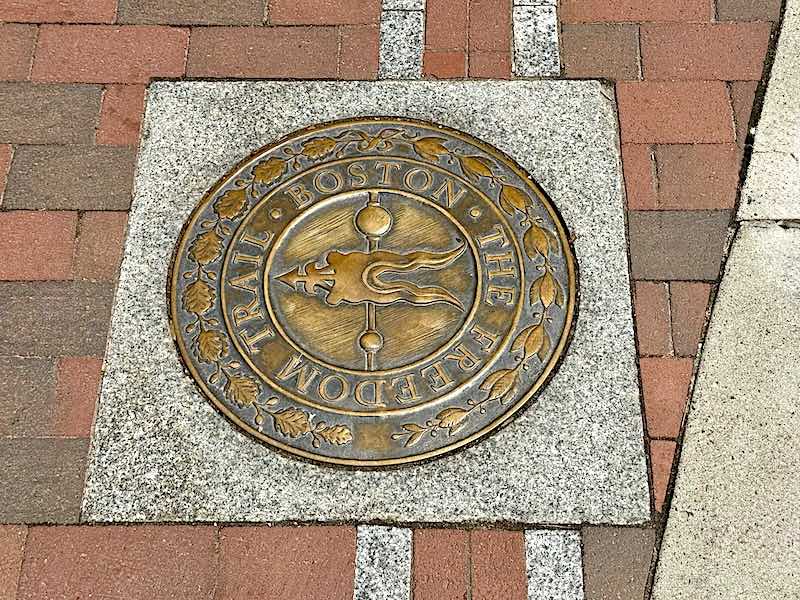
Freedom Trail
Boston One-Day Itinerary at a Glance
A good route for the day is to follow some of the Freedom Trail between Boston Common and the Old North Church. If you still have energy and daylight, continue across the Charles River to Bunker Hill and the USS Constitution area in Charlestown.
The Freedom Trail itself runs roughly 2.5 miles and connects 16 historic sites, but expect to walk considerably farther by the time you wander around the sites, stop for lunch, and make a few detours.
Sites on the Freedom Trail
- Boston Common
- Massachusetts State House
- Park Street Church
- Granary Burying Ground
- King’s Chapel & King’s Chapel Burying Ground
- Boston Latin School Site / Benjamin Franklin Statue
- Old Corner Bookstore
- Old South Meeting House
- Old State House
- Boston Massacre Site
- Faneuil Hall
- Paul Revere House
- Old North Church
- Copp’s Hill Burying Ground
- USS Constitution
- Bunker Hill Monument

Boston Commons – Brewer Fountain
Start at Boston Common
Begin your day at Boston Common, America’s oldest public park and a convenient starting point for exploring historic Boston.
The Common dates to 1634 and has served Boston in a remarkable variety of ways over the centuries. Today it is a pleasant green space surrounded by some of the busiest parts of the city. It is also right by the Park Street MBTA (Massachusetts Bay Transportation Authority) station, which is on the red and green lines, so it is easy to reach.
The Brewer Fountain, near the eastern side of the Common, makes an easy landmark for starting your walk.
- Buy Travel Insurance
- Get a Car Rental

Using GPSMyCity for a Self-Guided Boston Walking Tour
I used GPSMyCity as a guide for my self-guided tour through historic Boston. The app offers self-guided walks with the attractions displayed on a city map, so rather than joining a scheduled group tour, you can move through Boston at your own pace.
The Boston City Introduction Walk in the app covers a number of major central sights and makes a useful complement to the Freedom Trail.
One advantage of a self-guided tour is flexibility. If a historic building catches your attention, you can stop. If you want coffee, lunch, or a longer visit to a cemetery, you don’t have to worry about keeping up with a guide.
You can see that this particular tour had recommended stops, but you can also get information on other nearby sites in the city. Each site has a text description, and the major stops also have audio information.

54th Massachusetts Regiment Memorial
Robert Gould Shaw and the 54th Massachusetts Regiment Memorial
Facing Boston Common is the impressive bronze relief honoring Colonel Robert Gould Shaw and the 54th Massachusetts Infantry Regiment. The 54th was one of the first African American regiments organized in the North during the Civil War. The monument shows Shaw on horseback alongside the soldiers of the regiment and is one of the more striking memorials along this part of the walk. If you are not familiar with the story, I recommend the excellent movie “Glory”.
This site was not an official stop on my self-guided tour, nor is it on the Freedom Trail, but it is worth a stop for history buffs, since it is just across the street from the Massachusetts State House.

Massachusetts State House
From Boston Common, head uphill toward the Massachusetts State House, one of Boston’s most recognizable buildings. Its gold dome overlooks Boston Common from Beacon Hill and makes it almost impossible to miss.
The State House has been the seat of Massachusetts government since the late 18th century. Even if you don’t have time for a tour inside, it is worth walking up to see the building and its setting.

Granary Burying Ground
Boston’s historic cemeteries are among my favorite stops on the Freedom Trail.
The Granary Burying Ground, established in 1660, contains the graves of Samuel Adams, John Hancock, Paul Revere, and several victims of the Boston Massacre.
Take some time to look at the older gravestones as well. Many feature winged skulls, cherubs, hourglasses, and other symbols common in early New England funerary art.

King’s Chapel and King’s Chapel Burying Ground
Continue to King’s Chapel, another of Boston’s important colonial landmarks. Beside it is King’s Chapel Burying Ground, which dates to 1630 and is Boston’s oldest cemetery. Among the people buried here are Massachusetts governors, ministers, and early settlers.
One marker that caught my attention was for William Dawes Jr., one of the riders sent from Boston on the night of April 18, 1775, to warn that British troops were marching toward Lexington. Paul Revere became the best-known rider, thanks in no small part to Henry Wadsworth Longfellow, but Dawes was part of the same warning effort.

Old State House
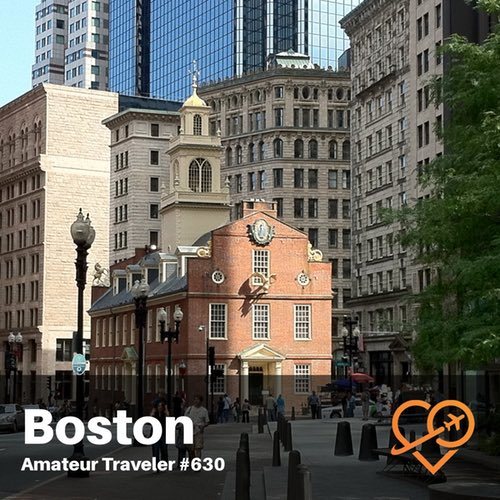
Continue toward the heart of downtown and the Old State House. Built in 1713, it is one of Boston’s most dramatic examples of old and new architecture standing side by side. The small brick building seems almost improbable surrounded by modern towers.
The Old State House served as the center of colonial government in Massachusetts. Just outside the building is the site associated with the Boston Massacre of 1770.
This part of the Freedom Trail is particularly compact. Boston’s colonial political world existed within an area you can walk across in a matter of minutes.
The MBTA’s State Station is now located just under the Old State House. It is on the Orange and Blue lines.

Faneuil Hall
From the Old State House, continue toward Faneuil Hall. Faneuil Hall has served as both a marketplace and a meeting hall since the 18th century and became associated with debates over independence, abolition, and other political movements.
It is also the gateway to one of Boston’s busiest visitor areas: Quincy Market.

Lunch Option: Quincy Market
If you want to keep your day centered on the Freedom Trail, Quincy Market is the easiest lunch stop. The long market building contains numerous food vendors, making it particularly useful when everyone in your group wants something different.
Consider a chowder bread-bowl from Boston Chowda Co., a lobster roll from Wicked Lobsta, or Regina Pizzeria if you want something less seafood-heavy. Don’t expect this to be a quiet local market. Quincy Market and the surrounding Faneuil Hall Marketplace are firmly on Boston’s tourist circuit, but the location could hardly be more convenient for a one-day itinerary.
Outside you are likely to find a juggler or other street performer, especially on the weekends in the space between Quincy Market and Faneuil Hall.
After lunch, continue north toward Boston’s North End.

Continue Into the North End
After Faneuil Hall, follow the Freedom Trail toward the North End, Boston’s historically Italian neighborhood. As you approach the neighborhood, the streets become narrower, and there are no MBTA stations.
Hanover Street is the main commercial artery of the North End, lined with Italian restaurants, cafés, bakeries, and pastry shops. If you skipped dessert at Quincy Market, this is a good place to correct that mistake.
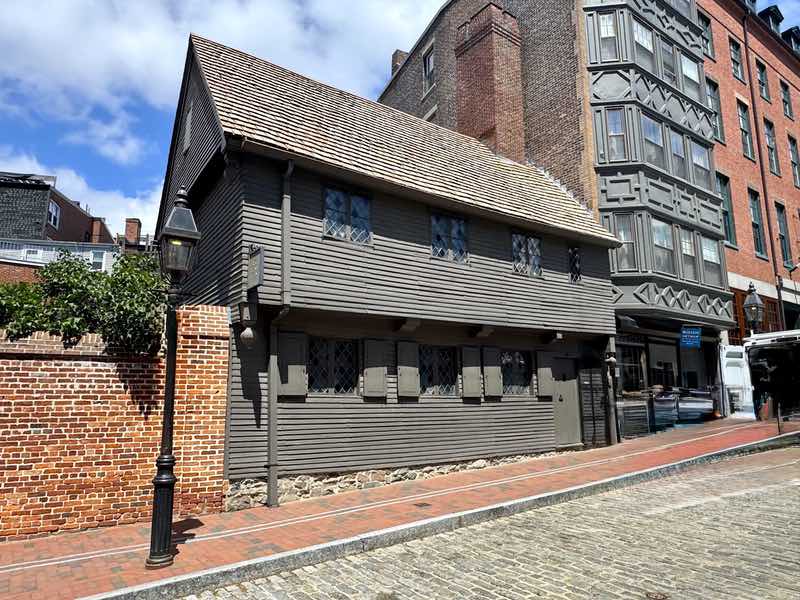
Paul Revere House – Photo by Barry Kramer
Paul Revere House
The next major Freedom Trail stop is the Paul Revere House. Built around 1680, it is the oldest remaining house in downtown Boston and was Revere’s home at the time of his famous ride in 1775.
Paul Revere bought the house in 1770 and owned it until 1800. He was living there when he set out on the night of April 18, 1775, on the ride that would make him famous.
After Revere sold it, the building had a surprisingly varied second life. It was divided into apartments and its ground floor was used for businesses including a cigar factory, bank, and produce shop. Revere’s great-grandson bought the building in 1902 to save it from demolition, and it opened as a historic house museum in 1908.
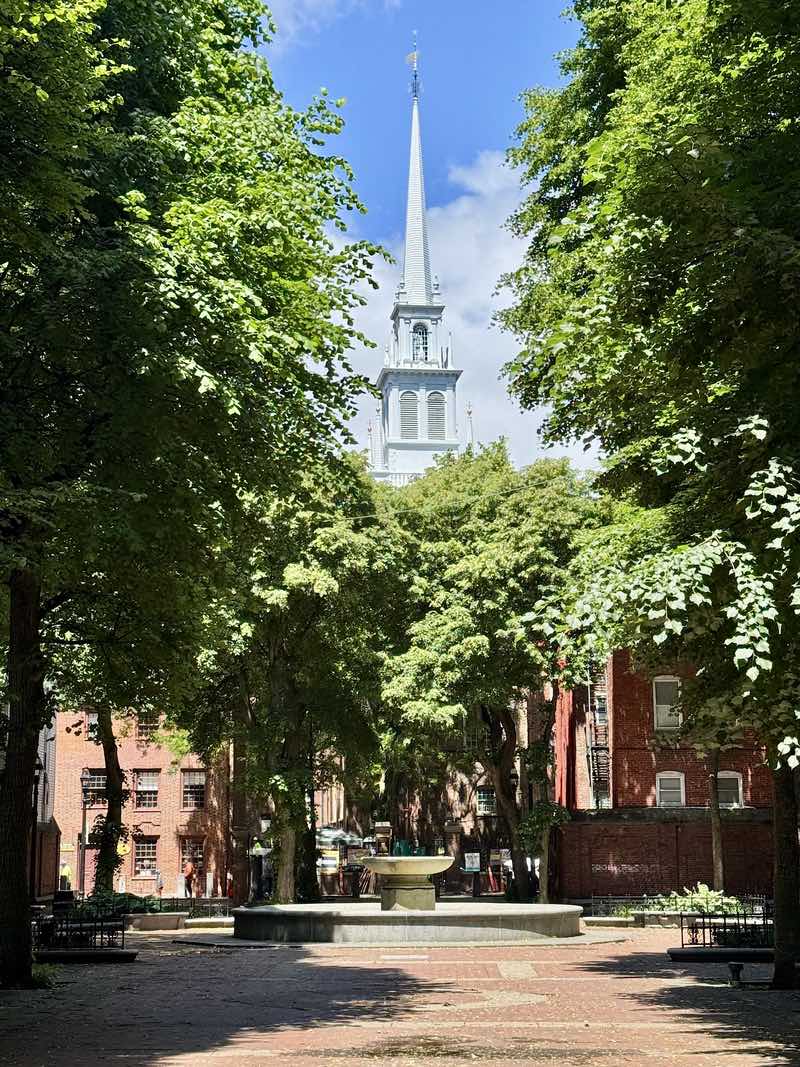
Old North Church – Photo by Barry Kramer
Old North Church
Continue through the North End to Old North Church, famous for the signal lanterns associated with Paul Revere’s ride.
The familiar phrase “one if by land, and two if by sea” refers to the signal arranged to indicate how British troops were leaving Boston.

Should You Continue to Bunker Hill?
At this point you have already had a very full day. But the official Freedom Trail continues across the bridge into Charlestown to the USS Constitution and Bunker Hill Monument. Whether you should continue depends on your interests and your feet.
There is a museum across the street from the Bunker Hill Monument. It explains the battle and, among other things, why the Battle of Bunker Hill happened on Breed’s Hill.
If Revolutionary War history is the main reason you came to Boston, keep going. If you have already spent six or seven hours stopping at historic sites, museums, cemeteries, restaurants, and bakeries, the North End makes an excellent place to finish.
I did not get to Charlestown the last time I was in Boston, because I had friends to meet up with instead. There is no rule that says you have to complete every inch of the Freedom Trail in one visit.
Dinner Option: Chinatown
For something less obvious than Legal Seafood, make a detour to Boston’s Chinatown for dinner. I recommend Fuchun Ju, a Chinese restaurant in Chinatown that is a good choice for a more substantial sit-down meal if you like soup noodles and the like.
Chinatown lies south of the main Freedom Trail route, near Downtown Crossing and South Station.

Where to Stay in Boston
On my last trip to Boston, I stayed in two different parts of the city.
If you want to be close to the Freedom Trail and the sights in this itinerary, the Hilton Boston Park Plaza is a good choice. It is near Boston Common and the Public Garden, with the Arlington T station nearby, and many of central Boston’s attractions are within walking distance.
If you are starting or ending your trip with a cruise, consider the Homewood Suites by Hilton Boston Seaport District. It is one of the closest hotels to Boston’s cruise terminal and also puts you near the waterfront and Seaport District. I stayed at both hotels during this visit and have full reviews of each at Hotel Scoop.

statue “Poe Returning to Boston”
Tips for a One-Day Boston Walking Tour
-
- Wear good walking shoes. Boston’s historic center is compact, but the mileage adds up quickly.
- Start early. The Freedom Trail becomes noticeably busier later in the morning, particularly around Faneuil Hall and the North End.
- Don’t treat the Freedom Trail as a race. Some of the most interesting discoveries are small plaques, gravestones, alleys, churches, and buildings between the headline attractions.
- Use the app as a guide rather than a command. GPSMyCity makes it easy to see nearby attractions and get yourself back on course, which means you can wander without worrying too much about getting lost.

King’s Chapel Burying Ground
Is One Day Enough for Boston?
No, but one day is enough to understand why Boston deserves more time.
Few American cities reward walking quite as much. In just a few hours you can move from a 17th-century cemetery to the Massachusetts State House, stand near the scene of the Boston Massacre, visit buildings connected with the American Revolution, eat lunch in one of the country’s oldest market districts, and finish among the narrow streets of the North End.
And because so much of the historic center is concentrated within a relatively small area, a self-guided walking tour works particularly well.
 6 National Parks in Massachusetts Near Boston Worth Seeing
 Self-Guided Walking Tour of San Francisco
 Travel to Boston, Massachusetts – Episode 630
 Boston Duck Tours
by Chris Christensen
Chris Christensen is the creator of the Amateur Traveler blog and podcast. He has been a travel creator since 2005 and has won awards including being named the "Best Independent Travel Journalist" by Travel+Leisure Magazine.+Chris Christensen | @chris2x | facebook
Leave a Reply
Tags: article, boston, massachusetts