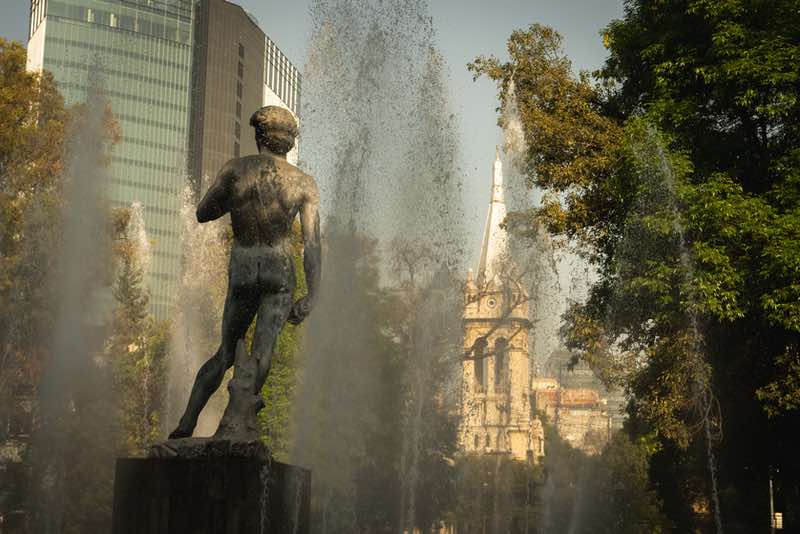
David statue, photo by Roeglio Rojas
Mexico City is a massive place, but that doesn’t mean it has to be an overwhelming blur while you visit. Part of what makes Mexico’s capital enchanting are the tiny details and the slow moments that can be had for the price of slowing down, shrinking your agenda, and taking time to explore a singular neighborhood or even a singular street.
Table of contents: ()

Rosetta Berlinesa, photo by Roeglio Rojas
Encounter the Roma Vibe
If you had 48 hours in Roma Norte, for example, and wanted to take it slow, you might start with a coffee and a tangy lemon berlinesa at the famous Rosetta bakery on Colima street. Don’t get on the waiting list for one of their outdoor tables; instead, stroll to nearby Parque Rio de Janeiro to people watch from a bench in front of Roma’s very own David, who poses sexily in the center of the plaza like he knows he lives in the city’s hippest neighborhood.
Along the streets nearby, some of the city’s best galleries await. The Olivia Foundation on Tonala Street is only a few years old, but has already become a stand-out for its collection of female-focused art and artists. It’s housed in a three-story building renovated by hotshot chilango architect Alberto Kalach, whose industrial minimalism is changing the face of CDMX’s interiors.

Colima 71
Sleep Surrounded by Art & Design
Kalach also led the redesign and renovation of the Colima 71 hotel. A former grade school turned art boutique hotel in Roma, which can serve as a chic base from which to explore this part of the neighborhood. In addition to spacious rooms and luxurious amenities (a 24-hour coffee and honor bar among them), the hotel is home to artwork by Sofía Táboas, Iñaki Bonillas, Darío Escobar, and Chavis Mármol, whose “Olmec Head crushing a Tesla” has become one of the most talked-about pieces in the city.
The hotel’s gallery includes 100-year-old ceramic pieces from Michoacán, hand-hammered copper pots from Guerrero, and a detailed tree of life from the Estado de Mexico. These traditional pieces are complemented by more contemporary art, such as Oscar Morales’ Virgin of Guadalupe, made entirely from minuscule pieces of colored straw, and the massive Quetzalcoatl sculpture that hangs in the building’s stairwell.
Gallery Hop through the Neighborhood
About a half a block down from Colima 71 is Mooni, a pop art gallery and shop that sells a multitude of styles and artists, priced accessibly enough that an artistic souvenir seems well within the budget. Close by is the tiny Almanaque gallery, which features contemporary photographers, both local and international.
Around the corner on Tabasco Street is the Arroniz gallery, housed in the former home of Kati Horna, one of the neighborhood’s famous past residents. She was a surrealist photographer who, along with Remedios Varo and Leonora Carrington, surrealist painters who also lived in Roma, helped create the bohemian culture in Roma in the 1940s, an inheritance for today’s local creatives.
The OMR gallery, a few blocks away on Córdoba, is actually the former location of Walter Gruen’s record store – the husband of Remedios Varo, who supported her during her most prolific years in Mexico. OMR is now one of the city’s most influential art galleries, bringing renowned exhibits from around the world to this little corner of Mexico City.

Casa del Libro, photo by Roeglio Rojas
Explore Historical Landmarks
Spend the lunch hour in one of Roma’s oldest haunts, the Covadonga. This Spanish-style cantina on Puebla Street has been owned and operated by the Asturias Immigrant Society in Mexico City for 86 years.
Inside, an impressionist version of Diego Velázquez’s El Triunfo de Baco is set in three pieces against the far wall, and big-screen TVs broadcast whatever soccer game is on at the moment. I promise you will barely notice them as you dig into your Spanish tortilla or Valencian paella and sip a banderita (a shot of tequila, a shot of lime, and a shot of sangria) while watching old timers play domino.

Sagrada Familia church, photo by Roeglio Rojas
Just next door is Mexico’s National University’s (UNAM) Casa de Libro. This is one of the largest single-family homes built at the neighborhood’s inception (1,200 square meters) and housed Roma’s first elevator. Across the street, you’ll see the Sagrada Familia church. If you have a minute, peek inside to see the stained-glass windows, which are full-on Art Nouveau, with decorative flowers and greenery imagery. Head back to Colima Street to see another Art Nouveau gem, the MODO neighborhood museum, one of only eight officially designated Art Nouveau buildings in the city.
The museum houses collections of objects that sound a bit odd but are endlessly fascinating (Mexican kitchen utensils from the 1950s, for example). They have a great little gift shop of contemporary Mexican knick-knacks if you’re interested.
For more traditional crafts, Artes de Mexico is around the corner, the commercial outpost of the Artes de Mexico magazine. This shop stocks pottery, alebrijes, embroidered clothing, and other regional goods from across the country. Copies of the magazines in their vast catalog are also on display, and in the back of each is an English translation of the articles.

Bar Mauro, photo by Roeglio Rojas
End the Evening With a Hand-crafted Cocktail
For dinner at one of the neighborhood’s more popular upscale restaurants, like Rosetta or Maximo Bistrot, it’s important to make a reservation in advance. But if you are touring without a plan and deciding at the last minute, try The Lamb. They have incredible cocktails and British dishes like fish pie and fried beef gizzards, and almost always have a table available for last-minute diners. Fugaz, a few blocks north of Rio de Janeiro Plaza, has an innovative, seasonally curated menu featuring vegetable-forward dishes and plenty of local seafood.
Mexico City is no slouch when it comes to excellent cocktail bars, and if you are staying in the neighborhood, several good options are close enough to be just a few minutes away walking. Maybe start with Bar Mauro, which won the #2 spot on North America’s Best Bars list this year and has a mid-century-chic, lively, boozy vibe. If it’s too packed, Las Brujas bar, just off the Rio de Janeiro plaza, is owned and operated by an all-female staff and has a rotating menu of exceptional cocktails and small plates.
Chill Out with Morning Yoga
On day two, start from the Colima 71 hotel and head down the street to Casa Basalta, where you can take an early morning yoga class with Con Pausa on the second floor. Afterward, stop by Alma Negra for a quick coffee or Delirio for something more substantial. Delirio is owned by Monica Patino, one of the early chefs who worked to put Mexico City on the food map.

Roma neighborhood, photo by Roeglio Rojas
Uncover Vintage Gems
All up and down Colima and the surrounding streets are high-end vintage and upcycled clothing stores, good places to find one-of-a-kind items for yourself or as a gift for someone. Blanco Vintage has 1990s Christian Dior shorts and 80s silk jackets, while Back to Life Boutique has its own line of upcycled items and lots of nostalgic 90s looks. Erre Garage is men’s clothing with a mechanic shop/racing theme across most of their items – vintage BMW hats, worn leather jackets, and Goodyear mechanic jumpsuits. For home interior and decorative pieces, Piezas Únicas on Álvaro Obregón is an institution in the neighborhood.
For contemporary designs, pop into Audette to check out their Italian leather bags, or Cardon – two shops in one: one with a collection of clothing from different designers that might include oversized, boxy dress shirts or frilly pink tank tops, and the other with accessories – bags, funky jewelry, and statement pieces.

Mercado Medellin, photo by Roeglio Rojas
Eat Your Way through Roma’s Streets
A nice option for lunch is a food tour in the neighborhood, where a guide can help you wade through the hundreds of street food options or lead you through the local Mercado Medellín with its glorious displays of fruits, veggies, candies, and confections. Afterward, you might want to grab an ice cream at Helado Bonito and sit for a spell in Plaza Luis Cabrera, another delightful green space much loved by residents.
Outdoor markets here are an integral part of the fabric of urban life, and Colonia Roma hosts several throughout the week – along Morelia Street near Parque Pushkin on Wednesdays and Sundays, at the corner of Merida and Guanajuato streets on Fridays, and an organic farmers’ market in Lopez Velarde Park on Sundays.

Rio de Janeiro Plaza, photo by Roeglio Rojas
Wind Down with a Delicious Menu
For dinner, sit among the gorgeous greenery at Chui, a new vegetarian restaurant in Roma that proves vegetables can be the star of the show, or just down the block, try some homemade pasta at Sartoria, quite possibly the best Italian restaurant in Roma.
If you fancy a post-dinner drink El Desconocido on the other side of Plaza Rio de Janeiro has an old-timey theme with tarot card readings, dim red lighting and a spooky circus ambiance that might sound lame but ends up feeling very sexy, and if you are staying at Colima 71 and want a nightcap close to home, try Santo Hand Roll, they have some curious mixology with flavors not found in other places.
Whatever you do, make sure to sneak in a nap if you can and enjoy the city at sidewalk level; you will leave with a better understanding of this neighborhood’s daily rhythms and maybe even an artsy reminder of your incredible vacation.
 Mexico Trip Journal – Day 1 – to Mexico City
 Mexico Trip Journal – Day 3 – Mexico City
 Mexico Trip Journal – Day 2 – Mexico City
 First Conversation in Spanish – Mexico City, Mexico
by Lydia Carey
Lydia Carey is a freelance writer and translator based out of Mexico City. She has worked as an editor and writer for various publications including Eater, AAA magazine, Hemispheres magazine, New York Times Travel, Mexico News Daily, Lonely Planet and many others. Lydia has been living in Mexico for almost 20 years and has traveled extensively through Latin America. She is associate editor at Luxury Latin America and the author of Mexico City Streets: La Roma.Leave a Reply
Tags: article, mexico city