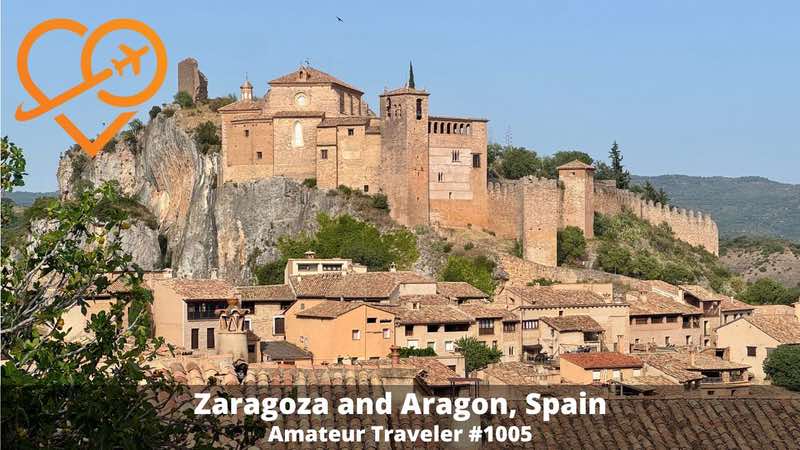
In this episode of Amateur Traveler, host Chris Christensen talks about his press trip through Aragon, Spain, joined by fellow travelers Kevin Revolinski and Cathy Bennett Kopf. Aragon sits in northeastern Spain, west of Catalonia, and stretches from Zaragoza north to the Pyrenees and the French border.
Why Visit Aragon?
Aragon offers Roman ruins, Mudéjar architecture, cathedrals, castles, abbeys, Garnacha wine, medieval villages, mountain scenery, and outdoor adventure, without the crowds of Spain’s better-known cities.
Zaragoza
The trip begins in Zaragoza, Spain’s fourth-largest city, located roughly between Madrid and Barcelona. They stayed at Hotel Silken Reino de Aragón, near the old city and the Roman Theater in Zaragoza. Zaragoza was founded by the Romans as Caesar Augusta in 14 AD. Visitors can still explore the Roman Theater and other Roman museum sites.
Highlights in Zaragoza included the Patio de la Infanta, a reconstructed Renaissance courtyard inside the Ibercaja bank headquarters, and a temporary Goya exhibition.
Chris also visited the Basilica of Santa Engracia, connected with early Christian martyrs from Roman Zaragoza. Its crypt contains fourth-century sarcophagi.
El Tubo and Zaragoza Food
Dinner was in El Tubo, Zaragoza’s lively tapas district. The group ate at Montal, a restaurant, shop, wine shop, and museum. Aragon is closely tied to Garnacha, also known as Grenache, and Zaragoza has festivals celebrating wine, medieval culture, flowers, jazz, and the Fiesta del Pilar.
Chris also notes that El Tubo is a good place to look for Mudéjar-inspired tapas, often using ingredients such as lamb, almonds, pine nuts, raisins, and figs.
Zaragoza Cathedrals and Mudéjar Architecture
Zaragoza is part of the UNESCO-listed Mudéjar Architecture of Aragon. Mudéjar architecture blends Christian buildings with Islamic-influenced design, especially brickwork, tile, and geometric decoration. La Seo, Zaragoza’s older cathedral, has a beautiful Mudéjar exterior wall and a richly decorated Gothic interior. One chapel was left unrestored to show how dark centuries of candle smoke had affected the church.
The Cathedral Basilica of Our Lady of the Pillar is Zaragoza’s other great church. It is tied to the tradition that the Virgin Mary appeared to the apostle James on a pillar. Chris notes that this story is not supported by the biblical record, but the basilica itself is impressive, with Goya paintings, Civil War bomb damage, and a tower elevator with city views.
Market, Cooking Class, and Aljafería
The group visited Zaragoza’s Central Market and took a cooking class at La Zarola focused on Garnacha wine. Dishes included goat cheese with caramelized onion and Garnacha, almond soup, and pork cheeks cooked in Garnacha.
Another highlight was the Aljafería Palace, an 11th-century Islamic palace and fortress later adapted by Christian rulers. It includes Islamic arches, gardens, a mosque, Mudéjar ceilings, and is part of Zaragoza’s UNESCO designation.
Dinner that night was at La Clandestina Bistro, where the group had ternasco de Aragón, a traditional Aragonese lamb dish.
Veruela Abbey
Leaving Zaragoza, the group visited Veruela Abbey, a fortified Cistercian abbey from the 12th century. Chris enjoyed the cloister, the carved figures, the old measuring marks used by builders, and the large abbey church.
Aragon Wine Country
Aragon has several important wine regions. Cariñena is known for Garnacha and Tempranillo reds. Campo de Borja is called the “Empire of Garnacha,” especially for old-vine Garnacha. Calatayud produces higher-altitude, fresher Garnacha wines. Somontano, near the Pyrenees, grows both Spanish and international grapes.
The group visited Aragonesas, a large Campo de Borja wine cooperative, where Chris especially liked the Fagus old-vine Garnacha. They also visited Tierra de Cubas in Cariñena, another cooperative that produces affordable wines, Cava, and a red blend called 8.0.1.
Huesca, Mallos de Riglos, and Loarre Castle
The group stayed in Huesca at Hotel Pedro I de Aragón. Nearby are the Mallos de Riglos, towering red rock formations popular with climbers.
The next day, they visited Loarre Castle, an 11th-century Romanesque castle and abbey built near the former frontier between Christian and Muslim lands. Chris loved the walls, towers, chapel, keep, and sweeping views.
Ordesa y Monte Perdido National Park
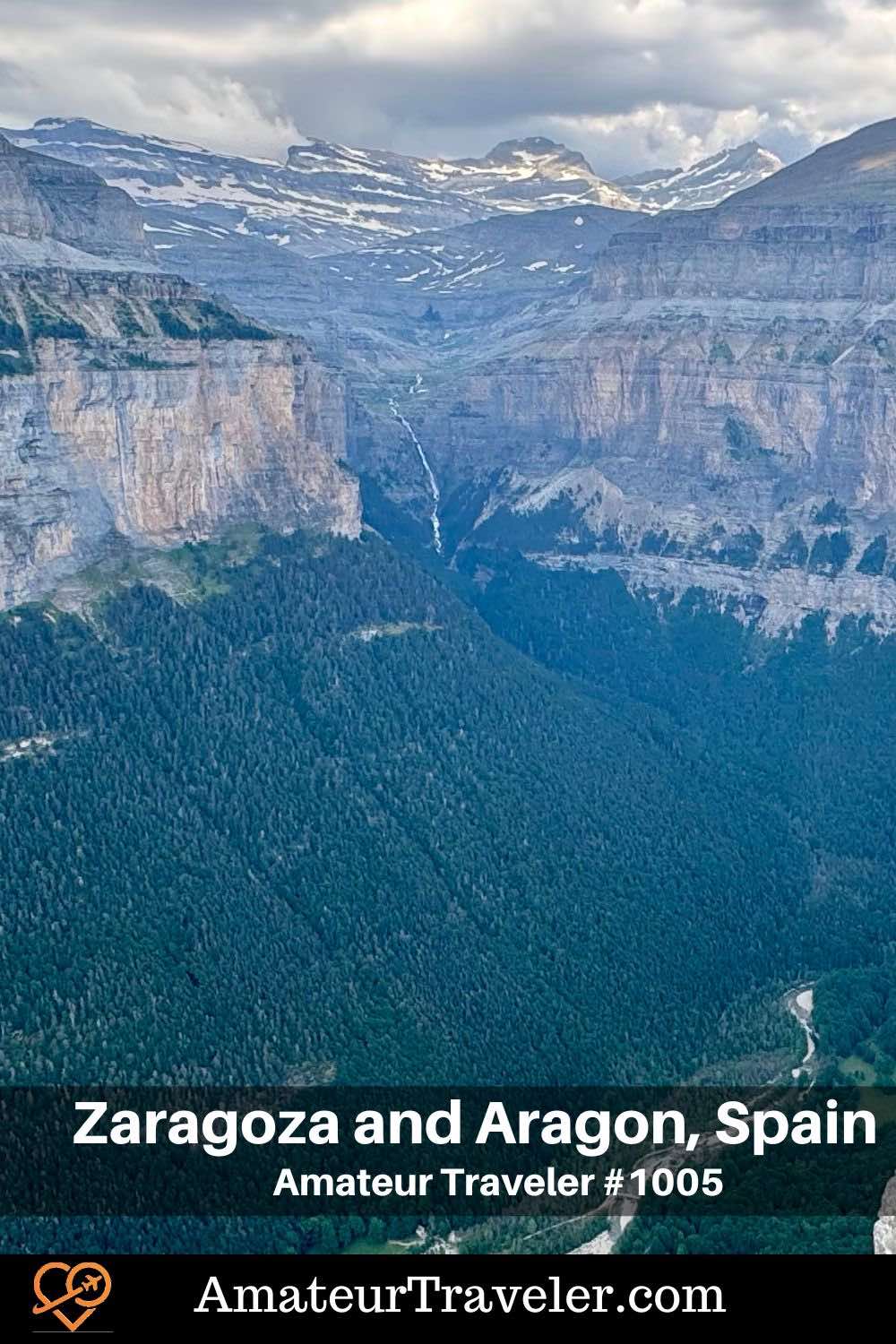
One of the trip highlights was Ordesa y Monte Perdido National Park in the Pyrenees. With Miradores de Ordesa, the group took a 4×4 ride up a rough mountain road to about 2,100 meters, then hiked to a dramatic viewpoint.
They saw the deepest canyon in Europe, a distant waterfall, the Pyrenees peaks, and a bearded vulture. Kevin described the canyon reveal as one of the great moments of the trip.
Canyoning Near Alquézar
The most adventurous activity was canyoning with Sally Adventures near Alquézar. The group wore wetsuits and helmets to descend a cold river canyon by hiking, climbing over rocks, sliding down rock chutes, jumping into pools, and floating through clear water.
Chris, Kevin, and Cathy all found it challenging but memorable. Chris recommends bringing a glasses strap if you wear glasses, and getting clear details beforehand about the route and difficulty.
Alquézar
After canyoning, the group visited Alquézar, a beautiful medieval village in the Sierra de Guara. The town sits above a canyon and was revived in part by adventure tourism, including canyoning, via ferrata, hiking, and rock climbing.
They had lunch at Mesón del Vero, stayed at Hotel Boutique Maribel, and took a guided walk through the village’s narrow lanes, chapels, old homes, and historic details.
They also tried dobladillo de Alquézar, a local pastry with a sweet-savory anise flavor, revived by Panadería Repostería O Forno after the old recipe had nearly disappeared.
Dinner at Cueva Reina was one of the best meals of the trip, with canyon views, creative food, and memorable owners.
Aragon as a Road Trip
Both Cathy and Kevin recommend Aragon as a road trip destination. Spain’s highways are modern and well-signed, and a car lets travelers stop at wineries, castles, monasteries, mountain villages, and scenic overlooks.
When to Go
They visited in mid-June, when Zaragoza was hot, with temperatures in the mid-90s to over 100 degrees Fahrenheit. May or September may be better for travelers who want milder weather.
This press trip to the province of Aragon was paid for by the Tourism Board of Spain and the province of Aragon. The opinions expressed are my own.
Sponsors

- Upgrade your wardrobe with high-quality essentials and get free shipping and 365-day returns at Quince.com/TRAVELER.

- Save 50% on Unlimited premium wireless plans starting at $15/month at MintMobile.com/traveler.

- For a limited time, try OneSkin with 15% off using code TRAVELER at oneskin.co/TRAVELER.

- Find the card that fits your lifestyle and apply today at joinbilt.com/traveler

subscribe: rss feed | Apple podcasts

right click here to download (mp3)
Show Notes
Zaragoza, Spain: Roman Ruins, Mudéjar Architecture, Goya, Garnacha, and Two Remarkable Cathedrals
A Road Trip Through Aragon’s Wine Country, Castles, Pyrenees, and Canyoning
Aragon
Things to do in Zaragoza, Spain (Podcast)
Zaragoza
Ordesa y Monte Perdido National Park
Silken Reino de Aragón: Comfort in Central Zaragoza, Spain | Hotel Review
Patio de la Infanta, la enciclopedia libre
Francisco Goya
Basílica de Santa Engracia (Zaragoza), la enciclopedia libre
Engratia
El Tubo
Montal Restoration
Museo de la Torre Nueva
Fiestas del Pilar
Monasterio de Piedra
Caesaraugusta Theatre Museum
Mudéjar Architecture of Aragon
Church of San Pablo, Zaragoza
La Seo / Cathedral of the Savior, Zaragoza
Cathedral Basilica of Our Lady of the Pillar
Zaragoza Central Market
La Zarola | Cooking courses in Zaragoza
Aljafería Palace
La Clandestina Bistro
Garnacha / Grenache
Veruela Abbey
Cariñena Wine Route
Campo de Borja
Calatayud Wine Region
Somontano Wine Region
Aragonese Wineries
Paired Tastings, Restaurant and Events – Tierra de Cubas
Huesca
Hotel Pedro I de Aragón in Huesca, Spain | Hotel Review
Mallos de Riglos
Castle of Loarre
Fiscal Grill Restaurant: Grilled Meats and Fish
Ordesa viewpoints by 4×4 | Classic excursion from Broto and Buesa
Sally Adventures – Canyoning and Multi-adventure activities in Sierra de Guara
Rutica 41 – Jorge’s company
Alquézar
Mesón del Vero Brasserie | Alquézar
Hotel Boutique Maribel
Panadería O’Forno
Dobladillo de Alquézar
Cueva Reina
The Mad Traveler
SheBuysTravel
All The Write Places
GoNOMAD Travel
Community
on Kumano Kodo Trail in Japan – Episode 672:
Hello Chris!
My name is Katherine. I am a regular listener to your Amateur Traveler podcast. I recently came across an episode on Kumano Kodo and hiking in Japan. This episode inspired me to plan a trip to Japan which included the multi day hike of Nakahechi trail in the Kumano region. It was a beautiful hike and I was impressed by the hospitality and kindness of the local people. Your other interviews on Tokyo and Osaka were also incredibly helpful in highlighting some areas of the cities worth visiting on a trip with limited time.
Thank you very much for doing this show! It is very informative, inspirational and very well suited to us, North American travelers who have limited vacation time. I am attaching a picture of us at Kumano-Nachi Taisha Grand Shrine at the end of our hike. I really appreciate your work, and without it I would have never known about multi-day hikes in Japan!
Thank you,
Katherine.
- Guided Tours in Spain
- Get a universal plug adapter
- Buy Travel Insurance
- Get a Car Rental
- Get an eSim to be able to use your smartphone abroad.


 Zaragoza, Spain: Roman Ruins, Mudéjar Architecture, Goya, Garnacha, and Two Remarkable Cathedrals
 Travel to Zaragoza, Spain – Episode 784
 A Road Trip Through Aragon’s Wine Country, Castles, Pyrenees, and Canyoning
 Book Review: “The Espresso Break” by Barbara Zaragoza
by Chris Christensen
Chris Christensen is the creator of the Amateur Traveler blog and podcast. He has been a travel creator since 2005 and has won awards including being named the "Best Independent Travel Journalist" by Travel+Leisure Magazine.+Chris Christensen | @chris2x | facebook
Leave a Reply
Tags: aragon, audio travel podcast, podcast, spain, zaragoza