Zaragoza, Spain: Roman Ruins, Mudéjar Architecture, Goya, Garnacha, and Two Remarkable Cathedrals
categories: europe travel
Cathedral-Basilica of Our Lady of the Pillar
I went to Aragon because of Zaragoza.
That is not the only reason I went, but it was the reason I first raised my hand when Patricia from Spain’s tourism office asked where I wanted to visit. We had done an episode of Amateur Traveler about Zaragoza a while back, and that conversation had stayed with me. Zaragoza sounded like one of those cities that had too much history, too much architecture, and too much food to be left off my Spain list.
It did not disappoint.
Zaragoza is the fourth-largest city in Spain, but it does not seem to attract as many foreign visitors as Madrid, Barcelona, Seville, or Granada. That is part of its appeal. It has Roman ruins, two cathedrals, Mudéjar architecture, Goya, tapas, wine, and a walkable old town, but without the crush of tourism you find in some of Spain’s better-known cities.
We stayed our first couple of nights at the Hotel Silken Reino de Aragón, right near the border between the modern city and the historic core. The hotel was only a couple of blocks from the Roman theater, which gives you a sense of how much history is underfoot in Zaragoza.
Table of contents: ()
- Where Is Zaragoza
- First Impressions: A Pleasant City with Layers
- El Tubo: Tapas in the Old City
- Roman Zaragoza: Caesar Augusta
- Zaragoza’s Sweet Shops
- Mudéjar Architecture in Zaragoza
- La Seo: Zaragoza’s Older Cathedral
- Basilica of Our Lady of the Pillar
- Plaza del Pilar and the River View
- Central Market
- Cooking with Garnacha at La Zarola
- The Aljafería Palace
- Dinner at La Clandestina Bistro
- When to Visit Zaragoza
- Why Visit Zaragoza?

Where Is Zaragoza
Zaragoza sits about halfway between Madrid and Barcelona, a little farther north than Barcelona. It is in the region of Aragon, west of Catalonia, and is well connected by Spain’s high-speed rail network.
That makes Zaragoza an easy detour if you are traveling between Madrid and Barcelona. But I would not treat it only as a stopover. Zaragoza deserves at least a couple of days, especially if you like history, architecture, food, wine, and cities that feel lived-in rather than overrun.
First Impressions: A Pleasant City with Layers
Our first afternoon in Zaragoza took us into the newer part of the city. It is a pleasant shopping area, with El Corte Inglés and other shops, but I was more interested in the history.
One of our first stops was, oddly enough, a bank.

Patio de la Infanta
The headquarters of the Ibercaja Bank contains the Patio de la Infanta, a reconstructed Renaissance courtyard from a 16th-century palace. The palace itself is gone, but the courtyard was taken apart and rebuilt here. It gives you a glimpse of the wealth that once existed in Zaragoza’s merchant and banking families. Before the Peninsula War (Napoleonic Wars), there were 200 such palaces in Zaragoza, but only 20 remain.
At the time of our visit, the bank’s basement also hosted a Goya exhibit because the Goya Museum in the old town was under renovation. Goya is strongly associated with Zaragoza, and some of the works on display featured his darker, more disturbing images from the Spanish Civil War.

We also visited the Basilica of Santa Engracia, whose crypt contains fourth-century sarcophagi tied to early Christian martyrs, including Zaragoza’s local saint. Zaragoza was a Roman city, and Santa Engracia is traditionally connected with the persecution of Christians under the Roman Emperor Diocletian.
It was a good first afternoon, but the next day made Zaragoza click for me.

El Tubo: Tapas in the Old City
That evening, we headed into El Tubo, the old tapas district just inside where the city walls once stood. The walls are gone, but the neighborhood remains a lively area of narrow streets, small restaurants, and tapas bars.
Our welcome dinner was at Montal, a restaurant, shop, wine shop, and museum space. The museum in the basement is dedicated to the Torre Nueva, the “New Tower,” which was actually an old clock tower built in the early 1500s and demolished in the late 1800s because it leaned. It was the leaning tower of Zaragoza, if you will.

Montal Wine Shop
Dinner was late, because this was Spain. I had come in from Paris, and several of us were still adjusting to the schedule, but we learned a lot over that meal. Zaragoza and Aragon are proud of Garnacha, which many wine lovers know by its French name, Grenache. We heard about the Grenache Wine Festival, the Medieval Festival, the Flower Festival, the Jazz Festival, and the major Fiesta del Pilar in October.
We also learned that a surprising amount of Spain’s fruits and vegetables come from Aragon, 25%. I had not known that. Aragon is not just castles and mountains. It is also a major agricultural region.
In El Tubo, we were told to look for Mudéjar-inspired tapas, influenced by Muslim culinary traditions. You are more likely to find lamb, almonds, pine nuts, raisins, figs, and similar flavors than ham in those dishes. We were also told to watch for Soles Repsol, a Spanish restaurant rating system that works somewhat like Michelin stars, but with suns.

Roman Zaragoza: Caesar Augusta
The next day, we saw more of old Zaragoza, and for me, this was the highlight of the city.
Zaragoza was not called Zaragoza in Roman times. It was Caesar Augusta, founded in 14 AD and named for Emperor Augustus. The Roman Theater is one of several Roman sites in the city. It is not as complete as some Roman theaters, and it is no longer used for performances, but the museum helps you understand the layout and life of Roman Zaragoza. There are four Roman museums in the city if you are interested in Roman history.

Pastelería Fantoba
Zaragoza’s Sweet Shops
Zaragoza is also known for sweets. The tourism board has a pass that gives you tickets to several sweet shops in the city. I like experiences like this because they give you a reason to wander. You are not just moving from monument to monument. You are following a trail through local businesses, tasting along the way.
We toured Pastelería Fantoba, which is the oldest of those shops, and it was a fun way to connect food with the city. Zaragoza has long been associated with sweets. Chocolate was first produced in Europe in the nearby Monasterio de Piedra.

tower of La Seo
Mudéjar Architecture in Zaragoza
Zaragoza is connected to the UNESCO-listed Mudéjar architecture of Aragon. Mudéjar architecture is Christian architecture influenced by Muslim design, often with intricate geometric tilework, brickwork, and decorative patterns.
The city has three sites tied to this designation. One is the Aljafería Palace, which we visited later. Another is the parish church of San Pablo, which we did not get to see. The third is La Seo, the older of Zaragoza’s two cathedrals.
The exterior wall of La Seo, especially the side closest to the river, is one of the most beautiful examples of Mudéjar detail we saw. The patterns are intricate and geometric, reflecting the Islamic artistic tradition of avoiding depictions of living things.

La Seo
La Seo: Zaragoza’s Older Cathedral
La Seo is the older of Zaragoza’s two cathedrals, and it is a fascinating building. Inside, La Seo is a gold-filled Gothic cathedral. The oldest part of the cathedral date back to 1140.

La Seo
One of the details I found most interesting was a chapel intentionally left unrestored. The rest of the cathedral had been cleaned, but this one chapel was left blackened by centuries of candles and flame. It lets you see what the whole interior once looked like before electric lights and modern restoration.

Basilica of Our Lady of the Pillar
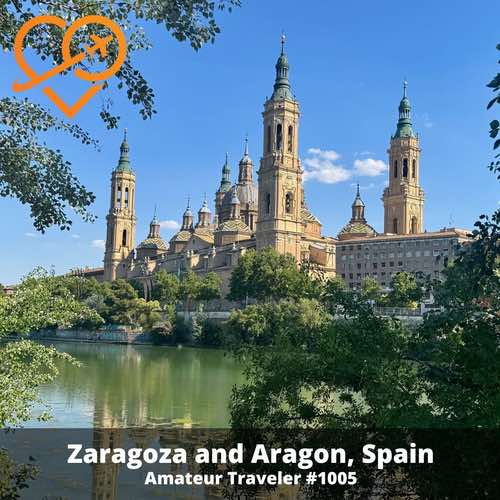
Basilica of Our Lady of the Pillar
The other cathedral is the Cathedral Basilica of Our Lady of the Pillar. It is enormous and very different in style from La Seo.
The basilica is built around a tradition involving the apostle James. According to the story, James the Greater was in Spain around 40 AD when the Virgin Mary appeared to him, standing on a stone pillar, accompanied by angels. The small pillar and statue are still venerated inside the huge church.

Our Lady of the Pilar (lower right, in orange)
Since I also host a Bible Study Podcast, I have to say there is no biblical evidence for this story. From the biblical accounts, it seems much more likely that James remained in Jerusalem, where he was executed around 44 AD. But whether you come for the legend, the architecture, or the views, the basilica is an impressive building.

bombs
During the Spanish Civil War, bombs were dropped on the church, and some of the bombs and damage were left in place. The church itself was built over a long span, from 1681 to 1872, with the towers added later in the 20th century. It is one of the largest churches in the world and the second largest in Spain, after Seville, from what I could find.

view from the tower of Our Lady of the Pillar
One of my recommendations is to go around to the riverside of the basilica and take the elevator up the rear tower. You can continue further by the spiral staircase if you have the mobility. The view over the city and over the colorful tiled roof of the cathedral is worth it.
I also recommend crossing the river to get a better view of the whole building (see above), since it is hard to take in from the plaza directly in front of it.

Plaza del Pilar and the River View
The Plaza del Pilar is one of the great urban spaces in Zaragoza. It gives you access to both cathedrals and several other sights, but the basilica is so large that you need to move around to appreciate it.
In the plaza, near the cathedral, is a large modern fountain depicting Spanish America. Look closely, and you can see Mexico, Central America, and South America represented in the design.

Central Market
Near the cathedrals is Zaragoza’s Central Market, a beautiful market worth a stop, even if you are not shopping for groceries. If you were staying in an apartment, this would be a tempting place to buy ingredients. Even as a visitor, it is a good place to photograph and browse.

“chef” Kevin Revolinski
Cooking with Garnacha at La Zarola
From the market, we did a cooking class at La Zarola, which was my second cooking class in Spain. I recommend this kind of experience. It is hands-on and social, and it gives you a better sense of how local ingredients are used. I was taking the class with the other 4 people on my press trip, but it would also be a good way to meet strangers.
This class focused on cooking with Garnacha. We made caramelized onion with goat cheese and Garnacha, cold almond soup with smoked sardines (not in mine) and red wine gelatin, pork cheeks cooked in Garnacha with potatoes and apples, and a dessert I no longer remember, except that the class was great fun.
The class started at 49 euros, and everyone seemed to enjoy it.

The Aljafería Palace
The Aljafería is Zaragoza’s great palace, and its name means the Palace of Jafar (not the one from Aladdin). The name comes from Abu Jafar Ahmad ibn Sulayman, one of the last Muslim rulers in the 11th century.
From the outside, the Aljafería looks like a castle because it is a fortified palace, with walls, towers, and a keep. Inside, it has the features you expect from an Islamic palace: gardens, orange trees, arches, and intricate architectural details. It also contains a mosque.

Later Christian rulers added Mudéjar ceilings and other decorative elements, so the palace tells several chapters of Aragon’s history at once. During our visit, there was also a temporary Goya exhibit with larger pieces than we had seen earlier at the bank.

One of the beautiful dishes at La Clandestina Bistro
Dinner at La Clandestina Bistro
That night, we ate at La Clandestina Bistro in the old town. The name means the secret bistro, though it is not really that secret. It was a fixed-price meal and a very good one. One of the main dishes was ternasco de Aragón, a traditional Aragonese lamb dish. This was one of several meals on the trip that reminded me how much Aragon has to offer as a food destination.
They have a tasting menu that starts at 48 euros or 39 euros, Tuesday to Thursday lunch and dinner, and Friday lunch.
When to Visit Zaragoza
We visited in mid-June, and Zaragoza was hot. The temperatures I noted ranged from about 95 to 103 degrees Fahrenheit, or roughly 35 to 40 Celsius.
If you are planning a trip focused on Zaragoza, I would consider May or September rather than the heat of midsummer. The city is walkable, and you will enjoy it more if you are not trying to explore Roman ruins and cathedral plazas in 100-degree heat.

Why Visit Zaragoza?
For me, Zaragoza worked because it had depth. The first day, it felt like a pleasant city. The second day, after the cathedrals, Roman theater, Mudéjar architecture, cooking class, and palace, I understood why it had stayed in my mind since that earlier podcast episode.
Zaragoza did not disappoint.
I visited the hotel on a press trip visiting the province of Aragon with the Tourism Board of Spain. The Tourism board paid for my hotel nights. The opinions expressed are my own.
I visited the hotel on a press trip visiting the province of Aragon, paid for by the Tourism Board of Spain and the region of Aragon. The opinions expressed are my own.

 Travel to Zaragoza, Spain – Episode 784
 Zaragoza and Aragon, Spain – Episode 1005
 Book Review: “The Espresso Break” by Barbara Zaragoza
 Sightseeing in Malta – An Island of Fortresses and Cathedrals
by Chris Christensen
Chris Christensen is the creator of the Amateur Traveler blog and podcast. He has been a travel creator since 2005 and has won awards including being named the "Best Independent Travel Journalist" by Travel+Leisure Magazine.+Chris Christensen | @chris2x | facebook