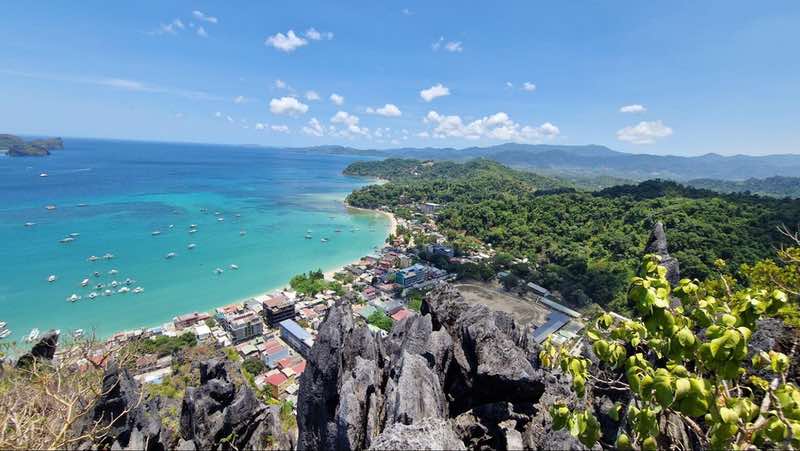
El Nido viewpoint of the entire city
If you have a week in the Philippines and only enough budget for one base in Palawan, the choice usually comes down to El Nido or Coron. Both sit on the same wild stretch of limestone karst in the country’s western frontier. Both run daily boat tours that take you to the lagoons and beaches you have already seen on Instagram. The difference is what kind of trip you actually want.
I spent three days based in El Nido: one full-day boat tour, two fun dives offshore, the hike up Taraw Cliff, and a lot of slow walking through town. This is what those three days actually cost, what worked, and the small Coron comparison that might decide where you put your week.
Table of contents: ()
Getting There Is Half the Commitment
Before any of the lagoons, there is the matter of arriving, and it is worth setting expectations. Most travelers fly into Puerto Princesa, the provincial capital, because flights there are cheaper and more frequent than the small airport at El Nido itself. From Puerto Princesa, you face roughly five hours of road north. The vans leave throughout the day from a terminal near the airport, they fill up before they go, and the drivers take the mountain road faster than you would like. If you get carsick, sit up front and bring something for it.
The other option is flying straight into El Nido on one of the small turboprop services, which turns five hours of road into about an hour and a half of air. The catch is price. Those flights cost several times the van, sell out in high season, and run on a limited schedule. For most independent travelers, the van wins on budget, and arriving overland at least gives you a sense of how remote this corner of the country really is. You do not stumble onto El Nido. You commit to it.

Outside of El Nido farm fields
Day 1: Town, Hostel, and the First Beer
The van drops you off on the main road at the edge of town after about five hours and 600 pesos (~$11). I checked into Happiness Hostel El Nido, paid $14 for a dorm bed, and walked straight to the beach to figure out what kind of trip I had just booked.
El Nido town is small. You can walk from one end to the other in fifteen minutes. The main drag is one street of restaurants, dive shops, and tour operators all selling the same four boat tours at the same posted prices. There is no point in haggling. The price is the price, set by the local tourism board, and the only real decision is which tour and which operator.
The four tours are labeled A, B, C, and D, and they exist precisely so the boats spread across different parts of the bay instead of all crowding the same lagoon. Tour A is the lagoon headliner. Tour C leans toward snorkeling and hidden beaches and is the one most people rate second. B and D fill in the rest. You do not need a guide to tell you which to pick. You need to decide how many boat days you actually want, because they start to blur faster than you expect.
The first evening is for sitting on the beach with a 70-peso ($1.25) San Miguel and watching the bangka boats come in from the day’s tours. This is also when you book whichever tour you want for the next morning. Most hostels and operators close bookings around 9 pm. There is a rhythm to the town in the evening: the boats unload, the day-trippers shower off the salt, and the one street fills up with people comparing which lagoon was best. It is an easy place to fall into conversation, which is half of why people pick El Nido in the first place.

El Nido beach with shops and restaurants
Day 2: Tour A, the Standard Route
I booked Tour A. It is the most popular of the four routes and hits the Big Lagoon, Small Lagoon, Secret Lagoon, Shimizu Island, and Seven Commandos Beach. Cost: 1,400 PHP (~$25), lunch included, snorkel gear extra at 150 PHP. You also pay a one-time 200-peso environmental fee that is valid for ten days across all the tours, so keep the paper receipt because they check it.
The tour is good. The water at Big Lagoon is the green-blue color that makes the photos look fake. Small Lagoon you reach by swimming through a gap in the limestone. Lunch is grilled fish, pork, eggplant, rice, and fresh fruit served on banana leaves on a beach. None of this is a secret, which is the problem.

Boat trip El Nido
By 11 am, there were eleven other boats in Big Lagoon. At Secret Lagoon, I waited fifteen minutes for the gap to clear so I could swim through. At lunch, four boats were parked at the same beach, which meant about 80 people sharing a strip of sand. The crew was great. The food was good. But you do not have these places to yourself, and pretending otherwise would be lying.

Naked island Philippines
This is the honest math of El Nido that the feeds leave out. The scenery genuinely earns the hype. The limestone walls rise straight out of water clear enough to see your shadow on the bottom, and the first time you paddle into Big Lagoon, it does stop you. What it is not, by mid-morning in season, is quiet or private. Manage that expectation before you arrive, and you will enjoy it more. Arrive expecting an empty postcard, and you will spend the day annoyed at strangers in your photos.
Tip: book the earliest morning departure your operator offers. The first boats out get thirty minutes of relative quiet at Big Lagoon before the rest catch up. That half hour is the difference between the trip you imagined and the one everyone else is having an hour later.
Day 3: Diving and the Hike Above Town
I dove with Submariner Diving, a two-tank fun dive for 5,200 PHP (~$93) including gear, lunch, and the boat. The reef life is decent. Visibility was around 15 meters, schools of yellowtail snapper, lionfish in the cracks, healthy coral in patches, but bleached in others. If diving is the reason you are coming to the Philippines, El Nido is fine, but it is not the trip. Coron is for the World War II wrecks. So is Apo Reef. So is Tubbataha if you have liveaboard money.
That is not a knock on El Nido so much as a question of priorities. As a place to do a casual fun dive or your first few open-water dives, the water is warm, the operators are professional, and the conditions are forgiving. As a destination, you build an entire trip around for the diving alone, it sits a tier below the names that draw serious divers to this part of the world. Know which traveler you are before you spend the money.

Diving with fish and coral, nearby El Nido
In the late afternoon, I hiked Taraw Cliff. There is an unguided route that gets you partway up for a town view, and a guided scramble that takes you to the proper summit for around 600 PHP. The summit version is sharp limestone karst, hand-over-hand in places, gloves recommended, and the payoff is a top-down view of the entire bay with the bangka boats coming in. This is the El Nido shot you have seen on every travel feed. Doing it on the last afternoon, after the lagoons start to feel repetitive, is the right rhythm.
A word on that hike: the rock is genuinely sharp, the kind that takes skin off if you slip, and the guided route exists for a reason. Closed shoes with grip, not flip-flops. Water. Start late enough that the worst of the heat has passed, but early enough to be down before dark, because there is no lighting on the way back. None of this is dangerous if you respect it, and the view from the top is the single best thing I did in three days.

One of the visited islands on the boat trip, nearby El Nido
What Three Days in El Nido Actually Cost
This is the question every traveler I met was asking. Here is the breakdown, in pesos and US dollars, with everything included except the flight to Palawan.
- Accommodation: Happiness Hostel El Nido dorm bed, $14/night x 2 nights = $28. Private rooms in town run 2,400 to 3,200 PHP ($43-57) and mid-range hotels along Corong-Corong beach start around 3,500 PHP ($63). Corong-Corong sits a short tricycle ride from the main beach and trades the town’s noise for sunset views, which is the right call if you want quiet and the wrong one if you want to roll out of bed into the bar street.
- Boat tour: Tour A, 1,400 PHP ($25). Tours B, C, and D are all 1,200 to 1,500 PHP. Snorkel gear rental, 150 PHP. Environmental fee, 200 PHP one-off.
- Diving: Two-tank fun dive with Submariner, 5,200 PHP ($93). A single Discover Scuba intro dive runs around 3,500 PHP ($63). Open Water certification, roughly 18,000 to 22,000 PHP ($320-395) over three to four days.
- Food: Local rice plates at carinderias cost 120 to 200 PHP per meal. A proper sit-down dinner at a restaurant on the main road is 350 to 600 PHP. Three days of mixed eating, around 1,800 PHP ($32). The carinderia route, the small canteens serving whatever was cooked that morning from a row of pots, is both the cheapest and the most genuinely local way to eat, and it is where your money goes furthest.
- Drinks: San Miguel beer at a beachfront bar, 70 to 100 PHP ($1.25 to $1.80). Cocktails, 250 to 400 PHP. A reasonable two-night drinking budget, 1,000 PHP ($18).
- Transport: Van from Puerto Princesa airport to El Nido, 600 PHP ($11) one way. Tricycles around town, 50 to 150 PHP per ride. Taraw Cliff guide and entry, 600 PHP. Three days of local transport plus the hike, around 1,000 PHP.
Three-day total for one boat tour, one dive day, eating local, drinking moderately, and the cliff hike: roughly 13,000 to 14,000 PHP, or $235 to $250. That includes the van from Puerto Princesa but excludes your flight to Palawan. Swap the dive day for a second boat tour, and you drop the total by around $60. Add a private room instead of a dorm, and you add roughly the same back. The number moves, but the shape of a sensible three days stays the same.

Boat trip, view on El Nido
The Small Coron Comparison
I did not go to Coron, so I will keep this honest. The travelers I met in El Nido who had done both said two things consistently. First, the headline boat tours in Coron felt less crowded than El Nido’s, partly because the islands sit further apart, so when boats spread out, they actually spread out. Second, diving in Coron is a different category. The Japanese WWII wrecks sit in 20 to 40 meters of water just offshore and are the reason most divers pick Coron over El Nido in the first place.
The trade-off: Coron town is smaller, the nightlife thinner, and the social scene less active. El Nido pulls solo backpackers and twenty-something couples. Coron pulls divers and slightly older travelers willing to swap bar nights for quieter water.
If your trip is built around diving, fly into Coron. If it is built around lagoon-hopping, beach lunches, and meeting people in dorms, El Nido. If you have a week, do both; the fast ferry runs daily and takes about four hours for around 1,800 PHP ($32). The two-base week is the version most people who have done it recommend, because each place covers the other’s weakness: El Nido for the lagoons and the people, Coron for the wrecks and the calm. Planning the order of a multi-stop Philippines route is the kind of thing worth mapping out before you book anything, and a destination guide for the Philippines is a sensible place to sketch the rough shape of it.

El Nido boat trip views to an island
Practical Tips That Actually Matter
Bring cash. ATMs in El Nido run out, charge 250-PHP fees, and have daily withdrawal caps of around 10,000 PHP. Pull what you need from Puerto Princesa before the van. This single point catches more travelers off guard than anything else on the island, because almost everything here, tours included, runs on cash.
Book boat tours the day before, not weeks in advance. Prices are fixed, and operators are interchangeable. Booking through your hostel is the easiest route, and it means someone knows where you went if a tour runs late.
Skip the “all four tours in four days” trap. After Tour A and Tour C, the experience starts to repeat. Two boat tours plus one non-boat day (diving, the cliff hike, or just resting) is a better rhythm. The marginal lagoon on day four is not worth another full day on a boat at full price.
The 5 PM rain in the shoulder season is real. May through October, expect a daily downpour around late afternoon. It clears within an hour. Plan boat tours for morning departures and treat the afternoon rain as a feature, not a problem, because it empties the town for an hour and resets the heat.
Pack light and pack for water. You will be wet most of every boat day, so a dry bag for your phone and a quick-dry layer matter more than anything else in your luggage. Reef-safe sunscreen, water shoes for the sharp rocks, and a refillable bottle round out the short list. Everything else you can buy on the main street if you forget it.

El Nido sunset seen from a local outrigger boat.
Final Take
El Nido delivers exactly what the photos promise, with the asterisk that the photos never show the other eleven boats. Three days is enough to do one signature tour, get one dive day or hike day, walk the town, and leave without feeling like you missed something. Stretch it to four if you want a second boat tour. Anything beyond that, and you are paying full tour prices to see lagoon variations of the same scene.
Pick El Nido for the lagoons, the social scene, and the easy logistics. Pick Coron for the wrecks and the quieter water. Either way, you are not making a wrong choice. You are choosing what kind of three days you want.

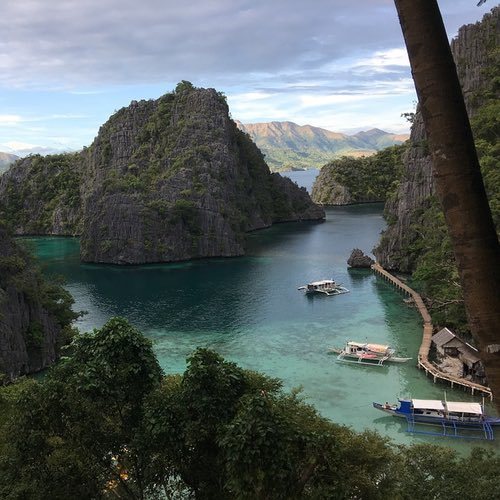 Philippines’ Best Undiscovered Islands (Camiguin, Palawan, Boracay)
 Travel to the Philippines – Episode 475
 Batad Rice Terraces – The Philippines
 Travel to the Island of Cebu in the Philippines – Episode 457
by Wouter van Kemenade
About the author: Wouter van Kemenade runs Pack Lightly, a multilingual travel platform building free trip-planning tools and destination guides for independent travelers.Leave a Reply
Tags: article, palawan, philippeans