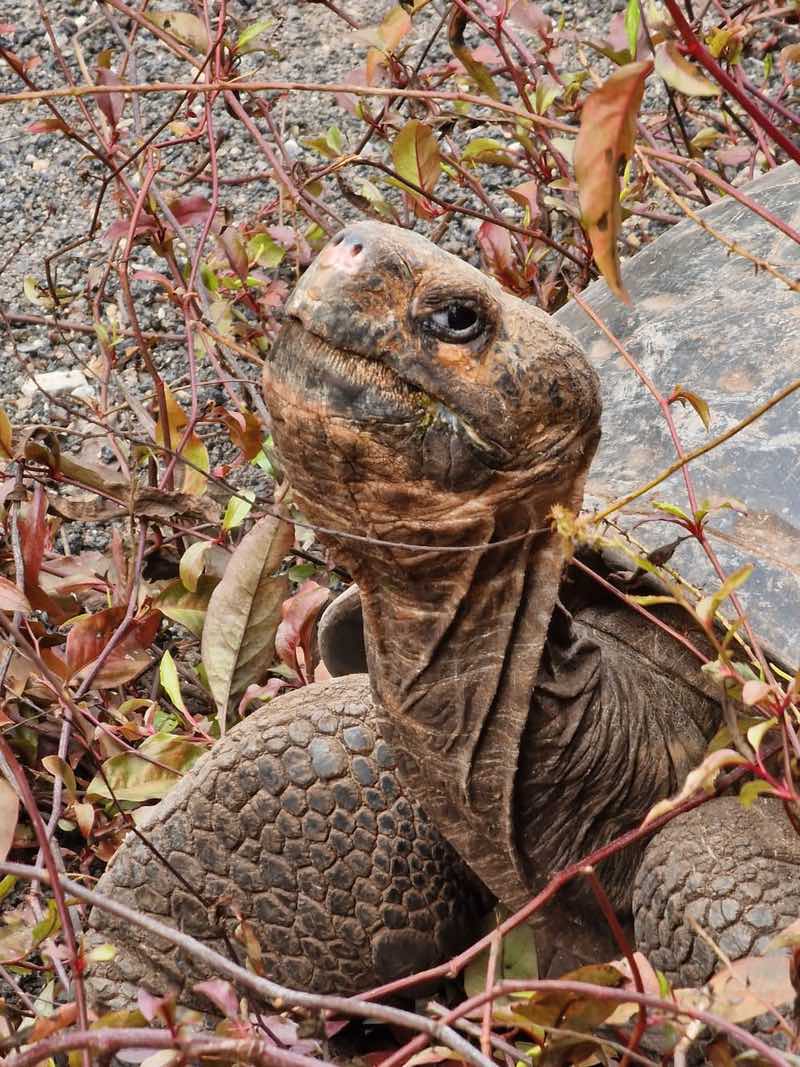
A Galápagos giant tortoise pauses long enough for a portrait… and maybe even a smile, Isabela Island, Galápagos. Photo by Caroline Marmon
A day on Isabela Island, from sea level to the rim of Sierra Negra
Most visitors come to the Galápagos dreaming of snorkeling with sea lions, penguins, sea turtles, and sharks. I don’t blame them. But if giant tortoises are at the top of your wildlife wish list, leave your mask and fins behind for a day. This walk begins at sea level and ends at the rim of a volcano, and the tortoises are everywhere in between.
Table of contents: ()
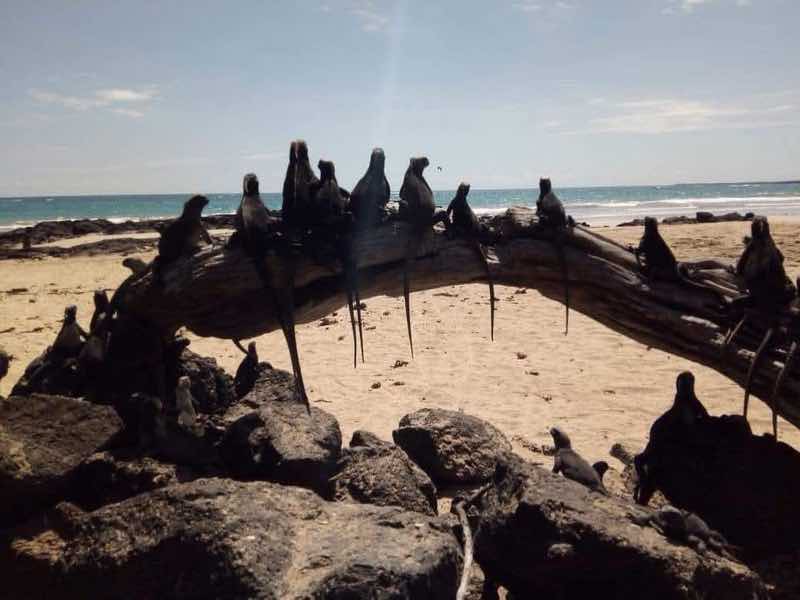
Marine iguanas gather on driftwood at the Pink Iguana Bar Marine Iguana Sanctuary, Puerto Villamil, Isabela Island, Galápagos. Photo by Claudia Hodari
Sea Level (0 m)
This walk begins in Puerto Villamil at the Marine Iguana Sanctuary, just past Casa Rosada, the pink house. Spend a few minutes watching dozens of marine iguanas warming themselves in the morning sun while lava lizards dart between lava rocks and prickly pear cactus. It’s a reminder that some of the Galápagos’ most extraordinary wildlife doesn’t require getting wet.
From there, turn onto the trail.
Instead of following the road, walk the shoreline. The beach stretches nearly three kilometers, and at a relaxed pace, it takes about half an hour to reach the Galápagos National Park ranger station. Keep your eyes open from the very start.
One of the first birds you’re likely to notice is my personal favorite: the lava gull. It isn’t the flashiest bird in the Galápagos, but it is the world’s rarest gull. Smaller than the gulls most people know, with a charcoal-gray body, a black head, and a surprisingly bright red mouth, it patrols the shoreline with complete confidence, as if it owns the place.
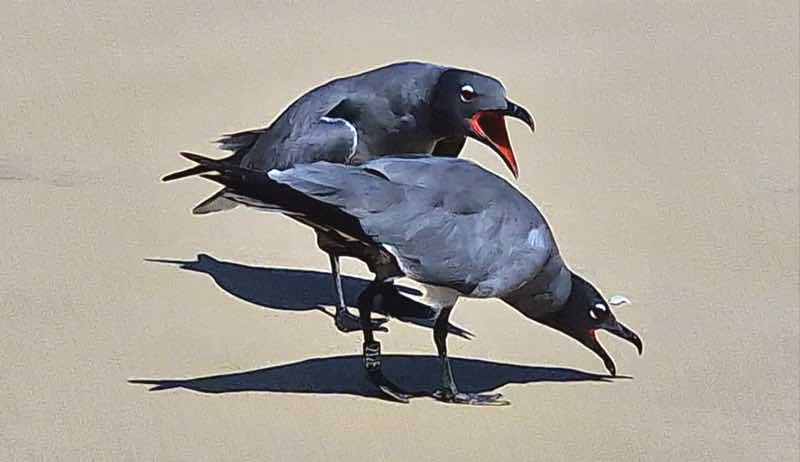
A pair of lava gulls, the world’s rarest gull species, exchange a few choice words on the beach in Puerto Villamil, Isabela Island, Galápagos. Photo by Caroline Marmon
As you continue along the firm sand near the water’s edge, look higher up the beach for protected sea turtle nests during nesting season. The nests are usually marked so visitors don’t accidentally disturb them. Then look down. Tiny ghost crabs vanish almost as quickly as they appear, their burrows surrounded by little balls of sand pushed to the surface while digging. Stand quietly for a minute, and you’ll often see one cautiously emerge before disappearing again at the slightest movement.
It’s tempting to hurry toward the famous Wall of Tears. Resist the temptation. The real adventure is only beginning.
At the ranger station, brush the sand off your feet, put your shoes back on, and sign in. This is your last restroom before continuing, so take advantage of it. Cross the chain, and everything changes.
Towering opuntia cacti frame a series of shallow lagoons. Depending on the season, you may spot Galápagos flamingos feeding in the water. On rare occasions, the lagoons themselves take on a faint pink hue, making the scene feel almost surreal. My favorite is Poza Tuna, named after the prickly pear cactus that dominates this part of the trail.
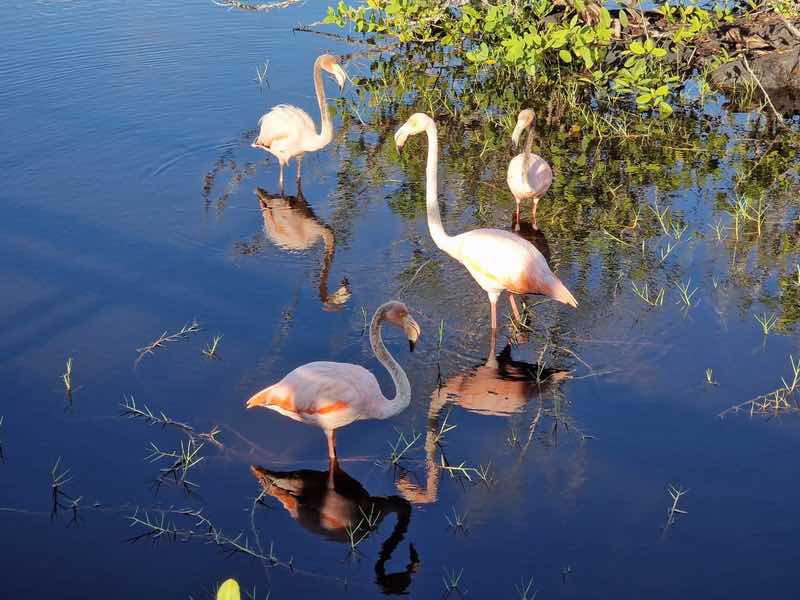
American flamingos paint the wetlands of Puerto Villamil shades of pink, Isabela Island, Galápagos. Photo by Caroline Marmon
Just beyond the entrance, a short path on the left leads to La Playita, a quiet cove tucked behind lava rocks. A little farther along is Playa del Amor, where the surf has polished volcanic stones into smooth, rounded shapes over thousands of years. Slow down here. It’s worth it.
The trail makes its only sharp right turn at Playa del Amor. A few minutes later, a small wooden sign points left toward the Lava Tunnel and El Estero. Most people keep going straight.
Here’s where I recommend turning left.
You don’t have to explore it now. The estuary is even better on the return trip, when the afternoon heat makes a swim irresistible. Just make a mental note. This quiet side trail leads to one of Isabela Island’s true hidden gems.
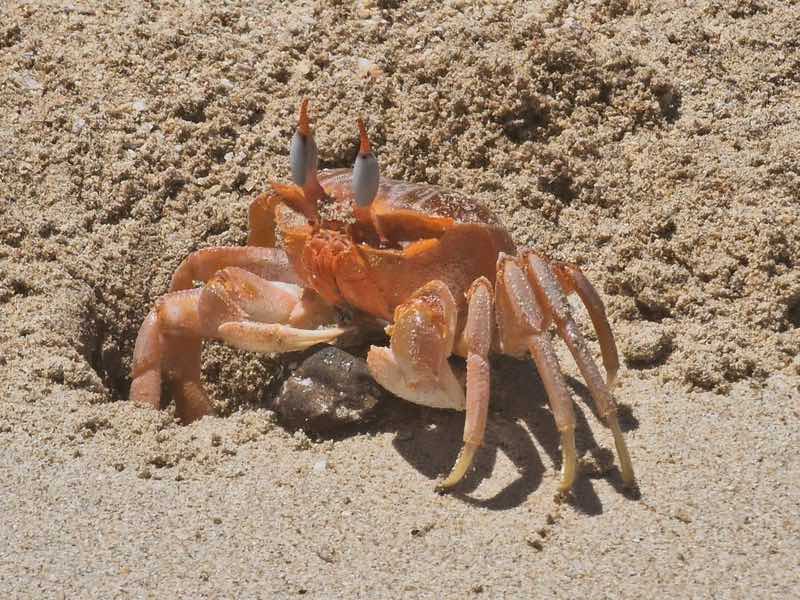
The beach’s tiniest artist. A ghost crab emerges from its burrow, surrounded by hundreds of tiny sand balls left behind after a busy morning of feeding, Puerto Villamil, Isabela Island, Galápagos. Photo by Caroline Marmon
The Puerto Villamil coastline lies within protected mangrove wetlands, and nowhere is that more obvious than here. The mangroves grow taller, the shade deepens, and all four Galápagos species grow side by side. The red mangrove is the easiest to recognize, its tangled prop roots reaching into the salt water like giant fingers. Duck beneath two low branches, then another. Suddenly the forest opens.
The estuary appears almost without warning: half saltwater, half freshwater, with a sandy bottom and calm, crystal-clear water. It’s one of my favorite places on Isabela. Sea lions often stretch out on the banks as though they own the place, and sometimes they’ll slide into the water and swim alongside you. Green sea turtles are regular visitors. If you’re especially lucky, a Galápagos penguin may dart through the channel. Blue-footed boobies, pelicans, lava herons, and yellow-crowned night herons patrol the water’s edge.
Remember this place. We’ll come back after we’ve found the tortoises.
Cross the wooden bridge and something changes. Not dramatically. The Galápagos rarely announces itself that way. The mangroves close in on one side of the trail while towering poison apple trees offer shade on the other. Known locally as manzanillo, they look like something from a pleasant garden, their trunks beautifully twisted. They are not. Their milky sap burns skin on contact, and on rainy days even the water dripping from their leaves can blister. Walk beneath them if you must. Just don’t touch them.
If you look toward the coast from the bridge, you’ll often spot blue-footed boobies and pelicans on the rocks, either resting or folding their wings and dropping straight into the water after a fish.
A few minutes later, a wooden sign appears at the edge of the trail.
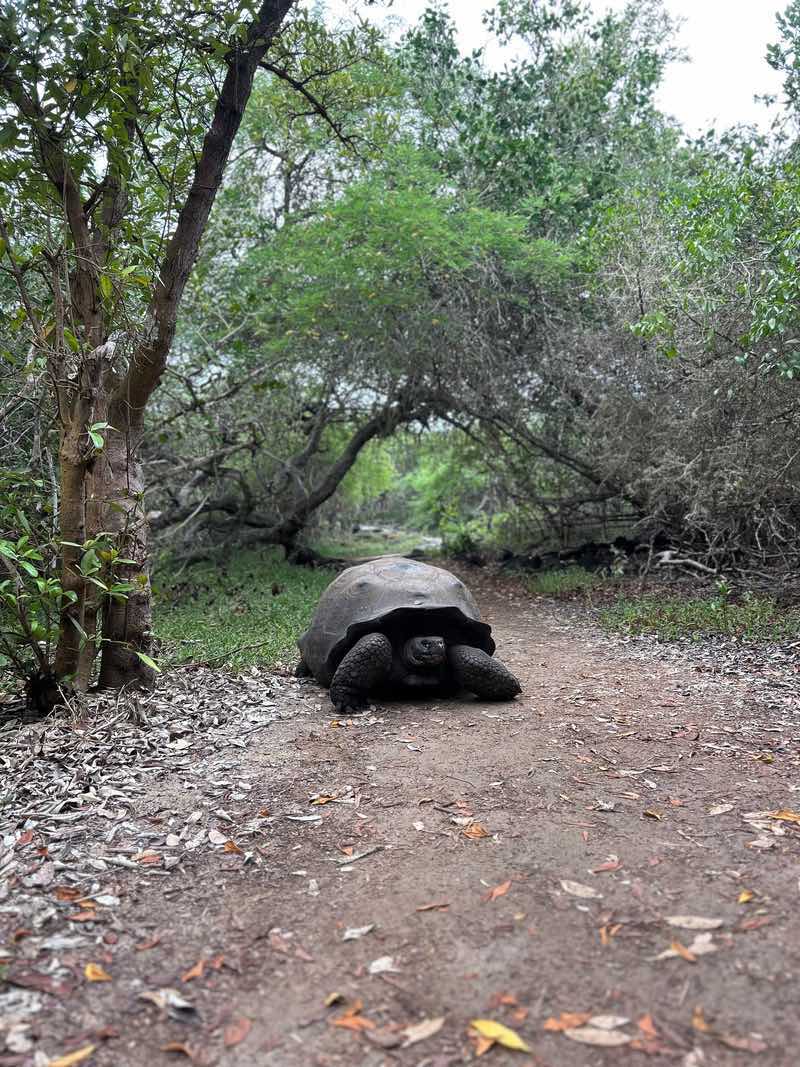
A Galápagos giant tortoise makes its way along the Ruta de Tortugas toward the Wall of Tears, Isabela Island Galápagos. Photo by Luis Miguel Flores
Ruta de la Tortuga.
This is where the walk changes character entirely. Get your camera ready. The giant tortoises of Isabela’s lowland zone, Chelonoidis vicina, don’t announce themselves. They simply appear when you’re paying attention.
Sometimes one is right in the middle of the path, ancient and unhurried, regarding you with the mild indifference of a creature that has been here for more than a century and intends to be here for at least another. Other times you’ll walk past one resting beneath a shrub and only notice it when something shifts at the edge of your vision, or hear it moving through dry leaves.
This is why I always say: walk, don’t cycle. Cyclists move too fast for this trail. They’re chasing the destination. The tortoises are the destination. The Galápagos National Park closes at 6:00 p.m., and you must be out before then.
When you find one, resist every instinct to get closer. Stay at least 2 meters, about 6 feet, away. It’s a park rule, and it matters. Please don’t touch the shell. It isn’t armor. It’s bone, fused directly to the tortoise’s spine and ribs. It feels everything. These animals have survived on these islands for millions of years. The least we can do is let them continue undisturbed.
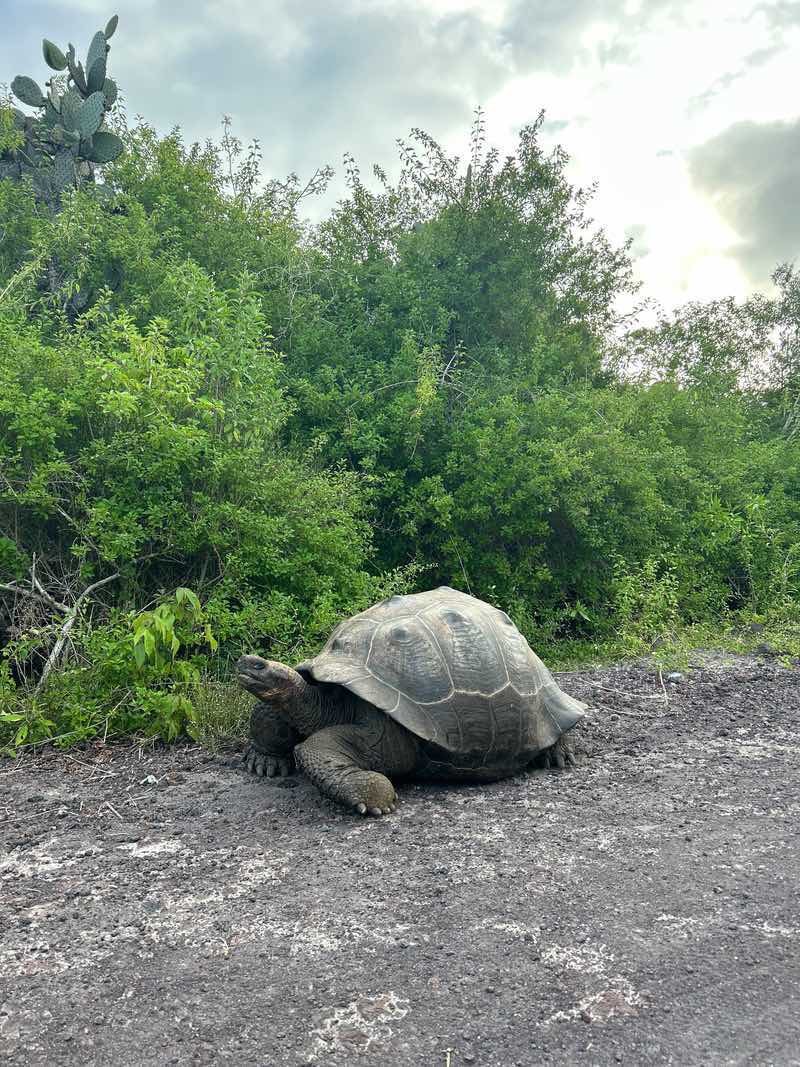
A Galápagos giant tortoise crossing the road near the Ruta de Tortugas, Isabela Island, Galápagos. Photo by Luis Miguel Flores
On a good day, you might count four, five, or seven tortoises between here and the wall. On an extraordinary day, you might find yourself watching a hatchling no bigger than your fist. Proof that, after everything these islands have been through, life is still finding its way.
The trail opens. The vegetation thins. At the end of it, something dark rises against the sky.
El Muro de las Lágrimas
The wall does not ease you into its history. It is massive and graceless, built from rough volcanic basalt stacked by hand to a height of six or seven meters, stretching almost a hundred meters across a landscape that had no need for it. No road ran alongside it. No village sat behind it. It kept nothing out and nothing in. It was built between 1946 and 1959 because building it was the punishment. And because the men ordered to build it had nowhere to go.
Around 300 prisoners worked here under thirty guards, housed in barracks the US military had left behind after the war. The island itself was the prison. Sharks and open ocean in every direction. The labor was the cruelty: prisoners quarrying heavy lava rock and carrying it back through equatorial heat, day after day, to build something that meant nothing. Many didn’t survive it. In 1958, those who remained revolted. The colony closed the following year.
The wall was never finished. It still blocks nothing from anywhere.
Climb to the viewpoint above it, and you’ll look out over the Bay of Villamil, the blue Pacific stretching to the horizon, impossibly beautiful from up here. This place of suffering is set inside one of the most extraordinary landscapes on earth. The Galápagos has a way of holding contradictions like that. Cruelty and wonder, separated by a few hundred meters of lava rock.
Come back down. Start walking.
The tortoises are still there on the trail behind you.
Puerto Villamil Lowlands
You’ve seen wild giant tortoises in their natural habitat, walked through mangroves and wetlands, and stood before one of the Galápagos’ most haunting historical sites. Before climbing higher, stop at the Arnaldo Tupiza Giant Tortoise Breeding Center, just outside Puerto Villamil.
It’s the perfect place to understand what you’ve actually been looking at all day.
Here you’ll find several of Isabela’s giant tortoise populations side by side. Their shells aren’t all the same. Some are broad and dome-shaped; others have the distinctive saddleback form that evolved on drier islands, where reaching higher vegetation became a survival advantage. You’ll also see the much flatter shell shape here, and it’s one of the only places where you can. Rather than trying to memorize every subspecies, simply appreciate how evolution shaped each population differently.
The interpretation center tells the conservation story behind these animals. Giant tortoises once faced extinction on several islands, but captive breeding and reintroduction programs have helped many populations recover. If you arrive around 9:00 a.m. on a Monday, Wednesday, or Friday, you’ll often catch feeding time. The usually slow-moving tortoises suddenly become surprisingly energetic, stretching their long necks toward the keepers long before breakfast arrives.
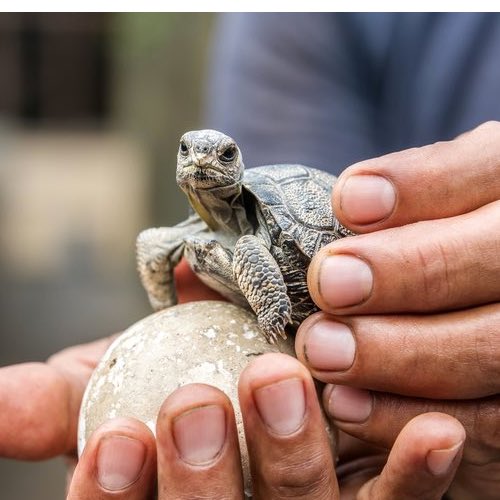
My favorite part is the hatchlings. They’re raised separately for good reason. Rats are among their greatest predators, but adult tortoises can be just as dangerous. In the wild, young tortoises instinctively keep their distance because one misplaced step from an animal weighing hundreds of pounds can easily crush them.
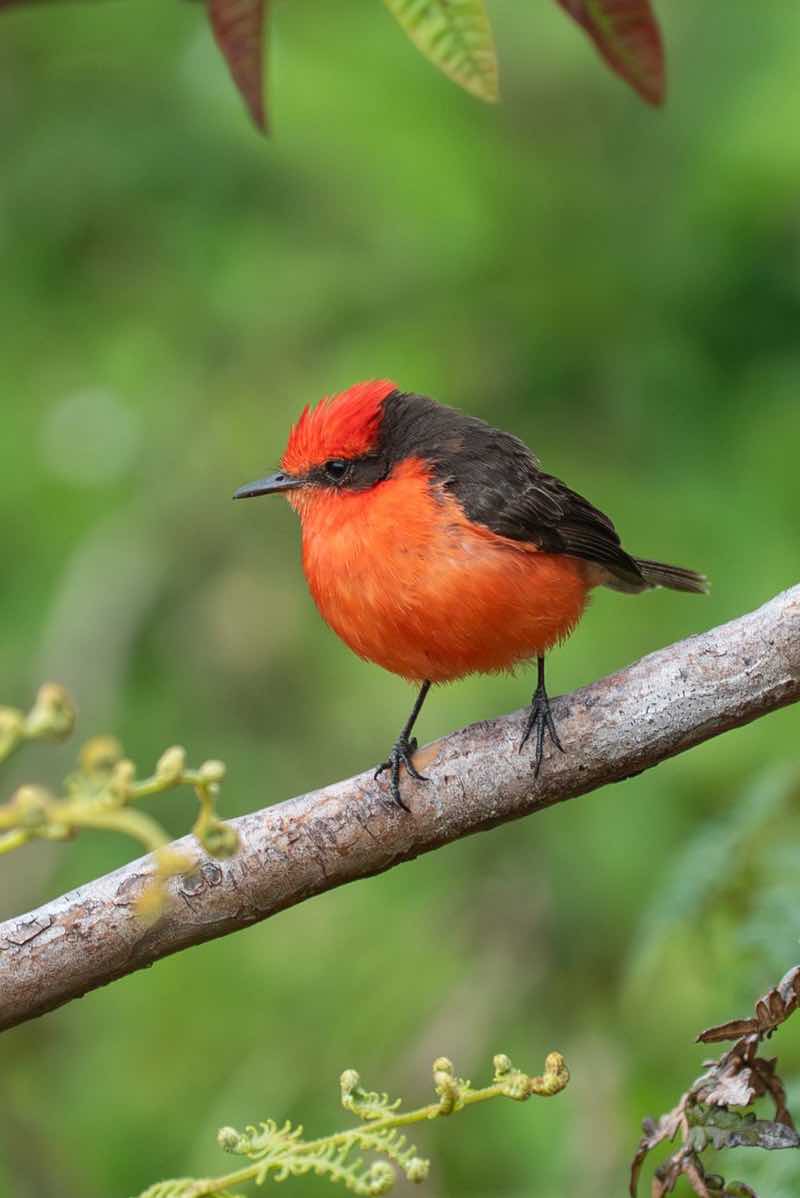
A male Brujo Flycatcher, endemic to the Galápagos Islands, flashes brilliant red in the Guayaba Forest of the Galápagos National Park, Isabela Island, Galápagos. Photo by Rohan Holt
Tomás de Berlanga (159 m)
About ten minutes by taxi from Puerto Villamil, at roughly 159 meters above sea level, Isabela changes again. The dry coastal zone gives way to cooler, greener country. Palo santo forest fades behind you, replaced by farmland, flowering gardens, and fruit trees heavy with mangoes, bananas, passion fruit, and citrus. Most of the bright flowers are introduced ornamentals; the Galápagos’ native blooms tend toward white and pale yellow.
One of my favorite stops is Campo Duro. More than a tourist attraction, it’s a working family farm where you can stretch your legs and enjoy one of the freshest lunches on the island with advance reservations. Almost everything on your plate comes from the surrounding gardens. Simple food, memorable because of where it came from.
Take time to wander the property. Galápagos rails, Galápagos flycatchers, and other birds move through the palms and fruit trees. It’s one of the best chances you’ll have to spot a rail, a small, elusive bird that’s far easier to hear than to see. Campo Duro is also home to a spacious natural enclosure where giant tortoises roam freely, giving you another chance to observe them up close.
If you continue up the paved road and take the fork to the right, Cueva de Sucre is about a kilometer farther on. The short walk to this lava tunnel is easy and doesn’t require a guide. Bring a flashlight, or simply use your phone, and resist the temptation to touch the golden patches on the cave walls. They aren’t mineral deposits. They’re slow-growing lichens that have taken years to form.
If you enjoy cycling, consider bringing your bicycle in the taxi rather than riding uphill. From Campo Duro you can visit Cueva de Sucre, continue to the Mango Viewpoint for sweeping views of Puerto Villamil, the coastline, and Sierra Negra Volcano, then coast almost entirely downhill back to town.
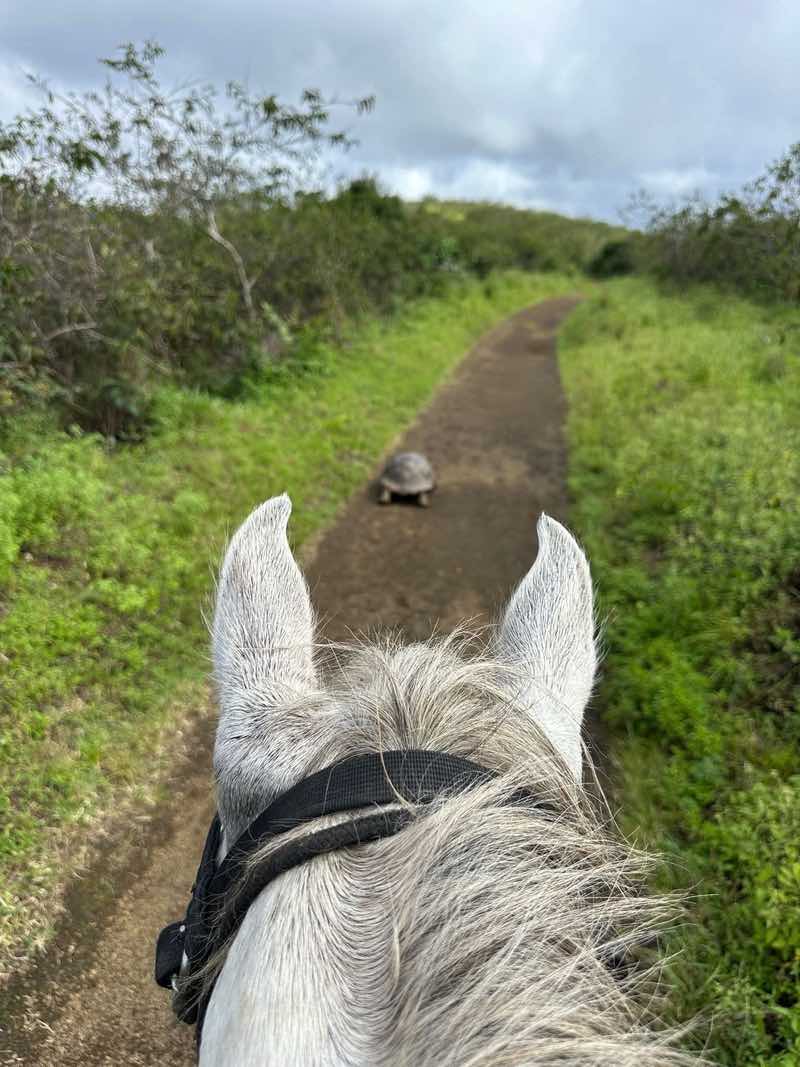
Enveloped in the cool garúa, a Galápagos giant tortoise continues its ancient journey across Isabela Island, Galápagos. Photo by Claudia Hodari
El Cura & the Highlands (870 m)
Beyond Tomás de Berlanga, the road climbs steeply. By the time you reach El Cura, about 870 meters above sea level, you’re often enveloped by the garuá. The air is cooler, the vegetation shifts again, and Sierra Negra begins to dominate the horizon.
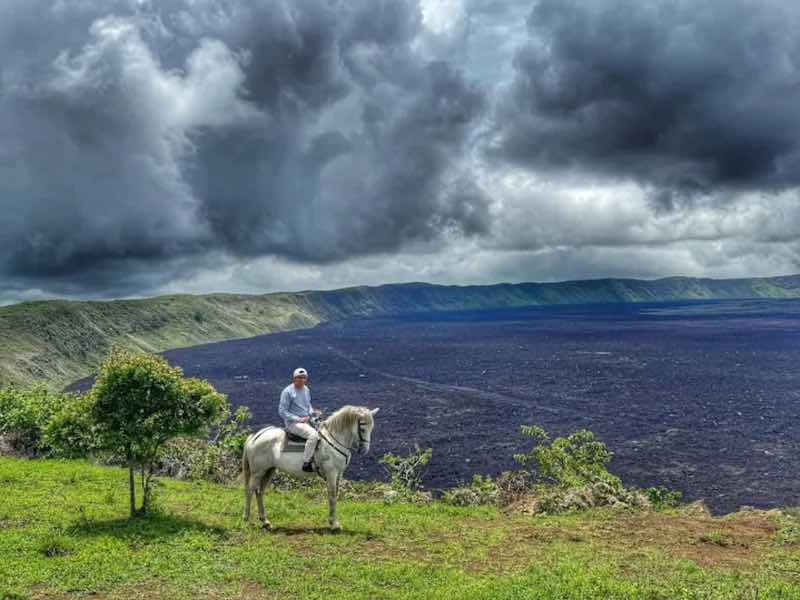
A solitary rider overlooks the Galápagos’ largest caldera from the rim of Sierra Negra Volcano, Isabela Island, Galápagos. Photo by Claudia Hodari
Sierra Negra Rim (1,124 m)
The tortoises don’t live up here year-round. That’s the first thing to understand.
Once the rains arrive, usually in late January or February, the highlands turn green and giant tortoises climb to the summit zone to graze on fresh grass. They stay as long as the food lasts. By the end of July, the grass has browned, the fallen guayaba fruit is gone, and the tortoises drift back to lower elevations. The summit grows quiet again.
The window is January through July. Visit outside it, and you may see nothing. Visit during it, and you might see four tortoises in a single afternoon.
We saw four on horseback last year. Then two more on the ride back down. The last one appeared on July 31, a date I remember because of Lavinia.
When Lavinia’s mom reserved the July 31 horseback ride two and a half months in advance, she told me her daughter dreamed of seeing a wild Galápagos giant tortoise from the back of a horse.
Back home in New Zealand, Lavinia had a three-year-old Hermann’s tortoise named Ptolemy Tabitha Tegeirian. Ptolemy was named after the ancient mathematician. Tabitha, just because. Tegeirian, Welsh for orchid, is Lavinia’s own middle name. A tortoise that may live for well over a century deserves a proper name.
She came with her sister, Maisie, and their mom. All three loved horses, but that day I was riding for Lavinia. We found a tortoise, and she got her moment.
As it turned out, July 31 was the last tortoise sighting of the season.
That’s how it goes up here. You never quite know what you’ll find.
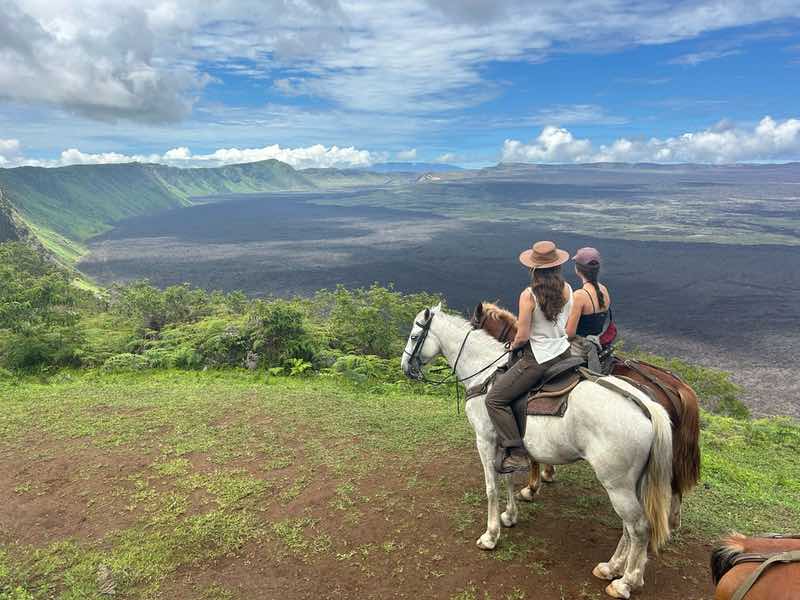
Caption: Riders pause above the vast Sierra Negra caldera, taking in the view toward the historic sulfur mines, Isabela Island, Galápagos. Photo by Claudia Hodari
The horses, for their part, aren’t entirely sure what to make of tortoises. They know cows. They know dogs. A giant tortoise is something else entirely: a slow, dome-shaped creature that smells like nothing familiar and moves like a rock that’s decided to walk. The horses don’t spook, exactly. They negotiate, edging past a tortoise with just a little more space than necessary, pretending to be casual about it.
It’s one of my favorite things to watch.
Up at 1,124 meters, the landscape looks nothing like the coast you left behind that morning. The air is cooler, the vegetation denser, and on cloudy days the summit feels almost misty. Then the caldera of Sierra Negra, the largest in the Galápagos, opens before you. You’re standing on the rim of a volcano that is very much alive, looking into something vast and ancient, while somewhere behind you a giant tortoise grazes as if none of it is happening.
Maybe, if you’ve been here long enough, it isn’t.
The last tortoise I saw that season was on July 31. It grazed near the rim, indifferent to the volcano, the horses sidestepping past, and Lavinia, who had traveled halfway around the world. That’s the thing about Isabela. You come for the wildlife. You stay for the way it all holds together, the ancient and the new, the cruel and the beautiful, the slow creature in the path, and the person learning to slow down enough to see it. If you can spare one more day, do it. This island rewards travelers who don’t rush.
Planning Your Isabela Island Trip
Here’s everything you need to follow this same itinerary, from ferries to packing lists.
Two Seasons
Mid-December to mid-May: hot and rainy. Mid-May to mid-December: cool and dry. Recommended stay: 4 nights.
Getting Here
The Santa Cruz–Isabela ferry takes about 2 hours and costs $30 each way. It departs Santa Cruz at 7:00 a.m. and 3:00 p.m., and Isabela at 6:00 a.m. and 3:00 p.m. Book ahead during high season. Coming from San Cristóbal? Fly direct if possible. Ferry connections route through Santa Cruz and usually consume an entire day.
Getting Around
The water taxi from the ferry to the dock costs $1 per person, plus the $10 municipal dock fee upon arrival. Around town, taxis charge a flat $2 for up to four passengers. Puerto Villamil is easy on foot. Regular bikes rent for $2–3 per hour; Bike and Surf has thorn-resistant tires for the Wall of Tears road. Electric bikes run about $5 per hour near the Pink Iguana Bar.
Local tip: A taxi to the Wall of Tears trailhead at the end of the beach costs $5 for up to four people, including bicycles, and skips the least interesting stretch. A taxi with bikes to Tomás de Berlanga costs $10; to El Cura, $20.
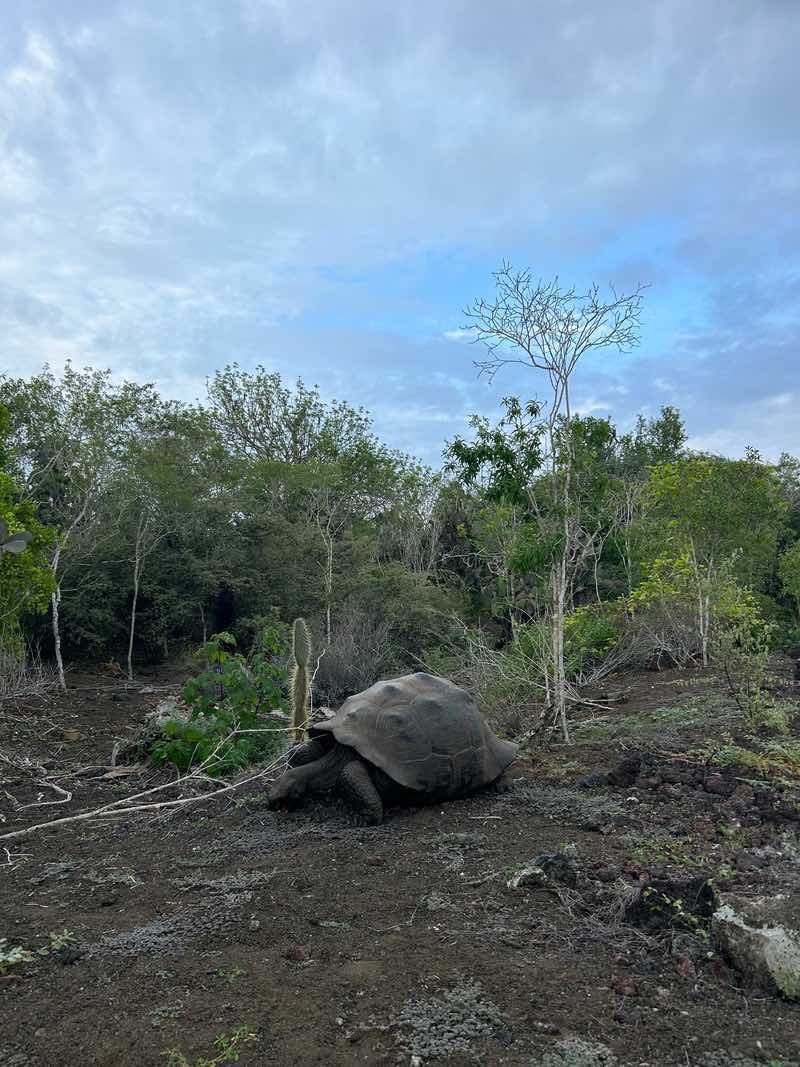
Galápagos giant tortoise crossing the road to the Wall of Tears, Isabela Island, Galápagos. Photo by Luis Miguel Flores
No Guide Necessary
You can explore these on your own:
- Concha de Perla for calm-water snorkeling with sea lions and penguins.
- Wall of Tears by foot or bike, bring 2 liters of water if walking, 1 liter if biking, plus closed-toe shoes.
- Cueva de Sucre lava cave.
- Flamingo lagoons.
- Mango Lookout Point.
- El Estero.
- Downhill biking from Tomás de Berlanga (easy) or El Cura (extreme).
All other tours require a certified guide.
The Two Must-Do Tours
Sierra Negra, one of the most active volcanoes and the largest caldera in the Galápagos. Explore on foot or in the saddle with Galloping Galápagos, which offers horseback tours for riders of all experience levels across lush highlands and volcanic landscapes that most visitors never see.
Los Túneles, exceptional snorkeling with sea turtles, penguins, reef sharks, rays, and sea horses.
Tortoise Breeding Center: $10 per person, guide included.
Where to Stay
Accommodation ranges from simple guesthouses to beachfront boutique hotels. The west end has the liveliest restaurant and bar scene. Isabela Beach House is a great beachfront option on the east end. Albemarle and Cormorant offer more upscale stays. Mi Playa and many Airbnbs are solid mid-range choices. Iguana Crossing has a pool. Janet’s Hostel is a great budget option with breakfast and a guest kitchen.
Where to Eat & Drink
For lunch in the highlands, try Campo Duro with advance reservations. In town, don’t miss the fresh seafood, ceviche, and encebollado. Lobster season runs roughly mid-August through mid-December, though exact dates shift each year slightly depending on Galápagos National Park regulations. Restaurants worth seeking out: Mangrove, Upstairs at the Booby Trap, Cafetal, Albita, and The Lighthouse. For coffee, Pan y Vino. For local craft beer, stop by Zaroa Brewpub.
The Pink Iguana Bar has live music on Tuesdays and Fridays, cold drinks, and something you won’t find anywhere else in the Galápagos: a safe harbor for young marine iguanas. The official nesting area down the beach is municipally protected, but introduced cats have devastated juvenile survival there. On this property, the Iguanaman Foundation maintains hiding spaces beneath the terrace, tiny gaps the hatchlings and yearlings can duck through after dark. I’ve looked for two- and three-year-old iguanas at Playa del Amor and other nesting sites. I only find them here. The happy hour crowd and the iguanas go about their business a few feet apart, neither much bothered by the other.
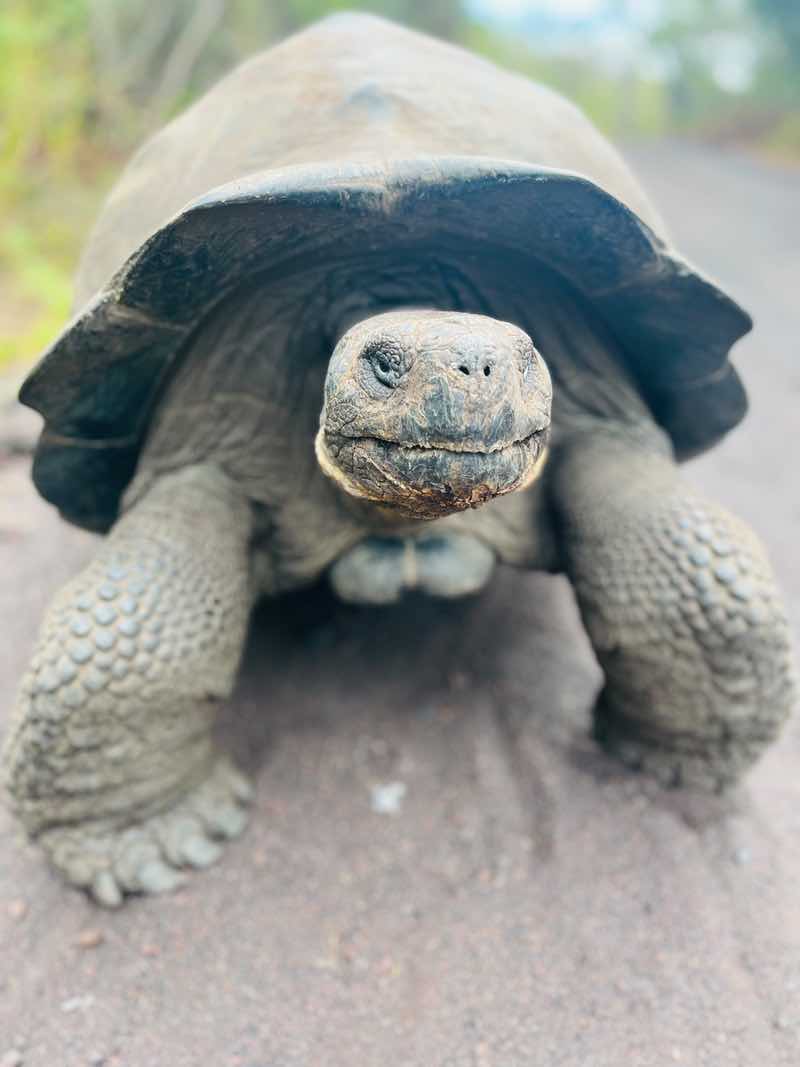
A face only a naturalist—or E.T.—could love. Galápagos giant tortoise, Isabela Island, Galápagos. Photo by Jeanette Warner
Money & Connectivity
The local currency is the U.S. dollar. Two ATMs on the island are usually reliable, but carry small bills as backup. Credit cards are accepted at some businesses, often with a 15% surcharge. Most hotels and restaurants now use Starlink. Claro has the best mobile coverage.
What to Pack
Closed-toe shoes, a light rain jacket, sunscreen, a reusable water bottle, seasickness medication, and a sweatshirt for cool highland evenings. The volcano highlands are generally free of biting insects. Along the coast, horseflies appear on hot sunny days, drawn to salt on your skin. A quick rinse with fresh water after swimming keeps them away. Bring a waterproof phone case.
Apply sunscreen behind your knees and on the tops of your feet, two spots almost everyone forgets. If you do get burned, ask your hotel or a friendly local for fresh aloe vera, known here as sábila. It grows everywhere, and it works.
Bring good vibes. Smile at people. This island runs on kindness.
 Galápagos on a Budget – DIY Guide
 Budget Travel to the Galapagos Islands – Episode 960
 Travel to the Galapagos Islands, Ecuador – Episode 755
 The Best Time to Visit The Galapagos Islands
by Claudia Hodari
Claudia Hodari is a Galápagos National Park guide and founder of Galloping Galápagos Horseback Riding Tours on Isabela Island, Ecuador. She has lived in the Galápagos since 1992 and writes about wildlife, conservation, and land-based travel.Leave a Reply
Tags: article, ecuador, galapagos islands, isabela