Captain Ben
When I asked Captain Ben where we were going that day, he often gave the same answer:
“I don’t know.”
He was not being evasive. He genuinely did not know yet.
A Maine windjammer voyage is shaped by the wind, tide, current, weather forecast, and the availability of a safe anchorage. The captain may have several possibilities in mind, but there is no fixed itinerary posted outside the cabin.
That took me a couple of days to understand.
I am accustomed to travel where the route is decided before the trip begins. Our six-night voyage aboard the Schooner Heritage was different. Each morning, the Maine coast presented a new set of options.
Over the course of the week, we sailed about 116 miles from Rockland through Penobscot Bay. We passed islands and lighthouses, rowed ashore at Swans Island, held a lobster bake on Wreck Island, reached shelter just before a powerful squall, and ended our final full day in Pulpit Harbor.
The route mattered, but the uncertainty was part of the experience.
- Learn more about the Schooner Heritage at: The Schooner Heritage: What Life Is Like Aboard a Maine Windjammer
I was a guest of the Schooner Heritage. The cruise was hosted (paid for), while I paid for transportation to Rockland, pre-cruise expenses, and crew gratuities. All opinions are my own.
Table of contents: ()
- The Maine Windjammer Tradition
- Boarding in Rockland
- Introductions
- Monday: Rockland to Kimball Island
- Sailing without a Straight Line
- Tuesday: Merchant Row and Swans Island
- Lobster Buoys and the Working Coast
- Wednesday: Finding Lobster Island
- Thursday: Racing the Squall
- A Typical Day under Sail
- Friday: A Long Sail to Pulpit Harbor
- Saturday: Returning to Rockland
- Practical Advice for a Maine Windjammer Voyage
- Who Will Enjoy a Maine Windjammer Cruise?
- Final Thoughts

Schooner Heritage
The Maine Windjammer Tradition
The Maine coast was once served by thousands of schooners carrying cargo between small ports and larger cities.
They transported lumber, granite, lime, natural ice, bricks, fish, canned goods, Christmas trees, and agricultural products. On return voyages, they might carry coal, grain, manufactured goods, or other supplies.
These schooners were the freight trucks of their era.
Steamships, railroads, motor vessels, and highways gradually made them obsolete. In the 1930s, Frank Swift began using aging schooners for passenger trips, helping establish the Maine windjammer tradition.
The modern Maine Windjammer Association includes owner-operated vessels that offer multi-day sailing voyages. Some are converted cargo ships. Others, including Heritage, were built specifically for passengers.
The fleet carries relatively small groups, from roughly 16 to 31 passengers depending on the vessel. The small scale is central to the experience.
You are not one of several thousand passengers moving between restaurants, theaters, and scheduled excursions. You are part of a temporary community aboard a sailing vessel.

Boarding in Rockland
Heritage sails from the North End Shipyard at 11 Front Street in Rockland.
Passengers board on Sunday evening, but dinner is not served that night. You can eat before boarding or stow your luggage and walk back into town.
The cabin was made up with bedding, pillows, blankets, towels, and soap. (Learn more about the Schooner Heritage).
Rockland is about two hours from Portland, four hours from Boston, and 60 miles south of Bangor. Some passengers drove from the Midwest. I flew on Cape Air, which uses very small aircraft between Boston and Rockland.
Free parking is available at the wharf.

Introductions
By Monday morning, our bags were aboard, the water tanks were full, shore power was disconnected, and the crew was preparing to get underway. We ate breakfast in the harbor where we did introductions to the other passengers and crew.
The co-captains of the ship are Ben Welzenbach and Sean Grimes. There were 6 others on the crew: the first mate Greg, Duane, Emma, Claire, Winter, and Matthew.
The real surprise came when the passengers introduced themselves. There were a few multi-generational groups. There was one gentleman who was on his 3rd of 5 different cruises on ships from Maine Windjammer, all scheduled back-to-back. There were people who had scheduled two different sailings on the Heritage back-to-back.
But there were also people who had been on the Heritage 25 or 50 times before. I later learned that 60% of the passengers on any particular sailing are repeat customers.
- Buy Travel Insurance
- Book discount cruises HERE
- Get a Car Rental

Monday: Rockland to Kimball Island
Leaving Rockland Harbor was more complicated than I expected.

Co-owner Sean in the Clark Kent
Heritage does not have a conventional engine in the hull. A diesel-powered yawl boat named Clark Kent helps pull or push the schooner through harbors and calm water.
Rockland Harbor was filled with lobster boats, sailboats, windjammers, docks, and mooring lines. As Clark Kent began maneuvering us away from the shipyard, the wind caught Heritage and pushed us toward a lobster boat.
The crew deployed fenders and pushed the vessels apart in a brief moment of drama.

clearing the harbor
Once clear of the harbor, we raised the sails and headed across Penobscot Bay.
We sailed between North Haven and Vinalhaven through Fox Island Thoroughfare, passed Goose Rocks Light, and continued toward Isle au Haut.
The day ended near Kimball Island.

Goose Rocks Light
We had sailed 23.3 nautical miles and reached a top speed of 9.5 knots, close to Heritage’s practical maximum.
It was a strong first day and an immediate introduction to the scale of Penobscot Bay. Islands appeared in every direction. Some supported towns and roads. Others were little more than granite, spruce trees, and seabirds.
Sailing without a Straight Line
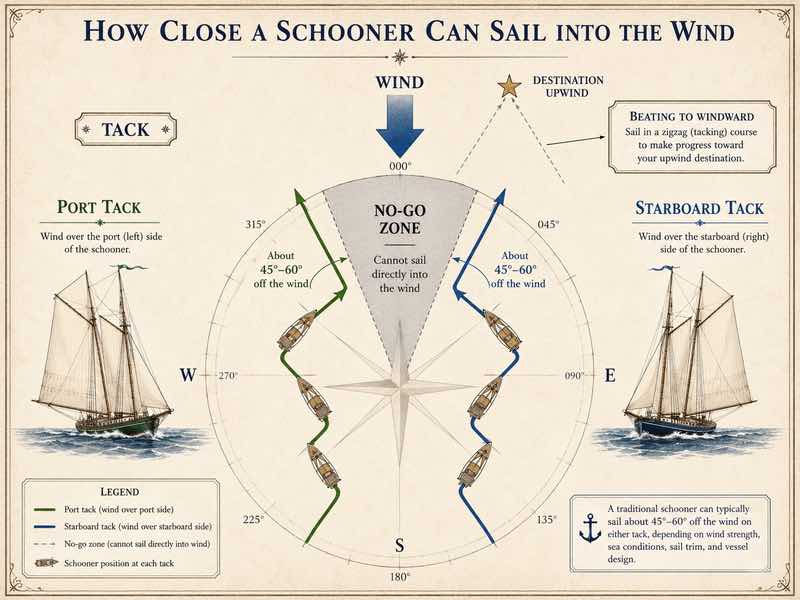
A schooner cannot sail directly into the wind.
To make progress toward an upwind destination, Heritage must sail at an angle, then change direction in a maneuver called a tack. The resulting route is a zigzag called beating to windward.
Each day the captain would update the ship’s log with where we had sailed and what the conditions had been. It did not try to track every tack we made, but it did give some impression of how busy the crew was kept during a specific sailing day.

That makes modern GPS estimates less useful than they appear.
At one point, I looked at the navigation display and told Captain Ben that it said we would reach our destination in three hours.
“Yes,” he replied, “but that’s straight.”
The GPS was calculating a direct route. Heritage still had to sail around islands, avoid ledges and lobster gear, and work with the wind.
A destination three hours away in a straight line may require much longer under sail.

Tuesday: Merchant Row and Swans Island
The next morning, we sailed east through Merchant Row.
This collection of islands lies between Isle au Haut and Deer Isle. Most are granite islands with spruce trees and limited places to land.
The scenery was classic coastal Maine: narrow passages, wooded shorelines, occasional houses, and lobster boats working among brightly colored buoys.

Toothacher Bay
We entered Jericho Bay, where the wind became less consistent, and used the falling tide to help carry us into Toothacher Bay.
We anchored in Burnt Coat Harbor on Swans Island after sailing 13.8 nautical miles with a top speed of 7.6 knots.
This was our first shore excursion. Half the passengers climbed into Archie, Heritage’s largest rowboat. The passengers provided the power.

In theory, everyone watches the rower ahead and matches that person’s rhythm. When it works, the oars move together, and the boat glides across the water.
When it does not work, the result resembles what one passenger called a “spastic spider.” Oars collided. Timing disappeared. The rowboat still reached shore near a yellow dilapidated lobster shack. Two crew members brought it back for the other half of the passengers who wanted to go ashore.

Burnt Coat Harbor Light
We landed near a weathered lobster building and walked toward Burnt Coat Harbor Light and the surrounding state park.
The excursion was informal. There was no tour bus waiting, no numbered paddle, and no guide holding a sign. We rowed ashore, explored, and returned to the schooner.

Toothacher Bay
Lobster Buoys and the Working Coast
By mid-July, lobster buoys covered the bays of Maine. Each lobsterman uses a distinctive color pattern. A buoy might be red with yellow stripes or painted in another unique combination. One buoy commonly marks two traps.
Watching lobster boats work was part of almost every morning.
The bait generally lasts about three days, so lobstermen return regularly to haul the traps, sort the catch, rebait them, and lower them again.
A license may allow as many as 800 traps.
Most lobsters caught are returned to the water because they are too small, too large, or are carrying eggs. Female lobsters with eggs are marked by a V-notch in the tail. They can’t be kept as long as that notch remains. The conservation system helps preserve breeding females and maintain the fishery.
The buoys were colorful and photogenic; they looked like some sort of aquatic confetti cake.

location of “lobster island”
Wednesday: Finding Lobster Island
Heritage had carried live lobsters from the beginning of the trip. During the day, they were kept in a metal tank aboard the schooner. At night, they were lowered into the sea in containers that allowed fresh seawater to circulate.
On Wednesday, Captain Ben announced that we would look for Lobster Island.
This confused me.
How could the captain need to find an island if he had charts and GPS?
Lobster Island, it turned out, is like Air Force One. The name applies wherever the lobster event happens on that voyage.
The captain needed an island with a beach where the boats could land, and the crew could safely prepare a lobster bake.
That day, Wreck Island became Lobster Island.

Schooner Heritage at Wreck Island
We sailed back into Jericho Bay with a fresh northwest wind that gradually weakened. Near McGlathery Island, we short-tacked in lighter air, making frequent turns to continue forward.
We anchored near Wreck Island after sailing 18.1 nautical miles.

The crew transported lobsters, cooking pots, food, and equipment ashore. The passengers followed in the rowboats.
A fire was built on the beach. Hamburgers and hot dogs were ready when we arrived. The lobsters went into a large pot over the fire. There was also corn, watermelon, and s’mores.
Passengers sat in camp chairs or found places on the rocks. The schooner floated offshore as the light began to fade.
The experience was simple, but the setting made it memorable: waves touching the beach, seabirds calling, smoke rising from the fire, and Heritage silhouetted beyond the shore.

“you are here”
Thursday: Racing the Squall
Thursday morning brought a change in plans. We might normally have sailed toward Stonington on Deer Isle. Instead, the forecast called for thunderstorms and strong wind later in the day.
Ben decided to head for Carver Cove on Vinalhaven, a protected anchorage where Heritage could wait out the weather.
The challenge was timing. A sailing vessel does not move according to a highway schedule. The wind was slower to develop than expected, and our progress across the bay was uncertain.
We beat to windward toward Vinalhaven, gradually gaining speed as the breeze strengthened.
Fortunately, the storm was also delayed.
We entered Carver Cove, dropped the regular anchor and the heavier storm anchor, lowered the sails, and began furling them (collapsing them and tying them closed). Passengers helped fold the mainsail back and forth along the boom. The crew secured the canvas and started raising the deck awning.
Then the squall arrived.
The change was immediate.
As the crew struggled to put up the canvas awning, the breeze became violent wind. Rain blew sideways. Loose fabric snapped and flapped.
Reports over the radio suggested gusts near 60 knots in some nearby harbors. Two other windjammers reportedly had foresails damaged, and one yawl boat was swamped.
Heritage was already anchored with its sails down.
The successful arrival was not simply good fortune. Ben had studied the forecast, changed course, selected a safe harbor, and allowed enough time to secure the ship.

The squall passed, and the evening became peaceful again. Some passengers even took Lois Lane, one of the smaller rowboats, out into the harbor.
The contrast was striking. One hour, the wind was driving rain across the deck. Later, passengers were rowing on calm water.

Schooner Heritage
A Typical Day under Sail
Not every day was as dramatic.
Coffee appeared around 6:15 a.m., followed by breakfast at about 8.
The crew raised the sails and anchor, and we spent the day moving among islands, bays, and working waterfronts.
Lunch was usually served on deck.
Late in the afternoon, Heritage anchored in a protected harbor. We might go ashore, swim, row around the harbor, read, or simply watch the changing light.
An appetizer came before dinner. Dinner was followed by sunset and quiet conversation.
On two evenings, Ben and Sean played guitars for the passengers.
The experience had a relaxed rhythm, but sailing was never passive. Wind direction changed. The captain called for a tack. Crew members ran from the galley or their bunks to handle lines.
Passengers shifted chairs, moved out of the path of the mainsail tackle, or helped with the sails.

Pulpit Harbor
Friday: A Long Sail to Pulpit Harbor
Friday was our strongest sustained sailing day.
We sailed off the anchor in a brisk west-northwest wind, tacked toward Northwest Harbor, and passed through Eagle Island Passage.
From there, we crossed West Penobscot Bay and entered Pulpit Harbor.
We had not needed Clark Kent for almost three days, which meant the wind had been doing the work.
The day covered 26.8 nautical miles, the longest distance of the trip, with a top speed of 8.8 knots.
Pulpit Rock marks the entrance to the harbor. An osprey nest has occupied the rock for generations.
The harbor itself was filled with sailboats and surrounded by green shorelines. Some passengers and crew jumped from Heritage into the water.
Later, Sean fired the schooner’s cannon as a salute.
Pulpit Harbor was my choice for the prettiest anchorage of the week. Burnt Coat Harbor and Carver Cove were strong competitors, but Pulpit had the combination of sailboats, forested shores, osprey, lobster buoys, and calm evening light.

entering Rockland Harbor
Saturday: Returning to Rockland
We needed to return to Rockland by noon on Saturday.
There was little wind, so Clark Kent pushed Heritage toward the harbor while brunch was served on deck.
The final leg covered about 11.3 nautical miles at roughly 5.1 knots.
Over the course of the voyage, we had sailed about 116 miles.
That number does not fully describe the trip. A windjammer route is not simply the distance between anchorages.
It includes all the tacking, waiting, searching for wind, moving with the tide, and changing plans.

Practical Advice for a Maine Windjammer Voyage
Pack layers.
Maine weather can shift from warm sunshine to cool wind and rain within the same day. Bring a rain jacket and rain pants. I remembered the jacket but regretted not packing the pants during the squall.
Bring two pairs of soft-soled, non-skid shoes. Water shoes and tennis shoes worked well for me.
Other useful items include:
- Sunscreen
- Lip balm
- Sunglasses
- A hat with a strap
- Headphones
- A book or e-ink reader (it was too sunny on deck to read a book on my iPad)
- Soft-sided luggage
- Personal toiletries
Guests should notify the schooner about dietary restrictions well before departure.
Dinner is not served on boarding night.
The company recommends a crew gratuity, traditionally given in cash, although I was able to use Venmo after forgetting to bring enough cash.
Passengers should also be comfortable climbing steep companionways and descending a ladder into a rowboat.

Who Will Enjoy a Maine Windjammer Cruise?
This trip is best suited to travelers who enjoy:
- Maritime history
- Hands-on sailing
- Slow travel
- Island scenery
- Small groups
- Flexible plans
- Good but informal food
- Conversation
- Time away from constant connectivity
It is not for travelers who need a rigid itinerary.
Some days include a lighthouse, town, or island visit. Other days may be spent entirely aboard.
The captain may honestly tell you he does not yet know where the schooner will anchor that evening.
That uncertainty is not a flaw. It is the point.
If you think you might be interested, but you are not sure, the ships in the Maine Windjammer fleet also run shorter cruises.

Final Thoughts
A Maine windjammer voyage is not primarily about checking places off a list.
- I remember raising sails, rowing badly, watching lobster boats haul traps, and eating lobster on a beach while Heritage floated offshore.
- I remember the crew racing to secure the ship before the squall, then watching the harbor become calm again after the storm passed.
- I remember the sound of rigging, the wind filling the sails, the smell of bread from the galley, and conversations with wonderful passengers who were new to the ship or who had returned to Heritage 25 or even 50 times.
- I remember the amazing crew who worked tirelessly to trim the sails and/or bake me cookies.
The Maine coast provided the landscape, but the wind determined the journey.
That is what made the voyage feel different from almost every other kind of travel.

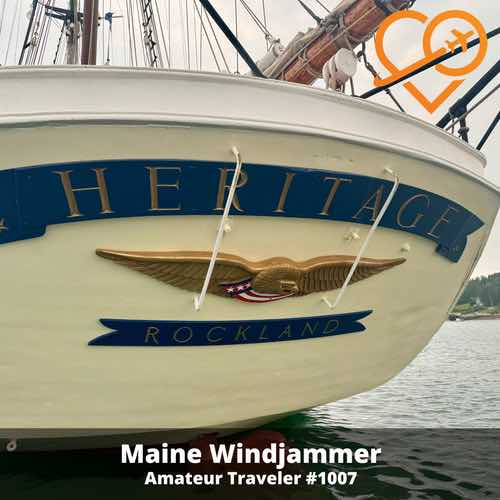 Sailing on a Maine Windjammer, the Schooner Heritage – Episode 1007
 The Schooner Heritage: What Life Is Like Aboard a Maine Windjammer
 Maine Windjammer Cruise – Episode 779
 Are You A Real Maine Expert? – Quiz
by Chris Christensen
Chris Christensen is the creator of the Amateur Traveler blog and podcast. He has been a travel creator since 2005 and has won awards including being named the "Best Independent Travel Journalist" by Travel+Leisure Magazine.+Chris Christensen | @chris2x | facebook
Leave a Reply
Tags: article, cruise travel, expedition cruise, maine, maine windjammer, sailing