The Schooner Heritage looks like a vessel from another century, but it was not converted from an old cargo ship or built as a replica of one particular historic schooner. It was designed from the beginning to carry passengers along the Maine coast.
That distinction matters.
Heritage combines the rigging, wooden construction, and hands-on sailing of a traditional coasting schooner with cabins, a large mess, running water, and the practical systems needed for multi-day voyages. It is not a luxury cruise ship, but neither is it a museum piece. It is a working sailing vessel where passengers live, eat, relax, and sometimes help raise the sails.
I spent six nights aboard Heritage on a voyage from Rockland, Maine. While much of the trip was about sailing among the islands of Penobscot Bay, the ship itself was one of the most interesting parts of the experience.
- Learn more about my voyage at: Sailing the Maine Windjammer Fleet: A Week Aboard the Schooner Heritage
I was a guest of the Schooner Heritage. The cruise was hosted (paid for), while I paid for transportation to Rockland, pre-cruise expenses, and crew gratuities. All opinions are my own.
Table of contents: ()
- A Purpose-Built Maine Schooner
- From Doug and Linda to Ben and Sean
- The Crew aboard Heritage
- Raising the Sails
- What Makes Heritage a Schooner?
- Clark Kent
- Joe
- The Ship’s Boats
- Life in the Cabins
- Electricity and Cell Service
- The Deck as the Main Living Room
- The Galley and Mess
- Food aboard Heritage
- A Typical Day aboard the Schooner
- Maintenance Is Constant
- Is Life aboard Heritage for You?
- Final Thoughts

A Purpose-Built Maine Schooner
Captains Doug and Linda Lee designed and built the Schooner Heritage at Rockland’s North End Shipyard. The vessel was launched on April 16, 1983, after several 3 winters of construction.
The schooner measures about 145 feet overall, with a 92-foot deck and 15 passenger cabins. The hull itself is approximately 95 feet long. Heritage can carry up to 30 guests, and there were 26 passengers on my voyage.

The vessel is built with red oak framing and planking and a white pine deck. Its mainmast rises nearly 80 feet. With the upper mast and rigging included, the top reaches about 102 feet above the water.
The mast is made from pressure-treated Douglas fir that was transported across the country from the West Coast by rail. It was moved through Rockland in the middle of the night and set into place with a crane and careful planning.
The mast has to be removed approximately every 10 years for inspection.
Heritage is not trying to imitate a specific schooner from the past. It is a modern working vessel built in the heritage of Maine’s coasting schooners.

Ben Welzenbach at the wheel
From Doug and Linda to Ben and Sean
Doug and Linda Lee operated Heritage for 37 years.
During their final seven years, representing six sailing seasons because of the pandemic interruption, Ben Welzenbach and Sean Grimes worked aboard the vessel. Ben served as first mate, while Sean worked as the cook.
When the Lees retired, they sold Heritage to Ben and Sean.
Ben now serves primarily as captain, while Sean combines his duties as co-owner and captain with responsibility for the galley. That description makes their roles sound more rigid than they are. Sean was not confined below deck, and Ben’s job involved much more than standing behind the wheel.
Heritage is part of the Maine Windjammer Association, where the vessels are owner-operated, and the owners must live in Maine. That creates a different atmosphere from a ship managed by a distant company. The people making decisions about the route, maintenance, food, safety, and guest experience are also the people whose names are on the vessel.

Ben, Sean and the Crew
The Crew aboard Heritage
In addition to Ben and Sean, the crew on my voyage included Duane, the first mate, Greg (who was attending Maine Maritime Academy), Emma, Claire, Winter, and Matthew.
What impressed me most was how coordinated they appeared.
Sailing a schooner requires many tasks to happen in the correct order. Lines must be released, sails raised, blocks controlled, anchors handled, and the vessel kept clear of docks, buoys, lobster boats, and rocky ledges.

Captain Ben might call:
“Sheet her in.”
“Take a little on the fore.”
“Stand by to come about.”
The crew would answer, “Standing by.”
For a passenger, the commands can sound cryptic. For the crew, they trigger a series of practiced movements around the deck.
I later learned that Claire was the only returning crew member from the previous season. Most of the others had been working together at sea for only a short time. Like sailors of old, they all had to “learn the ropes”. They had practiced handling the sails at the dock, but their first time performing the full choreography underway had been on the first passenger trip of the season.
That made their coordination even more impressive.
Raising the Sails
Passengers are welcome to help raise the sails, although no one is required to participate.
The crew leads a thick line down the deck and gives passengers enough room to spread out. Raising the sail begins with relatively easy hand-over-hand pulling. As the sail approaches its full height, the work becomes harder.
This is when rhythm matters.
Sometimes the crew sings a sea shanty. Sometimes the song is something more modern. The point is to get everyone pulling together.
Once the sail reaches the correct position, the command comes to “walk my way.” The passengers carry the line toward the crew member who will secure it.
Then comes “drop my line.”
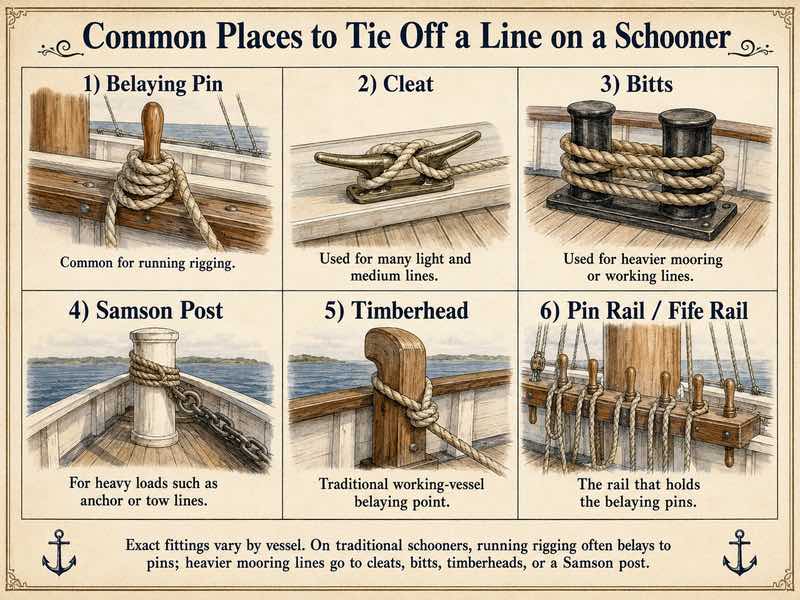
The line is attached to a belaying pin or cleat, coiled, and hung neatly out of the way.
The large pulleys used throughout the rigging are called blocks. The grooved wheels inside them are sheaves. Several blocks and lines arranged together form a tackle, creating mechanical advantage that allows the crew to control large, heavy sails.
The mainsail and foresail are large enough that their block-and-tackle systems need to be treated with respect. When the sails are loose, they can swing across the deck. The crew clears passengers from the areas where the tackle will move.
- Get a Car Rental
- Buy Travel Insurance
- Book discount cruises HERE

What Makes Heritage a Schooner?
A schooner has two or more masts, with the taller mainmast behind the forward mast.
That differs from a ketch, where the taller mast is forward, and a smaller mizzen mast stands behind it. A brig also has two masts, but it carries square sails rather than the predominantly fore-and-aft sails associated with a schooner.
Heritage carries a mainsail, foresail, headsails, and additional sails higher in the rig.

The arrangement allows the crew to adjust the amount of canvas to suit the conditions. Short pieces of rope on the sail (called reef points) make it possible to reduce sail area during stronger winds. Reefing is easier to do before the vessel is caught in severe weather. Trying to shorten sail in a strong wind is far more difficult.

Sean in Clark Kent
Clark Kent
Heritage does not have a conventional propulsion engine built into the hull.
Instead, it carries a diesel-powered yawl boat named Clark Kent. Like the fictional reporter who transforms into Superman, the relatively small boat becomes unexpectedly powerful when needed.
Clark Kent can pull Heritage away from a dock, push it through a calm harbor, or act like an external outboard motor when secured to the stern.
This system preserves the character of sailing without the constant sound and vibration of a large engine inside the schooner.

Joe
There is another engine aboard, but it does not propel the vessel. An old two-stroke engine named Joe helps operate the machinery used to raise the anchor and can be used to hoist the larger sails.
When Joe starts, everyone knows it.

Passengers preparing to depart in Archie
The Ship’s Boats
Heritage also carries 3 rowboats.
Archie is the largest and can carry roughly half the passengers at a time. It is used to transport guests ashore, powered by the guests themselves.
Lois Lane is a smaller rowboat that a few passengers may use around a protected harbor.
New Meadows is only large enough for one adult. It was originally intended for two children and was later restored for use aboard the schooner.
The names add personality, but the boats have practical roles. A windjammer usually anchors away from a dock, so getting ashore means climbing down a ladder and rowing.

Life in the Cabins
The cabins aboard Heritage are compact. There are 15 cabins that can hold up to 2 people, so the maximum number of passengers on the Heritage is 30, although our voyage only had 26, as some solo travelers like me had a cabin to themselves.
Cabins have upper and lower bunks, a sink with hot and cold running water, reading lights, small shelves, and electrical outlets. I am six feet three inches tall and just fit in the bunk. There was little unused floor space.
The schooner carries fresh water in tanks filled before departure. The water supplied to the cabin sinks is drinkable.
Two cabins have private heads (toilets). Other passengers (like me) share three marine toilets on the main deck. One of those compartments contains the only shower aboard.
I mostly washed at the sink in my cabin rather than waiting for the shower, although that was more for convenience than availability.
The accommodations are comfortable enough for sleeping and changing clothes, but the cabins are not designed as places where guests spend much of the day. Most passengers prefer to be on deck or in the mess.
Soft-sided luggage is recommended. A flexible bag can slide under a bunk or fit into a corner.
The cabin walls also do not provide the acoustic privacy of a hotel room, as the walls don’t go all the way to the ceiling in some places. Cabins also don’t lock. Headphones are recommended for listening to music or podcasts.
Each of the 3 toilets on deck is in a small compartment with a light, a toilet, toilet paper (which can go in the toilet), wipes, and hand sanitizer.
Electricity and Cell Service
Power normally comes from batteries. A generator is run at selected times, often while passengers are eating breakfast or dinner. That keeps the noise from interrupting the quieter experience of sailing.
Heating appliances such as hair dryers, curling irons, heating pads, and similar devices are not allowed.
Cell service is inconsistent. In some locations, I had enough reception to check email. In others, there was no service.
That is part of the rhythm of the trip. You may have a connection for an hour and then lose it when the ship enters a more remote harbor.

The Deck as the Main Living Room
Most life aboard Heritage happens on deck.
Camp chairs are available. Passengers also sit on the deck boxes and storage lockers.
Some of those lockers function as ice chests. Guests may bring their own soda, beer, wine, or liquor and store a limited supply on ice. Water, lemonade, iced tea, coffee, and tea are provided. There is no drink package, but there is also no corkage fee.
The best place to sit depends partly on the direction of the wind and the angle of the ship. When Heritage heels under sail, the shade will move with each tack that the ship takes. When the ship is not under sail, the crew will put up a tarp over the center of the ship for additional shade.
You will get a lot of sun, so sun protection is a must. A good floppy hat with a string to hold it on, sunscreen, and layered clothing is what to wear. Dress for dinner, means putting on a sweatshirt for a cool evening.

The area around the wheel is more restricted because of the mainsail tackle and the captain’s need to move between the wheel, charts, radio, and navigation equipment. But you are encouraged to come back, look at charts, and ask questions.

The bow is also a working area. It contains anchor chains, the catheads used to help handle the anchors, and the machinery connected to Joe.
Passengers are welcome to explore, but the ship is not arranged like a floating hotel. It remains a workplace. So you may need to move when the crew needs to access a locker, or haul up or down a sail.

The Galley and Mess
The mess is one of the features that reveals Heritage was designed for passengers.
There are three dining tables arranged around the space, with the galley occupying the remaining area. The crew also uses the mess as a work and sleeping area, so quiet hours begin around 10 p.m. The red curtains around the outside of the mess each hold a small sleeping cubicle for a crew member. This is their only personal space.
The galley stove burns wood. A wood-burning stove aboard a wooden schooner initially sounds like a questionable combination, but wood stoves have been used aboard vessels for generations. The fire is controlled, and there are no liquid accelerants involved.

The stovepipe passes through the deck. A water-filled trough around the pipe keeps it cool enough to avoid scorching the wood. The longer stove pipe can be replaced by a shorter version if need be.
The stove produces more than meals. It also creates one of the defining scents of the voyage. On deck, you might smell woodsmoke, fresh bread, cookies, or dinner cooking below.

Food aboard Heritage
Food is central to life aboard the schooner.
Breakfasts included blueberry pancakes and sausage, biscuits and scrambled eggs, French toast and bacon, banana coffee cake, blueberry buckle, and “boatmeal,” oatmeal served with granola and toppings.
Lunches (often served on deck) included fish tacos, chili with cornbread, turkey wraps, pasta salad, minestrone, and chicken-and-rice soup with Anadama bread.

Lunch under sail
Fresh bread appeared repeatedly. Anadama, made with cornmeal and molasses, was one of the most memorable.
Afternoon snacks included chocolate chip cookies, peanut butter cookies, snickerdoodles, lemon drops, brownies, crab cakes, charcuterie, salmon and lobster spread, and artichoke and mushroom dip.
Dinners included salmon and risotto, herb-crusted chicken with lemon-sherry sauce, lasagna with fresh bread, and a pot roast marinated in wine, tomatoes, and garlic.
The most memorable dinner was the lobster boil on “Lobster Island”, but the favorite meal for many was the lasagna.
Desserts included strawberry shortcake, lemon mousse, peach cobbler, and homemade ice cream made aboard.
The crew repeatedly suggested that we were not eating enough cookies. I offered that my doctor had told me just the opposite. The response was, “Your doctor isn’t here, is he?”

A Typical Day aboard the Schooner
Coffee appeared around 6:15 a.m. Breakfast was generally served at about 8.
After breakfast, the crew prepared the ship for sailing. The anchor came up, sails were raised, and Heritage headed into Penobscot Bay.
Lunch was usually served on deck.
By late afternoon, the schooner anchored in a protected harbor. Depending on conditions, passengers might go ashore, row around the harbor, swim, read, or sit on deck.
An appetizer came before dinner. Dinner was followed by sunset and a quiet evening.
On two nights, Ben and Sean played guitars for the passengers.
The daily schedule was simple, but it never felt empty. Sailing itself was the activity.

crew member aloft
Maintenance Is Constant
Operating a wooden schooner requires continuous work.
Every two years, Heritage undergoes a hull inspection. Other inspections occur on longer schedules, including inspections of fasteners and connections and removal of the mast.
The off-season is devoted largely to maintenance. The crew returns before the sailing season in April to scrape, paint, seal, repair, and prepare the vessel.
Shortly before my voyage, a large timber called a cathead had cracked and needed to be replaced. The repair was completed during the narrow turnaround between trips.
That is part of owning a wooden ship. Maintenance is not a separate project that ends. It is part of the vessel’s life.

Is Life aboard Heritage for You?
A voyage aboard Heritage is best suited to travelers who enjoy:
- Traditional sailing
- Maritime history
- Slow travel
- Informal communal meals
- Island scenery
- Conversation
- Flexible plans
- Time away from constant internet access
It is less suitable for travelers who expect:
- A large private cabin
- Daily showers without waiting
- Hotel-level privacy
- Elevators
- A fixed itinerary
- Nightly entertainment
- Constant cell service
- Conventional cruise amenities
Passengers should be comfortable climbing steep companionways and moving between the schooner and a rowboat.
The lack of luxury does not mean a lack of comfort. It means the comforts are different.
They include a warm meal after a day under sail, coffee waiting early in the morning, a chair on deck, the smell of bread from the galley, and a quiet anchorage at sunset.

Final Thoughts
The Schooner Heritage is more than the vessel that carried us through Penobscot Bay.
It shaped the entire experience.
Its size created a temporary community large enough to be varied but small enough for passengers to know one another. Its rig made the wind part of every decision. Its compact cabins encouraged everyone to spend time on deck. Its wood-fired galley turned meals and baking into part of the atmosphere.
What I remember most is the combination of sensations: rigging creaking, sails filling, crew commands crossing the deck, woodsmoke rising from the galley, and the smell of cookies appearing at an hour when no one had admitted to being hungry.
Life aboard Heritage is not luxurious in the conventional sense. It is made memorable by the captains, the crew, and by wonderful fellow travelers.
It is something rarer: a chance to live for a week aboard a working wooden schooner and let the rhythm of the ship determine the rhythm of the day.

 Sailing the Maine Windjammer Fleet: A Week Aboard the Schooner Heritage
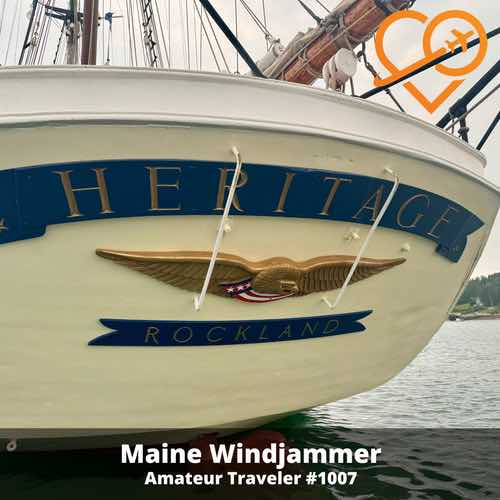 Sailing on a Maine Windjammer, the Schooner Heritage – Episode 1007
 Maine Windjammer Cruise – Episode 779
 Are You A Real Maine Expert? – Quiz
by Chris Christensen
Chris Christensen is the creator of the Amateur Traveler blog and podcast. He has been a travel creator since 2005 and has won awards including being named the "Best Independent Travel Journalist" by Travel+Leisure Magazine.+Chris Christensen | @chris2x | facebook
Leave a Reply
Tags: article, cruise travel, expedition cruise, maine, maine windjammer, sailing