Phoksundo Lake from viewpoint
The teahouse owner had not even woken up, but I opened the doors and let myself out, and there it was…
Phoksundo Lake in the early morning, before the sun had climbed over the western ridgeline, sat in a deep charcoal blue that didn’t look like water. It looked more like someone had cut out a piece of the night sky and left it pressed between two cliffs.
The rock faces above it, brown and bare and almost Tibetan in character, dropped straight to the shoreline without any softening. No trees at the edge. Just those vertical walls meeting that color.
I had been on trails in Annapurna, around Everest, and in Langtang. None of them had prepared me for the feeling of standing there in the cold at 3,611 meters, watching a lake that has no aquatic life and no explanation for why it looks the way it does.

landscape of Lower Dolpo
The Trek That Felt Different From the Rest of Nepal
Most people who trek in Nepal end up on one of the big routes: Annapurna Circuit, Everest Base Camp, Langtang Valley, or Annapurna Base Camp.
These are genuinely good treks, but they also come with established infrastructure, reliable wifi at tea houses, and a steady flow of trekkers from multiple different countries sharing the same trail in both directions.
Phoksundo Lake Trek doesn’t have any of that.
The trail starts from a place called Suligad, located in the Dolpa district (or Dolpo region) in the remote far west of the country. It leads to a peaceful Himalayan village called Ringmo inside Shey Phoksundo National Park, where Phoksundo Lake is located.
You pass through villages where the culture is Bon, not Buddhist (one of the oldest religious traditions in the Himalayas, predating Tibetan Buddhism itself).

Phoksundo Khola River
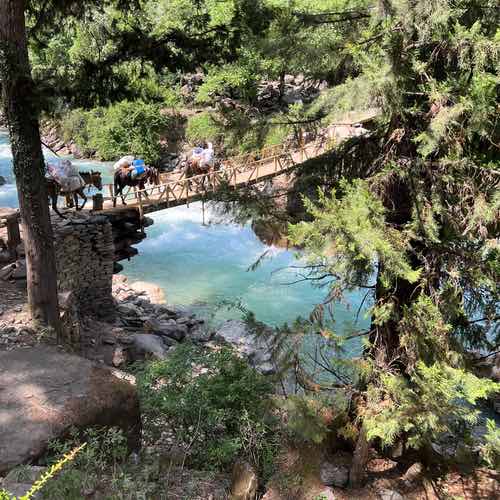
You cross multiple wooden bridges over the cold Phoksundo River waters. You could even be obstructed by a landslide zone or two and still figure it out on the spot. And for most of the trail, especially past Chhepka, the number of other trekkers around you drops to almost nothing.
There’s no organized trekking economy, no lodge menus with continental options, no line at the viewpoint. What you get here is trail, landscape, and the occasional other group passing in the opposite direction, and that’s about it.
For people who have done the popular routes and found themselves wanting something less managed and more honest about what it actually is, Phoksundo answers that question directly.

apple tree in Dolpa
Why Getting to Phoksundo Is Not Easy
Phoksundo is in Dolpa, one of Nepal’s most remote districts. And that remoteness doesn’t begin at the trailhead; it begins the moment you decide to go.
There are two main ways to reach the trek’s starting point. The faster option is to fly from Kathmandu to Nepalgunj, then catch a second flight from Nepalgunj to Juphal airport, and trek from there down to Suligad.
The problem with this route is that flights to Juphal are mountain flights, meaning they are highly weather-dependent and can be canceled on short notice. If you have a fixed return date, that unpredictability creates real pressure.
The other option is the direct bus from Kathmandu to Dolpa. Options of getting a private jeep are also available, but for more adventurous and budget-friendly travelers, this one’s perhaps the one you want to try.
I took this one. It took around 30 hours just to get to the starting point.
The bus passes through Pokhara, Musikot, and Jajarkot before reaching Dolpa. It is not comfortable in any conventional sense.
The trail is rated easy to moderate. But “easy to moderate” in Nepal still means river sections, loose trail, active landslide zones, and one steep climb just before Ringmo that we had been told was so steep it would make your nose touch the hill.

Phoksundo Lake in Ringmo village
The Moment I Saw Phoksundo Lake
Nothing about the trail from Saaijol hints at what is coming.
You climb through the steepest section of the entire trek, past the Phoksundo Jharana waterfall, which flows directly from the lake above and is worth stopping for, though the cold and the spray make it hard to stay long.
Then, the ridge opens. Ringmo village appears first, with small stone houses and prayer flags, and just beyond it lies Phoksundo Lake.
The first thing you register is its color. And I don’t have a precise word for it. Blue, but not the blue of mountain sky. Turquoise, but deeper and denser than the word suggests.
Standing in front of it for the first time, I thought of all the lakes I had seen in Nepal, and none of them looked even remotely similar.
The cliffs behind it are a dry, raw brown. The combination of that color against those bare cliffs is what makes the place feel more like the Tibetan plateau than anything in the Nepali Himalayas.

Suligad or Phoksundo Waterfall
I spent 45 minutes at one waterfall on the way up (it’s called Suligad Waterfall or simply Phoksundo Waterfall), just sitting and watching the water fall.
By the time I reached the lake itself, I had run out of things to say about it.
Just so you know: Phoksundo Lake sits at 3,611 meters. Its maximum depth is 145 meters, making it the second-deepest lake in Nepal after Rara Lake (with a maximum depth of 167 meters).
It covers 4.94 square kilometers with a distinctive Y-shaped body. And the word “Phoksundo” comes from the local word “Phokso,” meaning lungs, because from above, that shape does resemble a pair.
To see the Y-shape properly, you need to climb to the viewpoints above Ringmo village, which go up to around 4,045 meters. The trails up to those viewpoints are unmarked, steep, and entirely worth it.
The lake’s color shifts through the day in a way that made me keep walking back outside to check. Deep charcoal before sunrise. That dense turquoise by midday. Something between grey and green by late afternoon.

with lama of Thasung Tsholing Monastery
Ringmo: A Village That Taught Me What Slow Travel Truly Is
Ringmo village sits on the lake’s southern shore at roughly 3,640 meters. It is a small Bon settlement of stone houses, a few tea houses, yaks wandering through the lanes, and a monastery called Thasung Tsholing, which sits above the village facing the cliffs.
The local people speak a Tibetan dialect and refer to the lake by different names, such as Tsho Karpo, Rigmo, etc.
The tea houses in Ringmo are basic. The one we stayed in did not even have soap in the bathroom.
The food is simple: noodles, dal bhat, and whatever yak product is available. We got to try cold Yak Sukuti (dried yak meat) that first night, which is a must-try delicacy when you’re here.
In the evening, the group staying at the hotel next to ours brought out a flute and a madal (traditional Nepali instruments). Someone started singing “Resham Firiri”, a popular folk song.
The two Indian trekkers who had just come down from Upper Dolpo joined in without knowing a single word of the lyrics. Nobody asked them to. Nobody explained anything. They just sat in a circle in a small hotel with us and sang along.
That is what slow travel actually looks like when it is real and not a concept someone sells you.

Phoksundo River wooden bridge
Planning Your Own Phoksundo Lake Trek?
This is the part where I give you everything you need to actually make this trip happen.
The trekking itself is easy to moderate in difficulty, but the planning around it is where most people get confused. So, let me walk you through it properly.
When to Go?
Autumn (particularly October-November) is the most reliable time for the Phoksundo Lake Trek, and it is what I would personally recommend, too. The weather is stable, the skies are clear, and the trail is in its best condition.
Spring (late March through May) is the secondary option and works well, particularly if you prefer slightly fewer trekkers on the route.
What you want to avoid is the monsoon season, which runs from June through August. The lower sections of the trail near Suligad are prone to landslides during this period, and the overall trail conditions make the journey significantly more difficult than it needs to be.
Permits You’ll Need
After booking your flight to Nepal and obtaining the Nepal Tourist Visa on arrival (for most international travelers), you will need two additional permits to trek in this area.
The first is the Shey Phoksundo National Park entry ticket, which can be purchased right at the Suligad checkpost.
The second is a Restricted Area Permit (RAP) for Lower Dolpa, which is required for foreign trekkers and cannot be obtained independently. You must go through a registered trekking agency in Nepal to obtain it.
Itinerary
As mentioned above, you’ll need to go through a registered trekking agency, so your itinerary also depends on how the tour operator provides one for you.
But you always have the option to customize. Here’s what I personally recommend (you can seek this one from the agency you choose):
- Day 1 and 2: Arrive in Nepal, relax, explore the capital city’s heritage sites
- Day 3: Start your travel plan, do final shopping, pack your stuff
- Day 4 and 5: Reach the starting point, Suligad (either by bus/flight/jeep), and reach Kageni
- Day 6: Kageni to Saijol
- Day 7: Saijol to Ringmo, explore Phoksundo Lake and monastery
- Day 8: Explore Phoksundo viewpoints, Return to Renchi
- Day 9: Renchi to Dunai
- Day 10 to 11: Return to the capital
- Day 12: Relax in Kathmandu, go for more exploration
- Day 13: Depart from Kathmandu
Always add 1-2 buffer days, no matter the itinerary. And if you’re up for it, you could do the more popular ‘Lower Dolpo Circuit’ or take your adventure to a higher altitude to do the ‘Upper Dolpo Circuit’.
This Phoksundo Lake is simply one part of the Lower Dolpo Circuit and is suitable for all ages.

teahouse and eating dal bhat in Nepali style
Accommodation: Teahouses
Teahouses are available along the entire route, from Suligad to Ringmo.
However, the accommodation is basic (twin-sharing rooms, squat-style toilets in many places, and no hot showers beyond Chhepka).
Charging facilities are available along the route, but carrying a power bank is always recommended. And get an NTC SIM card (remember: NTC) for a more reliable signal.
Altitude Risks and Fitness Requirement
The lake sits at approx. 3,611 meters, and the highest viewpoint above Ringmo is around 4,045 meters. Neither number is extreme by Himalayan standards, but if you are traveling directly from Kathmandu and not accustomed to elevation, mild symptoms of altitude sickness (headache, poor sleep, fatigue) may occur.
So, give yourself a proper rest day in Ringmo before pushing up to the viewpoints, and take the acclimatization seriously even though the numbers might not look alarming on paper.
For general fitness, you need to be comfortable walking 6 to 8 hours a day on uneven terrain. It is doable for most trekkers with some hillwalking experience, but it is not a leisurely walk either.
The steep climb just before Ringmo will likely test your legs, so be mentally prepared.
Well, if you want to learn in depth, I have written a detailed guide to the Phoksundo Lake Trek on Travel Nepal Today, my very own personal travel blog. I’m open to messages, so contact me, and I’ll help you with the entire process, too.

teahouse in Kageni Dolpa
Final Thoughts
Phew. That was a lot of detail for a trek that barely anyone in the international travel world has heard of, wasn’t it?
But here is the thing: the logistics around Phoksundo are genuinely more complicated than the trekking itself, and most of the confusion I see from readers comes not from the trail but from trying to understand transportation, permits, timing, and what to actually expect once they get there. I hope this article cleared up most of that.
The color of that lake in the early morning is not something any article, including this one, will ever describe accurately. So, you have to be there to see it for yourself.
And on the way back through Dunai, buy some local apples and be sure to enjoy the proper rural side of Nepal that it’s known for. Happy traveling!

 The Upper Dolpo Trek: My Exciting Adventure – Nepal
 Travel to Nepal – Episode 861
 Best Trekking Places in Nepal: My Personal Experience with Additional Trekking Tips
 Planning for the Manaslu Circuit Trek in Nepal