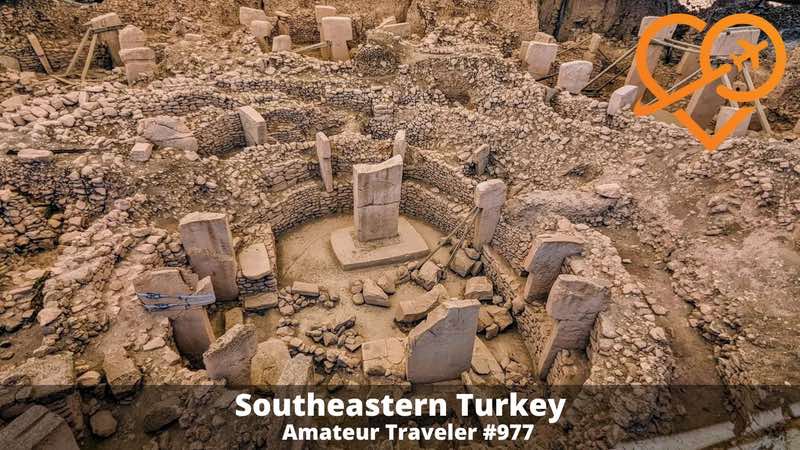
Hear about travel to Southeastern Turkey as the Amateur Traveler talks to Mark Michael from rambleswithmark.com about this region that is the home to people in the Bible like Paul and Abraham, ancient monasteries, and some of the oldest known megaliths.
Connection to Region
- Read William Dalrymple’s From the Holy Mountain in college, a journey through the region retracing the steps of John Moscos, a seventh-century monk
- It’s hard to underestimate how ancient this part of the world feels. In Urfa, they have a few prized local delicacies: one is a meatball they say that Abraham invented, another is a dessert they call Noah’s pudding, and there’s a pancake covered in molasses that is supposed to derive from the Hanging Gardens of Babylon. I have made a lot of Christian pilgrimages, almost always to sites from the New Testament or the early church; many sites on this trip are associated with Muslim traditions about Old Testament figures, which are usually similar but different from those preserved by Jews and Christians. If you are interested in the history of the Ancient Near East, Turkey is by far the easiest place to travel: Iran, Iraq, Syria, Lebanon, and Israel are all barred or unsafe.
- Turkey has good roads, helpful people, and relatively low costs (though inflation has climbed steeply in the past 2 years)
- Area is changing quickly through massive investment in GAP Project (22 hydroelectric dams on the Euphrates, 19 power plants, with initiatives to develop agriculture and tourism in region that has been Turkey’s poorest), allowing for development of tourist infrastructure, but accelerating decline of traditional ways of life, if you go now, it will still seem timeless, and you will be ahead of the tourist rush
- You feel like a traveler here, not a tourist. I only met one other native English speaker. People are curious and enthusiastic to show you their local treasures.
Getting there and getting around:
- Fly to Istanbul, Turkish Airlines is relatively low-cost, mid-range quality
- Take a regional plane to Adana (10 a day)
- Rent a car one-way, far easier to arrange as a one-way West-East journey
- Fly back from Sanliurfa, Mardin, or Diyarbakir (about three flights a day from each destination, choose what works best for your schedule).
- There are buses between major cities (efficient, can buy tickets online), but many interesting attractions are practically accessible only by car.
Where to stay
- I recommend “boutique hotels,” which are generally very cheap by American standards (~$75 a night). These tend to be in Ottoman-era mansions, with beautiful gathering spaces (courtyard gardens or divans with braziers). Quirky rooms, friendly hosts.
- Turkish hotels serve lavish breakfasts, lots of plates of cold cuts, pastries, fruit, vegetables, and spreads. You can eat a very light lunch, which frees up time in the middle of the day for sightseeing
- One downside of these traditional hotels is that most are in the pedestrian-only sections of cities, and you need to find a parking lot on the edge of the pedestrian area. Parking is cheap, and the hotel will usually send someone to help you park and shift your luggage if you ask in advance.
Day 1: Tarsus [stayed at Burhanoğlu Konağı]
- Fly into Adana, drive directly to Tarsus (40 km). Adana is an important industrial city and has some significant Ottoman mosques, but Tarsus is a more walkable, quiet, pleasant place for a half-day of exploring before getting some rest.
- The city is about 6000 years old. The local belief is that it was founded by Seth, son of Adam and Eve, whose tomb you can see in the Ulu Cami (grand mosque)
- Thrived in the classical period, when it was a major seaport, the greatest city of Cilicia, and an outlet of an important road over the mountains (Cilician Gates)
- Alexander the Great caught malaria here, Antony romanced Cleopatra, and the hometown of St. Paul. He was by trade a tentmaker, weaving waterproof cloth from the hair of Cilician goats (haircloth is still called cilice), occupied by Byzantines, Seljuks, Armenians, Crusaders, Ottomans
- A small section of the ancient city is excavated, part of the forum, and the old main street, also “Cleopatra’s Gate,”a remnant of a triumphal gate that could date from the time of her visit
- Two sites associated with St. Paul: his well, which stands on the site of his birthplace, a feature of Christian & Muslim shrines in this region: they usually involve a cave or a well or both; also a handsome 19th-century church, which was built on a very ancient site.
- Parts of the Ulu Cami date from the 13th century, but it incorporates spolia (pillars) that Antony & Cleopatra may have known. The mosque has its own bazaar, the Kirkkasik Bedestan, which adjoins the property and sells trinkets and handicrafts
- Makam i-Serif Camii: a mosque that contains what Muslims believe to be the tomb of the Prophet Daniel, also incorporated into the excavations of an ancient necropolis
- Great place to try an Adana kebab (spicy, long and skinny), though I don’t recommend the local enthusiasm for drinking salgam with it: purple juice of pickled turnips. Also, numerous shops selling kunefe: (shredded wheat layered with a mozzarella-like cheese and soaked in sugar water and lemon juice)
Day 2: Cilician Ramble Day-long west to east drive between Tarsus and Antakya (Antioch/Hatay) with lots of beautiful seaside scenery and interesting stops
- Anazarbus (Justinopolis): capital of Cilicia in the early Byzantine period, built in the 6th century by Justinian and destroyed in the 14th century by the Mamelukes
- Extensively excavated, the world’s longest preserved ancient street (which I nearly drove onto), given the poor signage. It was just me, the goats, and the cows
- Impressive reconstructed 3rd-century triumphal gate; ruined Byzantine shops and churches.
- Also, an upper city with a Crusader castle atop a steep bluff, apparently has incredible views and the ruins of the church that housed the tombs of the Armenian Kings– but involves some hand-over-hand climbing I wasn’t ready to try in that weather
- Yilankale (Snake Castle): 12th-century Armenian castle ruin, important for control of the mountain passes
- Great place to explore, lots of towers, some vaulted halls, crenellated walls
- It can be seen from a long distance and has incredible views of the Cilician plain.
- Local legend is that it was home of the Shahmaran (half woman-half serpent), who was queen of a subterranean paradise, discovered by a young man who came here looking for honey
- Musa Dagh: drive around Moses Mountain, a commanding mountain near the Mediterranean Sea.
- The mountain is famous for a 1915 battle between the local Armenians and Ottoman troops during the Armenian Genocide, inspired Fritz Werfel’s 1933 novel, The Forty Days of Musa Dagh.
- The French navy came to rescue, and this region was incorporated into Syria after WWI, only to become part of Turkey (along with Antakya) in 1939. This explains why this region is more heavily Christian and Arab-speaking, and also contains Turkey’s only Armenian village (Vakifli)
- Yunus Sutunu (Jonah pillar) was the first stop, marking the spot where the whale spat out Jonah, a pretty straight shot to Ninevah, in what is now Northern Iraq
- Stop for a late lunch at Hatay Sultan Sofrasi Kavalti Evi in Konacik, a great spot for local cuisine, which is heavily influenced by Syrian cooking, smooth hummus, tepsi kebab, fried meatballs, salads with pomegranate vinegar, UNESCO food region, also orange blossom water, aged goat cheese, local olive oil
- Hidirbey: home of the Moses tree, which gives the region its name. Legend is that Moses lived in this area while in exile from Egypt as a young man, and he put down his staff, and it grew into an enormous tree with a pump that promises the “water of immortality”, a slowly flowing creek with tables in the water under the spreading branches: great spot for a coffee or a sherbet
- Seleucia Pieria, the ancient seaport for Antioch, is home to the Titus Tunnel, a water-diversion system to keep the bay from silting up. Walk through the tunnel, and visit a series of necropoli, beautiful gardens
- Monastery of St. Simeon the Younger: fifth century, built during a craze for stylites, monks who lived for years on pillars as a form of ascetic discipline. Simeon the younger was a priest and healer, lived on the pillar for the last 45 years of his life, and the site became known as “the Wondrous Mountain.” A church was built there with four bays, and its pillar in the middle, and ruins still survive. There is a more famous Simeon the Stylite, who lived near Aleppo in Syria (the ruins are a UNESCO site, but it is unsafe to access now)
Finish by driving into Antakya/Hatay: the greatest city of the East in the classical era, famous for its luxury, a deeply significant cultural center: literature, scholarship, the arts
- I suggest staying there, despite the inconvenience; the city has traditionally thrived on tourist trade, energetically trying to rebuild after the Feb. 2023 earthquake.The seventh earthquake since the 2nd century. [Stayed at Luwi Antakya Boutique Hotel]
- Some hotels and parts of the famous bazaar are open, but earthquake damage is still extensive, following Google Maps, and it says turn into a street that is no longer there.
- I suggest dinner at the UNESCO Hatay Gastronomi Evi (Hatay Gastronomy House), which was located in a historic building in the Old City until the quake, now in the Expo Center. Food is the same as in the former location, a rotating menu of local specialties, ask the waitress what people like most. I had a long conversation with the waitress, who had been an exchange student in Louisiana and spoke excellent English-she said I was the first English-speaking tourist they had served since the quake, which was 15 months prior. She was pessimistic about the city’s restoration, since the local population supported the current president’s political rivals.
Day 3: Antioch and Gaziantep
- Go down to the Long Bazaar for breakfast, in the process of reconstruction, but some food stands are reopened.
- Mosque of Habib the Carpenter: currently being rebuilt, visit if opening: fascinating site, originally a pagan temple, then a church commemorating St. John the Baptist and a local Christian martyr, Habib. He is commended in the Koran for his faithfulness, and the site became one of the first mosques in Anatolia after being conquered by the Arabs in the seventh century. The current mosque dates from the 1200s.
- Church of St. Peter, a cave in the mountain above the city, said to be the first place of Christian worship in the city, where followers of Jesus “were first called Christian” (Acts 11:26), believed to date from 47 ad. Still traces of mosaic on the floor, and a tiny pool still used for baptisms. St. Matthew is said to have written his gospel here, and there were catacombs beneath, blocked off by a recent landslide.
- The Archeological Museum here is also famed, but still closed after major earthquake damage, and was formerly a beautiful Orthodox and Catholic church
Gaziantep: great place for lunch, said to have the best food in Turkey, and more sweetshops per person than anywhere else on earth
- Especially famous for pistachios (in Turkey, they call it the Gaziantep nut, and there’s an ancient statue of a boy with a bunch of them in the city’s archeological museum)
- Great place to try beyrak (lamb and garlic soup), or Ali Nezak (lamb kebab with eggplant puree). Baklava abounds, and also katmer, which includes clotted cream, the breakfast after the wedding night
- Zeugma Mosaic Museum: new project, enabled by GAP funding, 35 mosaics in total
- Damming the Euphrates unearthed a series of 2nd and 3rd-century mosaics at Zeugma, floors of elite villas in the 3rd century, when the Persians destroyed the city. Great use of plexiglass walkways,
- An impressive collection of Byzantine mosaics, mostly from excavated churches.
On your journey west, you may want to catch a boat to Rumkale, a Byzantine-era fortress on the Euphrates.
- It was the seat of a Syrian bishopric and then of the head of the Armenian Church, with impressive walls, ruined churches, and mosques
- Now it can be viewed only from the water. Numerous boats make regular trips from Zeugma, but one cannot land and explore the place until restoration work is completed
Day 4: Sanliurfa (Edessa): fascinating ancient city, suggest staying here for a few days, good base for excursions [Stayed at Şark Çırağan Konağı Butik Otel]
- Settlement here from about 9000 BC, and ancient Jews, Christians, and Muslims believe this was Biblical Ur, the birthplace of Abraham
- Located on the frontier of Roman and Persian worlds, became an eclectic melting pot of different cultures and religions; a large Jewish population, an intellectual center of Syriac Christianity (half Christian on the eve of WWI)
- Now entirely Muslim (“the God city”), most women veiled, no alcohol in most restaurants
- The Urfa kebab is famous (mild with onions, not peppers); kofte (meatballs): cig kofte (raw meat, but now with bulgur) and icli kofte (coated in bulgur and deep fried); Şıllık Tatlısı (crepe stuffed with walnuts, covered in molasses)
- Sira nights: local custom of evenings of music, dancing, poetry recitation, some are authentic and open to outsiders, others are put on solely for tourists, worth asking your hotel guide if some are on offer.
A series of grand mosques, many associated with figures from the Old Testament
- Balıklıgöl (Pool of Abraham): a series of pools with sacred carp, dating back at least to the 4th century BC, when the area was associated with the cult of Atargis, a Syrian goddess. Muslim legend is that the pools were related to a confrontation between Abraham and Nimrod. Abraham fell in love with his daughter Zeilha, and Nimrod cast him into a fire, but God turned the fire into the pools and the logs into the fish, or that Nimrod used the two pillars of the acropolis as the posts of a catapult, and shot Abraham down, and God gave him a soft landing by creating the pools. Don’t ask to be served fish; they are supposed to make those who eat them go blind. Lovely place to have a cup of tea and watch people, and marvel at the survival of the site for over 2000 years.
- Makam-ı İbrahim Mosque: houses a cave, believed to be the birthplace of Abraham
- Citadel: some ruins of historic fortifications, wonderful view of the city at night
- Sanliurfa Mosaic Museum and Archaeology Museum: built in situ over a Byzantine villa with a series of spectacular floor mosaics, some showing the Amazons; also excellent display of ancient treasures, including a replica of a Gobeliktepe temple that you can walk inside, really get a sense of the scale of these buildings
- Bazaar: large, rambling covered bazaar selling all kinds of items, handicrafts, household goods, food
- Hazreti Eyyüb Sabır Makamı: Tomb of Job: cave believed to be the place of Job’s suffering and a spring, which sprang up at God’s command, whose waters healed him.
Gobeklitepe: Neolithic site excavated about 30 years ago, about 20 km NE of the city
- A series of circular temples held up by massive monoliths (some as tall as 20 feet and weighing many tons), many carved with relief sculptures of animals or human features
- Dates to 9500 BC, more than twice as old as the Pyramids (6000 years older than Stonehenge), and before the development of pottery and agriculture and the domestication of animals
- The site has led to a reassessment of prehistory. It was assumed before that agriculture produced civilization and that religion was a product of leisure time, but this site suggests the process worked the other way around; crop cultivation may have come from the need to feed the large numbers of people who gathered to worship at these sites
- Well-curated museum, Area fully covered with walkways that allow close access to the site while also keeping viewers well away from the sensitive materials.
Day 5: Nemrut Dagi (Nemrut Mountain): an impressive series of ancient monumental statues atop one of the highest mountains in the region, increasing tourist traffic, guidebook cover shot
- The greatest monument of the Commagene Kingdom, a short-lived Hellenized Persian state that thrived for about two centuries around the time of Christ. Enormous scale and remote location combine to make this a very strange but evocative memorial
- Tomb of a Commagene king, Antiochus I, who constructed a series of 25-foot-tall statues of himself, as well as lions, eagles, and composite Greco-Iranian gods, like Zeus-Orasmades and Apollo-Mithras. Tend to have Greek faces and Persian dress and hairstyles.
- There’s also an astronomical chart with images of the heavenly bodies that suggests the date July 7, 262 BC, which may be the date that Pompey authorized Antiochus to rule
- They were beheaded at some point, probably as an act of deliberate iconoclasm, and the heads are strewn around the complex. Local people later associated them with Nimrod, Abraham’s enemy, thus the name of the mountain.
- about a three-hour drive one way from Sanliurfa, makes for a long, but manageable day trip, and can be combined with a few other nearby Commagene ruins. Not possible in the winter months. There’s a fairly steep 20-minute walk from the car park to the summit
- There are also tour companies that will do the drive for you, which could be worth it if you want to see the sunrise over the mountain, but these aren’t cheap, around $600 a person. You could also drive to Adıyaman and take a hired car or even a helicopter from there.
A few other ancient sites are nearby and can be easily visited on the way to or from Nemrut Dagi. The entrance fee to Nemrut Dagi covers those who charge admission.
- Karakuş Tumulus: funerary monument for three Commagene queens, including Antiochus’ wife, with pillars topped by eagles and relief carvings of kings and gods
- Cendere Bridge (Severan Bridge): 2nd-century Roman bridge built by the XVIth Legion during a war against Parthia. A little tea house to stop and enjoy the view.
- Arsameia: ruins of a Commagene city, contains the tomb of Mithridates I, the father of Antiochus I, and an altar that features a famous relief sculpture of Antiochus shaking hands with the god Herakles. There’s a cistern and some house ruins, and this can be a nice place for a picnic
- Yenikale: Mamluk Fortress (14th century), probably on the site of Antiochus’ palace. Recently reopened after prolonged restoration. There’s a shop here where you can try “Kurdish coffee,” made from a blend of roasted pistachios and turmeric
Days 6 & 7: Harran and the Tur Abdin [stayed in Mardin at Carra Konagi] Harran: ancient Haran, the home of the family of Abraham, once a grand place, thriving on the traffic of the Silk Road.
- The city was home to the first mosque in Anatolia and the first Islamic university. The Byzantine walls are largely intact, but the village inside is tiny, with sheep and camels pasturing and houses built into the walls
- Well of Jacob: marks the site where Jacob met Rachel, his great love, which resulted in 14 years of service to Laban, his taskmaster.
- Ulu Cami (great mosque), inside the walls built by Justinian in the 6th century. The mosque is from the 8th century, rebuilt by Saladin in the 12th century, and now it is only a shadow of its former grandeur, but it has a pretty fountain and some impressive old column capitals. Large spaces inside the walls are given over to pasturing sheep and camels
- There are numerous huts with beehive huts around the city, built of stones without mortar, topped with mud cones, and resistant to earthquakes. I visited a palace of interconnected huts owned by a man born in them. They are similar to the trulli at Alberobello, which may have first been built by Ottoman soldiers from the region in the 17th century.
- Also, an impressive ruined fortress, open for exploration
- The GAP Project is transforming the region: fields are green with irrigated crops, and lots of new houses. I had come with a bag of hard candy, as a guidebook told me that visitors were mobbed by local children begging for money and gifts, but no one met me. The guide at the beehive houses said no one actually lived in them anymore, and they were only used for barns and sheds.
- Nice restaurant [Harran Gastronomie Merkazie]
Tur Abdin: mountainous region east of Sanliurfa, with the largest cities being Mardin and Midyat, the traditional homeland of the Suriani, the Syriac Orthodox Christians
- Name means “mountain of slaves” or the “mountain of the servants of God”, references the large number of monasteries located here in antiquity (600 at the height, now just 2)
- Only about 30,000 Suriani still live in Turkey, and less than 10,000 of these in the Tur Abdin, faced low-level persecution, many went as refugees to Sweden and Germany in the early 2000s
- They speak a dialect of Aramaic, the language Jesus spoke, and their liturgical language is Syriac, using a fifth-century liturgy, the oldest one used by any Christian community in the world.
- They are Miaphysites, believing that Christ has a single nature, broke with the Orthodox church in the sixth century, a decision partly driven by Persian dominance in the region, and a desire to distance themselves from the Byzantine political orbit. They are sometimes called Jacobites for their great missionary bishop, Jacobus Baradeus (the rag-wearer).
- A few dozen churches and monasteries are scattered across the region, many of them well-maintained thanks to donations from successful Suriani living abroad, who keep summer houses here, and sometimes send their children to the monasteries for the summer
- To learn more, I recommend Stephen Griffiths’ Nightingales in the Mountain of Slaves, an account of his experiences visiting these communities in the 1990’s and 2000s. Also, Oswald Parry’s 19th-century Six Months in a Syrian Monastery
Mardin isthe best base: known as “the white city”, beautiful and walkable, lots of houses with ornamental carvings
- Lots of shops selling telkari, the traditional Suriani silver filagree jewelry, as well as the local wine, a robust red, the Suriani are very proud that Noah planted the first vineyard on a nearby mountain. Also famous for soaps (almond, pistachio, laurel, olive)
- Park your car at one of the car parks on the outskirts of the old city, and then make day trips out to explore the Tur Abdin monasteries and villages
- Mardin Museum, housed in the former Syrian Catholic Patriarchate, has an interesting collection of local artifacts, including silver jewelry
- Sultan Isa Medrese: a beautiful 14th-century complex with ribbed domes and an impressive entrance gate, considered one of the best examples of Artuqid architecture, a local Turkish principality under the Seljuks. Beautiful views of the city and across the plain from the flat room
Deyrulzafaran (Saffron Monastery), also called Mor Hananyo, was the seat of the Patriarch of Antioch, the head of the Syrian Orthodox Church, and his throne still stands in the chancel.
- The monastery dates from the fifth century, but the crypt of its chapel is said to be a temple to the Mesopotamian sun god, Shamash. Chapels contain tombs of the patriarchs, who were resident here for 800 years, as well as 12,000 martyrs
- The monastery has its own vineyard, a lovely wineshop and café; it’s also possible to stay overnight
- I had tea with one of the monks, Father Gabriel, who spoke excellent English (he had managed his family’s jewelry shop in the Grand Bazaar in Istanbul before becoming a monk).
- He was running the summer program, and several boys joined him in vigorously chanting the Evening Prayers in Aramaic, asking to stay behind for prayers or come for the liturgy on Sunday morning if you can.
Mor Gabriel: an older monastery, founded in the fourth century, the church was built by Justinian (about a century after monasticism began)
- Virgin Mary Church contains the Dome of Theodora (modeled on Hagia Sophia)
- Beautiful Byzantine mosaics and an impressive floor in opus Alexandrinum in the chancel: golden tiles with vines and crosses, and an early depiction of a Christian altar, reminded me of Ravenna
Hah (Anıtlı): can be tricky to find these places, which are often known by both a Syriac and a Turkish name.
- Church of the Mother of God is believed to be the very oldest, built by the (12) wise men on their journey home. It may be in part a converted Roman temple
- Unusual pyramidal dome, deeply carved capitals, palm trees, acanthus leaves, garlands, the carvings are beautiful but also deeply weathered, and the whole building looks impossibly ancient.
- The same village contains the ruins of a second church, Mor Sobo, which was a three-aisled basilica, the largest church in the region. Also, an outdoor basilica, for services in the summer
Mor Hadshabo: church in Ain Wardo like a fortress, site of the Suriani’s most successful resistance battles with the Ottoman army in 1915, you can still see bullets in the walls
- The caretaker took me up to the roof, which had a great view of the surrounding areas
- Also, a very impressive carved altar niche, much like the mihrab of a mosque, similarly, no figural art
Mor Yakub in Salah (Baristepe): 8th-century monastic church, restored by an active monk, Father Daniel, who is apparently active on Instagram
- This church, like several others, has a nave that is wide and shallow, which may reflect the primary use for monastic worship, but may also be based on Zoroastrian temple architecture; the monastery was probably built on the ruins of a Zoroastrian temple.
There are other fascinating sites: the church of Mor Lazoor, where the pillar of a stylite remains; Mor Evgen, where a hilltop monastery with dramatic views across the desert was recently reopened. Dara: a Byzantine city that became a major garrison town in the 6th century. The ruins are well-preserved and accessible
- Large necropolis, complex of cave tombs carved in the soft stone, some have reliefs and elegant arches and columns
- Cisterns to store water in case of siege, like the better-known ones in Istanbul
- Parts of the forum and fortifications are also preserved.
Nusaybin (Nisibis): city on the Turkiye-Syria border, famous in antiquity as a center for culture and learning, long the seat of the Nestorian Church (Ancient Church of the East).
- State Department discourages visits within 10 km of the border, but the hotel keeper in Mardin said I would be fine. He was right, I had to show my passport at a few checkpoints, but no problems
- Church of St. Jacob: burial place of Jacob Bardaeus, the spiritual father of the Syriac Orthodox Church.
- Church is surrounded by excavations of the former nave and monastic buildings; only the chancel survives, with some beautiful ornamental carving and the tomb of Jacob Bardaeus
- View across no-man’s land to Syria, can see remnants of the ancient gates of the city, which may someday be restored
Sponsors
- Buy Travel Insurance
- Get a universal plug adapter
- Get a Car Rental
- Guided Tours in Turkey
- Get an eSim to be able to use your smartphone abroad.


subscribe: rss feed | Apple podcasts 
right click here to download (mp3)
Show Notes
Rambles with Mark
Southeastern Turkey on Rambles with Mark
Adana
From the Holy Mountain: A Journey Among the Christians of the Middle East
Tarsus
Adana kebabı
Anazarbus
Yılankale (Snake Castle)
Musa Dagh (Moses Mountain)
The Forty Days of Musa Dagh (film)
Yunus Sütunu (Jonah’s Pilar)
Hidirbey Musa Agaci (Moses Tree)
Seleucia Pieria
Vespasianus Titus Tunnel
Monastery of Saint Simeon Stylites the Younger
Antioch
Antakya
Church of St Peter
Mosque of Habib, the Carpenter
Gaziantep
Zeugma Mosaic Museum
Rumkale
Urfa
Pool of Abraham
Şanlıurfa Archaeology and Mosaic Museum
St Job Tomb
Göbekli Tepe
Mount Nemrut
Commagene
Karakuş Tumulus
Harran
Diyarbakır
Tur Abdin
Mardin
Sultan Isa Medrese
Mor Hananyo Monastery
Mor Gabriel Monastery
Meryem Ana Monastery, Church of the Mother of God
Church of Mor Sobo
Mor Hadbshabo Church
Mor Jacob Monastery
Dara, Artuklu
Nusaybin
Community
Give me your feedback on the show at AmateurTraveler.com/1000


 Travel to Eastern Turkey – Video Episode 15
 Travel to Turkey (Türkiye) – Episode 835
 Travel to Bodrum, Turkey – Episode 271
by Chris Christensen
Chris Christensen is the creator of the Amateur Traveler blog and podcast. He has been a travel creator since 2005 and has won awards including being named the "Best Independent Travel Journalist" by Travel+Leisure Magazine.+Chris Christensen | @chris2x | facebook
Leave a Reply
Tags: audio travel podcast, podcast, turkey