The Independence Monument complex, Ashgabat
My visit to Turkmenistan was the second half of my G Adventures Best of Uzbekistan and Turkmenistan tour with listeners of the Amateur Traveler podcast, and it was also the part of the trip that felt the most different. Uzbekistan had been a country of restored Silk Road cities, blue tile, madrassas, minarets, markets, and a travel infrastructure that is clearly growing. Turkmenistan, by contrast, felt more remote, more controlled, less visited, and in some ways more surprising.
While Uzbekistan had about 12 million tourists in 2025, Turkmenistan only had 20,000. That is by intention. Uzbekistan is focusing on tourism revenue, and Turkmenistan is focusing on oil and gas production.
The route crossed from Khiva in Uzbekistan into northern Turkmenistan, then continued to Dashoguz, Kunya-Urgench, the Darvaza gas crater in the Karakum Desert, and finally Ashgabat, the capital. Along the way, we saw ancient ruins, white marble government buildings, a burning gas crater, and one of the most unusual capitals I have visited.
This was not a trip I would recommend doing independently. In fact, Turkmenistan is not really set up for independent travel in the way Uzbekistan is. A guide is not just helpful. It is part of how travel works in the country. That became obvious as soon as we reached the border.
Table of contents: ()
- Crossing from Uzbekistan into Turkmenistan
- Money in Turkmenistan
- Dashoguz: First Impressions of Turkmenistan
- Kunya-Urgench: The Ancient Capital of Khwarezm
- The Road to Darvaza
- Darvaza Gas Crater: Industrial Accident as Tourism
- From Darvaza to Ashgabat
- Monuments and Neutrality
- Nisa and the Parthians
- National Museum of Turkmenistan
- What About Merv?
- Food in Turkmenistan
- Connectivity and VPNs
- Turkmenistan Compared with Uzbekistan
- Who Should Visit Turkmenistan?
- Conclusion

Crossing from Uzbekistan into Turkmenistan
We crossed into Turkmenistan after our time in Khiva, the walled city in western Uzbekistan. Khiva already had one foot in the history of Khwarezm, the oasis region that straddles modern Uzbekistan and Turkmenistan. Crossing the border made it clear that the political border is modern, but the history on both sides is much older.
The border crossing was one of the most memorable parts of the trip, though not because it was efficient. First, we cleared the Uzbekistan side, which was relatively orderly once we got through the scrum of people at the gates. The border opened at 9 am, and we tried to be there early to get in line, but many people had the same idea.
We took a short bus ride between the two borders. The bus cost one U.S. dollar, and we somehow fit more people into it than I would have thought possible or recommended.
On the Turkmenistan side, the process became more chaotic. We had to pay $110 in U.S. dollars at the border, get a COVID test, get a visa, get our visa stamped, and have our luggage screened. We waited while our G Adventures CEO (guide), Yusuf, handled all of this for us, but there was a lot of pushing up to the windows, jostling with crowds, and running back and forth through a door guarded by a guard.
The dollars needed to be crisp, new-looking bills. This is not the place to bring worn currency from the bottom of a drawer. We had picked up dollars at a bank in Bukhara, Uzbekistan.
At one point, I found myself thinking that I wanted to bring my wife, who is a project manager, to reorganize the process. People moved back and forth through doors, different windows seemed to handle different steps, and it was not always clear what order things were supposed to happen in.
That said, Yusuf was excellent. Without a guide, I do not know how we would have managed it. We also saw another traveler whose local agency had apparently not shown up, and that made the point even clearer. She was not even allowed in until she had a guide.
I have no pictures of this process because pictures of any uniformed person in Turkmenistan are not allowed, and, as in many countries, borders are not places to take pictures.

Money in Turkmenistan
Before we left Uzbekistan, we were told to have around $350 in cash for Turkmenistan. That was not a formal requirement, but it was a useful recommendation. Of that, $110 was needed for the border fee, and another dollar was needed for the bus between borders.
The rest was for exchanging money and paying expenses in the country. Turkmenistan has both an official exchange rate and an unofficial exchange rate, and the difference matters. The official rate was around 3.5 manat to the dollar, but the unofficial rate we encountered was more like 15 to 1 or 18 to 1. If you use a credit card at the official rate, things can become much more expensive.
In our case, the drivers helped exchange crisp U.S. dollars into local currency. It had the feeling of one of those “what happens on the bus stays on the bus” travel moments. We paid for things in cash and tried not to have much local currency left at the end, because changing it back at the airport would have meant using the official rate.
This was in sharp contrast to Uzbekistan, where there was a single exchange rate, and we used credit cards easily in restaurants and hotels.

Turkmenistan flag
Dashoguz: First Impressions of Turkmenistan
After the border, we continued to Dashoguz in northern Turkmenistan. It is not a city that appears on many travel wish lists, but it was useful because it gave us our first taste of modern Turkmenistan.
Dashoguz is the capital of one of Turkmenistan’s five regions, and those regions are represented on the national flag. The flag includes five carpet patterns, one for each region, which tells you something important about Turkmen identity. This is a country that takes carpets seriously.

Dashoguz library
In Dashoguz, we saw government buildings, visited the local market, and started to get a sense of the architecture of post-independence Turkmenistan. Think white marble, gold accents, big public spaces, and symbolic buildings. If a building is a library, it may look like a book. In Ashgabat, the Petroleum Ministry looks like an oil derrick.
That style would become even more striking later in the capital.

Il Arslan Mausoleum, Konye-Urgench
Kunya-Urgench: The Ancient Capital of Khwarezm
From Dashoguz, we visited Kunya-Urgench, one of Turkmenistan’s 3 UNESCO World Heritage sites. Kunya-Urgench was the ancient capital of the Khwarezmian Empire, a power that once ruled over a much larger region before the Mongol invasion.
This was one of the historical stops I knew less about before the trip, but it helped connect the dots between Khiva and Turkmenistan. Khiva was part of the same broader Khwarezm region, and Kunya-Urgench means “Old Urgench.” Across the border in Uzbekistan, there is a modern city called Urgench, which is effectively the “new” Urgench.

Kutlug Timur Minaret
There is not a huge amount left at Kunya-Urgench compared with the restored monuments of Uzbekistan. The Mongols were not kind to this region. But what remains is still powerful: a tall, slightly leaning minaret, mausoleums, and the sense of a once-great city that has mostly disappeared back into the landscape.
This is the sort of place where you need some historical imagination. If you come expecting the restored tilework of Samarkand or Bukhara, you may be disappointed. But if you understand that this was once the capital of a major empire before Genghis Khan’s armies swept through, it becomes much more meaningful.
It also showed one of the big differences between the two countries. Uzbekistan has invested heavily in restoring and presenting its Silk Road cities for visitors. Turkmenistan’s ancient sites, at least the ones we saw, felt less polished and less interpreted, but also more raw.
The Road to Darvaza
After Kunya-Urgench and Dashoguz, we headed south into the Karakum Desert toward the Darvaza gas crater, often called the Gates of Hell.
The population of Turkmenistan is concentrated in the north, east, and south around Ashgabat, and in the west near the Caspian Sea. But in the middle of the country, there is a whole lot of desert. That is where we were headed. We stopped at an isolated store for toilets and stopped to see a falcon nest.
We switched into four-wheel-drive vehicles for the drive to Darvaza. Much of the journey was on a road, but “road” is a generous term in places. The highway was so potholed that our drivers would sometimes leave the pavement, drive through the sand beside it, and then rejoin the road. Only the final stretch was fully off-road through dunes, but even before that, it was a rough ride.

falcon nest
Yusuf told us that Turkmenistan is working on its highways, but the priority seems to be in areas with larger populations, especially in the south and east. The desert road to Darvaza is part of the adventure.
We arrived in the late afternoon, partly to avoid the heat and partly because the crater is best seen as the light starts to fade.
Darvaza Gas Crater: Industrial Accident as Tourism
The Darvaza gas crater is one of the strangest travel sights I have seen.
It is not an ancient religious site, a natural wonder in the usual sense, or a carefully designed monument. It is a Soviet-era industrial accident that became a tourist attraction.

Darvaza Gas Crater
The story, as it was explained to us, is that Soviet crews were drilling for natural gas and were told to speed up the work. Normally, drilling would be done more carefully, with concrete caps at intervals to control gas if it hit. In this case, the cement did not have time to cure properly, gas escaped, and animals were reportedly dying from the fumes.
The solution was to light the gas on fire, expecting it to burn out fairly quickly.
It did not.
It has been burning for decades.

Darvaza Gas Crater
The crater is not burning as dramatically as it did in some older photos, but it is still impressive. It is essentially the world’s largest fire pit. We saw it near sunset and then came back after dark, when the glow of the flames was much more visible.
The heat is real. Stand near the edge, and you feel it immediately. At night, the crater glows orange against the desert darkness. It is eerie, mesmerizing, and absurd all at once.
We stayed at a nearby yurt camp and had dinner there. Compared with the yurt camp we had used earlier in Uzbekistan, this was more basic, but that is part of the experience. We were in the middle of the Karakum Desert, not a resort.

Shepard Hut, Karakum Desert
One of the things I liked most about the stop was not just the crater itself, but the desert around it. There were tracks in the sand, a shepherd’s hut, and a sheep pen. The crater may be a famous sight, but the setting adds a lot.
For one of the people on our trip, Darvaza was the highlight. I can understand why. It is not beautiful in the same way Samarkand is beautiful, but it is unforgettable.

water crater
From Darvaza to Ashgabat
After our night near Darvaza, we continued south toward Ashgabat, the capital of Turkmenistan. On the way, the landscape was largely desert, including dunes near Erbent.
Ashgabat came as a shock after the desert. Suddenly, there were broad avenues, white marble buildings, gold domes, monuments, empty spaces, and an almost surreal sense of scale.

State Development Bank of Turkmenistan
The city was largely rebuilt after a major earthquake in 1948. Since independence, it has been transformed into a showcase capital, with monumental buildings, planned spaces, and architecture that often feels larger than the current population requires.
It is hard to describe Ashgabat without sounding unreal. White marble is everywhere. Gold accents are everywhere. There are giant monuments, broad empty roads, and buildings designed to symbolize their function. The city feels planned, polished, and oddly quiet.
People sometimes describe Turkmenistan as the “North Korea of Central Asia.” I do not think that description is fair. Turkmenistan is more closed than Uzbekistan and much less tourism-ready, but the people we met seemed friendly, normal, and well-fed. Also, while North Korea is investing in weapons, Turkmenistan has declared neutrality.

Monument of Neutrality
Monuments and Neutrality
In Ashgabat, we visited the Monument to Independence and the Monument of Neutrality. Neutrality is a point of national pride in Turkmenistan, and the country officially identifies itself as neutral.
That idea shows up in the way the capital presents itself. The city is filled with national symbols, large monuments, and architecture designed to communicate independence, order, and identity.

Nisa
Nisa and the Parthians
One of the best historical stops in Turkmenistan was Nisa, another UNESCO World Heritage site. Nisa was an ancient Parthian capital near modern Ashgabat.
The Parthians were contemporaries and rivals of Rome. If you remember the story of Crassus, one of the members of Rome’s First Triumvirate, he was defeated by Parthian horse archers at the Battle of Carrhae. The phrase “Parthian shot” comes from the tactic of mounted archers firing backward while retreating.
At Nisa, you can also glimpse the pre-Islamic religious world of the region. Zoroastrianism was important here, with its fire temples and burial customs. That made the site feel connected to a much older Central Asia than the Islamic monuments we had seen in Uzbekistan.

National Museum of Turkmenistan
National Museum of Turkmenistan
We also visited the National Museum in Ashgabat, which helped put Turkmenistan’s long history into context. The museum includes artifacts from the many cultures and empires that passed through the region, including Greeks, Persians, Parthians, Mongols, and others.
We had an English-speaking guide, a local university student, who helped interpret what we were seeing. That made the visit much more useful than simply walking past cases of artifacts.
The museum also displays what used to be the largest carpet in the world, though it has since been surpassed and is now the second largest. In Turkmenistan, even the museums remind you that carpets are not just decorative objects. They are part of national identity.
There was a photography fee at the museum and at the UNESCO sites we visited, but it was not expensive, roughly around five dollars.
What About Merv?
Our itinerary did not include Merv, Turkmenistan’s third UNESCO World Heritage site, which is a shame. Merv was one of the great cities of the Islamic world and an important stop on the Silk Road. Two members of our group, Susan and Tom, stayed longer and arranged a day trip there. Had I known in advance that it would be relatively easy to arrange, I probably would have added it as well.
Food in Turkmenistan
The food in Turkmenistan overlapped with what we had been eating in Uzbekistan: kebabs, rice dishes, bread, soups, salads, tea, and meat. In the desert, meals were simpler, as you would expect, with camp-style food near Darvaza.
One of the surprises of the overall trip was how good and inexpensive the food could be, especially in Uzbekistan, where some meals were only $4 or $5 per person. Turkmenistan required more cash planning because of the exchange-rate issue, but the basic food culture was familiar after our time across the border.
Expect hearty Central Asian food rather than delicate small plates: grilled meat, bread, dumplings, plov-style rice dishes, soups, tea, and salads.

Connectivity and VPNs
One practical detail I wish I had handled earlier was the VPN. You need one in Turkmenistan if you expect to access many of the sites and apps you normally use.
We had Wi-Fi in the hotel, though not at the yurt camp, but Wi-Fi does not mean unrestricted internet. Our guide recommended Jump Jump VPN, and I wish I had downloaded it before entering the country. Download your VPN before you arrive, because you may not be able to access what you need once you are there. This is one of those practical details that can make a big difference.

Ashgabat
Turkmenistan Compared with Uzbekistan
One of the most interesting parts of the trip was seeing Uzbekistan and Turkmenistan back-to-back. They share a region, a Soviet past, and some overlapping Silk Road history, but they feel very different as travel destinations.
Uzbekistan is clearly investing in tourism. Its major cities are restored, accessible, and relatively easy to navigate. We used Yandex Go, paid with credit cards in many places, wandered through markets, and saw plenty of other tourists in the major Silk Road cities.
Turkmenistan felt much less visited. There are fewer tourists, more restrictions, more cash logistics, greater dependence on guides, and less infrastructure than independent travelers might expect. But that also made it fascinating.

Iran is over these mountains
Who Should Visit Turkmenistan?
Turkmenistan is not for everyone. If you want easy independent travel, café hopping, flexible sightseeing, and the ability to change plans on the fly, Uzbekistan is a better fit. I wouldn’t plan on trying to be a digital nomad here.
But if you are interested in unusual places, ancient empires, post-Soviet capitals, desert landscapes, and travel that still feels genuinely unfamiliar, Turkmenistan is compelling.
This is especially true if you are already traveling in Uzbekistan. The overland route from Khiva to Dashoguz, Kunya-Urgench, Darvaza, and Ashgabat adds a completely different dimension to the trip.
You go from the restored beauty of Silk Road Uzbekistan to the rawer ancient ruins of Kunya-Urgench and Nisa, the odd spectacle of Darvaza, and the marble monumentality of Ashgabat.

Nisa
Conclusion
Turkmenistan is more complicated to visit than Uzbekistan. The border crossing was chaotic. The money situation required planning. The roads could be rough. Internet access was limited. Tourism is less developed than in Uzbekistan.
But Turkmenistan also gave us some of the most unusual experiences of the trip: the ancient ruins of Kunya-Urgench, the burning Darvaza gas crater, the strange grandeur of Ashgabat, the Parthian history of Nisa, and the layered exhibits of the National Museum. The two countries made for a great combination.

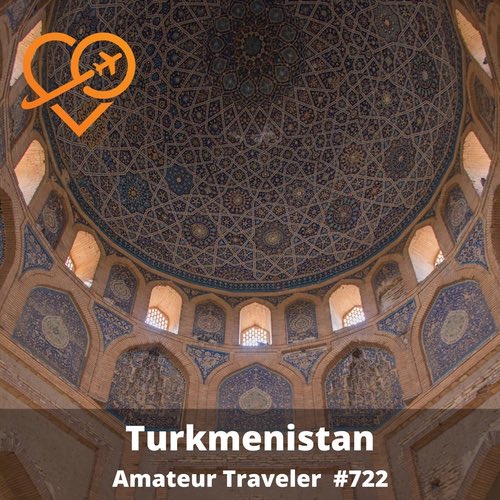 Travel to Turkmenistan – Episode 722
 Travel to Turkmenistan – Episode 958
 Uzbekistan – Part 1 of the Best of Uzbekistan and Turkmenistan
 Bike Travel in Central Asia (Turkmenistan, Uzbekistan, Kazakhstan, Kyrgyzstan) – Episode 172
by Chris Christensen
Chris Christensen is the creator of the Amateur Traveler blog and podcast. He has been a travel creator since 2005 and has won awards including being named the "Best Independent Travel Journalist" by Travel+Leisure Magazine.+Chris Christensen | @chris2x | facebook
Leave a Reply
Tags: article, g adventures, turkmenistan