Gur-Emir Mausoleum of Timur, Samarkand
Uzbekistan sits at the crossroads of some of the great stories of Central Asia: Silk Road caravans, desert khanates, conquerors, Soviet-era planning, and modern cities. I visited Uzbekistan as part of a G Adventures Best of Uzbekistan and Turkmenistan tour with listeners of the Amateur Traveler podcast.
The trip connected two very different countries in one overland journey, starting in Tashkent and ending in Ashgabat, with Samarkand, Bukhara, Khiva, the Karakum Desert, and the Darvaza gas crater along the way. This post will focus just on the Uzbekistan part of the trip.
This area sounds like an epic journey, but you may find the big surprise is how easy and comfortable it can be. There are long drives, border formalities, desert roads, village visits, and moments when the landscape stretches out into the rolling scrub or dunes that I expected, but there are also green cities with both ancient sites and modern conveniences.
Table of contents: ()

Chorsu Bazaar Tashkent
Starting in Tashkent
The trip began in Tashkent, Uzbekistan’s capital, and the easiest place for most travelers to enter the country. Tashkent is not the Uzbekistan of postcard domes and medieval courtyards. It is a large, practical, spread-out city with broad, green avenues, Soviet-era monuments, modern shopping streets, and a metro system that is worth seeing even if you do not need to go anywhere.
The tour itself does not cover Tashkent, so you will need to come early if you want to spend any time in the city. The city has been shaped by Russian imperial rule, Soviet planning, the 1966 earthquake, and post-independence growth.

Kosmonavtlar subway station
I only had half a day in Tashkent, but I took the metro to the Chorsu Bazaar and to Independence Square.
The first official moment of the tour was the group meeting at our hotel (Harris Hotel), the sort of practical but necessary gathering where you learn who you will be traveling with, how early the starts will be, how long the drives are, and what to expect at borders and hotels. Our meeting was followed by an optional dinner in nearby Park V Tashkente.
From our first meal onward, I was pleased with the food on this trip and how both good and inexpensive it was (often as little as $5 per person). Common foods included kebabs, plov, round breads, tandoor bread, dumplings, pastries, soups, tea, salads, melon, and pide (a Turkish-style pizza-like bread-and-cheese dish).

Shah-i-Zinda, Samarkand
Samarkand
From Tashkent, the route moved to Samarkand, one of the great historic cities of Uzbekistan. Samarkand was probably the city I was most excited to visit, as it is nearly synonymous with Silk Road caravans in my mind.
The first look at Samarkand came through an orientation walk. That is a useful way to approach a city that can otherwise feel overwhelming. Samarkand is not just one monument. Its major sites are spread around the city.
Gur-Emir Mausoleum of Timur

Gur-Emir Mausoleum of Timur, Samarkand
The optional visit to the Amir Timur Mausoleum, also known as Gur-e-Amir, fit naturally into the first day in Samarkand. Timur, or Tamerlane, was one of history’s great conquerors, and Samarkand became his imperial capital. His empire stretched across Central Asia, Persia, and beyond, and his descendants, the Timurids, left an architectural legacy that still defines the city. His grandson also invaded India and started the Mughal Empire.
The mausoleum is not just a tomb. It is an introduction to the city’s visual language: ribbed blue domes, glazed tilework, geometric patterns, sculpted ceilings, blue-green domes, and inscriptions. In contrast, the actual grave markers are simple stone blocks.

Shah-i-Zinda
Shah-i-Zinda was one of my favorite stops. It is a narrow avenue of blue-tiled mausoleums climbing the edge of the ancient Afrasiab hill. Its name means “The Living King,” a reference to the legend of Qutham ibn Abbas, a cousin of the Prophet Muhammad, traditionally associated with the site. Over time, the complex became both a pilgrimage destination and a prestigious burial place for nobles and members of the Timurid elite.
UNESCO includes Shah-i-Zinda among the major monuments of “Samarkand – Crossroad of Cultures,” along with the Registan, Bibi-Khanum Mosque, Gur-e-Amir, and Ulugh Beg’s Observatory.

Bibi-Khanym Mosque
Bibi-Khanym Mosque
The Bibi-Khanym Mosque was once one of the largest and most ambitious mosques in the Islamic world, built in Samarkand at the end of the 14th and beginning of the 15th century by order of Timur after his campaign in India. Timur wanted a monument worthy of his capital, and the mosque was constructed on an enormous scale and in great haste. That speed, combined with the daring scale of its portal, dome, and walls, may have contributed to the structural problems that appeared soon after its completion. We could see enough cracks in the building to give one pause.

That night, we tried plov, a rice and meat dish, which is Uzbekistan’s national dish.

Registan Square, Samarkand
Registan Square
We stayed at the Hotel Karvan, which was a short walk from Registan Square.
The next day, we visited the most famous site in Samarkand, Registan Square. Its name means “sandy place,” a reminder that this grand public space began as an open plaza where people gathered for markets, royal announcements, executions, and public events. Today, the square is framed by three great madrasas (from left to right): Ulugh Beg Madrasa, the Tilakari Madrasa, and the Sherdar Madrasa. The oldest of the three, Ulugh Beg Madrasa, was built in the early 15th century by the astronomer-king Ulugh Beg, Timur’s grandson. Sherdar and Tilakari were added in the 17th century.
Inside today, you will find vendors selling their crafts.

The Sherdar Madrasa is especially striking for its facade, where tiger-like lions chase deer beneath rising suns with human faces, imagery that seems to echo older Persian and Zoroastrian artistic traditions in a setting otherwise devoted to Islamic learning. In the back-right corner of this madrasa is an interesting exhibit featuring old photos of Samarkand before Russian rule, when it looked decidedly less Western.
A free afternoon gave us a chance to explore more on our own. I visited the Bibi-Khanym Mosque and the central market. Nearby is the Mausoleum of Islam Karimov, Uzbekistan’s first president.
These are near Afrasiab Hill, which was the site of old Samarkand, the city that existed before the Mongol conquest. When Genghis Khan invaded the Khwarazmian Empire in the early 13th century, Samarkand was one of its most important cities. In 1220, Mongol forces captured Samarkand, and the old fortified city on Afrasiab Hill was devastated. There is a museum on the hill with the history of that time period.

Ulugh Beg Observatory
Ulugh Beg Observatory
On the far side of the hill, I visited the Ulugh Beg Observatory. Not much remains of the building that was the observatory built by Ulugh Beg, the grandson of Timur. The observatory was among the most advanced astronomical centers of the medieval world. Ulugh Beg is remembered as a scholar and astronomer. From this hill on the edge of Samarkand, he and his team studied the movement of the stars and planets with remarkable precision, producing star charts and calculations that remained influential for centuries.
Very little of the original observatory survives above ground, but the most important feature can still be seen: the great curved trench of the giant sextant, once part of an instrument used to measure the positions of celestial bodies. A small museum provides more information about Ulugh Bey’s work.

Mausoleum of St. Daniel
Mausoleum of St. Daniel
In the area, I also visited the Mausoleum of St. Daniel, which is one of Samarkand’s most unusual sites. It is associated with the biblical prophet Daniel from the Old Testament. According to local legend, Timur brought a relic of Daniel back to Samarkand, hoping that the prophet’s presence would protect and bless his capital.
Inside the long, low mausoleum is an unusually lengthy tomb, covered in green cloth, which tradition says continues to grow over time. Visitors come not only to see the tomb but also to drink from the nearby spring, which some believe has healing properties.
These last two sites are a bit far to walk to, so I called a taxi using the Yandex Go app to get back to the hotel. Taxi rides are cheap, often less than $2 when booked with the app.

Chashma Complex
Into the Grasslands
Leaving Samarkand, the trip shifted from city architecture to desert landscapes. The route led toward Nurata and the Chashma Complex, a pilgrimage site associated with a holy spring.

Ruins of the fortress at Nurata
The itinerary also included the ruins of a fortress traditionally associated with Alexander the Great. Alexander the Great came through this region in the 4th century BC.
The day continued toward Aidarkul Lake, a large lake on the edge of the Kyzylkum Desert. On a cool, windy day in the rolling grasslands of Uzbekistan, we opted to forego a swim.
We made a community tourism stop where we “helped” a local woman bake bread in a tandoori oven. I always thought of this type of bread as Indian, but it was brought by the Mughals from Central Asia. The stop gave us a chance to meet some of the locals and try some delicious bread!

That night, we stayed at a yurt camp up near the Kazakhstan border. The yurt stay was one of the trip’s “local living” experiences. Sleeping in a yurt camp, sharing dinner, and hearing Kazakh singing in the evening gives the itinerary a pause between the famous Silk Road cities. It was not a luxury experience, but with electricity and WiFi, it was hardly roughing it either. Warm showers and flush toilets were a short walk from the yurts.

Robati Malik caravanserai
On our way from the yurts to Bukhara, we stopped at the Robati Malik caravanserai (part of the Silk Roads: Zarafshan-Karakum Corridor UNESCO site) for a quick visit to one of the many complexes that provided shelter and supplies to the numerous caravans on the Silk Road. They were spaced about 20 miles apart along the route. So the 10-day caravan journey from Samarkand to Bukhara would probably stop at 9 different caravanserais along the way.

pool in Bukhara
Bukhara
After the grand monuments of Samarkand and the bumpy drive out toward the yurt camp, Bukhara’s old center felt comfortable, walkable, and full of atmosphere. The historic core is a pedestrian-friendly maze of mosques, madrasas, trading domes, tea houses, restaurants, small shops, ponds, and bazaars. It was touristy, but in a way that still felt alive and enjoyable, with enough room to wander without worrying about traffic. We stayed at the Istat Boutique Hotel, which put us within walking distance of the historic center and made it easy to explore at a relaxed pace. The city quickly became one of my favorites on the trip.

Summer Palace of Bukhara
Summer Palace
After a quick orientation walk, we made an optional trip out to the Summer Palace, which was a taxi ride from the main tourist area. This was the country retreat of the last emirs of Bukhara. It was built in the early 1900s and blends traditional Uzbek styles with European influences coming in from Russia. It reminded me of the Dolmabahçe Palace in Istanbul.

Summer Palace of Bukhara
You see ornate rooms with mirrors, painted ceilings, carved plaster, bright colors, and decorative flourishes that feel both Bukharan and European. The emirs wanted their guests to understand both their wealth and their sophistication.

Ismail Samani Mausoleum
The next day, we did our official tour of the city. We started at the Ismail Samani Mausoleum, which is remarkable not for size or color but for the sophistication of its brickwork. It was built around the 10th century as the family tomb of the Samanid dynasty. It has a simple square form, a rounded dome, and almost basket-like decoration.
Nearby was another site dedicated to the Prophet Job called Chashma-Ayub, the “Spring of Job.” In the Koran, Job struck the ground with his staff, and a spring appeared.

Bolo Haouz Mosque
Bolo Haouz Mosque
We visited the Bolo Haouz Mosque, best known for its tall, slender wooden columns that support the large front iwan, or porch. Those columns are reflected in a pool, or hauz, in front of the mosque, which is where the name comes from: Bolo Haouz means something like “by the pool.” The mosque dates mainly to the early 18th century, with the columned porch added later.

Ark of Bukhara
The Ark
The Ark of Bukhara was, for centuries, the political center of Bukhara. It was both a palace and a fortress. This was the last site captured by the Red Army during its 1920 invasion. We visited on a rainy day, not the weather I was expecting in Uzbekistan in May.

Ark of Bukhara, Thrown Room
Inside, there are a few small museums that tell the history of Uzbekistan, a large area still in ruins, stables, and the throne room. From the walls there are some good views of our next stop at the Po-i-Kalyan complex.

Po-i-Kalyan complex
Po-i-Kalyan Complex
One of the most significant sites in Bukhara is the Po-i-Kalyan Complex. The name means something like “at the foot of the Great One,” referring to the Kalyan Minaret, the tall brick tower that dominates the complex.

Po-i-Kalyan Complex, view from the mosque
The Kalyan Minaret, dating to the 12th century, is the oldest and most famous element, with bands of patterned brickwork rising above the square. It is the only part of the complex that Genghis Khan left standing when he captured Bukhara. Around it are the Kalyan Mosque, the Mir-i-Arab Madrasa, and an open plaza.
A mosque and a madrasa frame the space with large portals, blue-tiled accents, domes, and courtyards. We were told that the madrasa is still in use for its original educational function.

Caravanserai
We also visited another Caravanserai with more unusual Zoroastrian-influenced tile work on its portal.

puppet Chris
We made a visit to a local puppet shop, where some people seemed to think I had found my doppelganger.

Across the Desert
The drive from Bukhara to Khiva is long. There is no getting around that. It crosses a great stretch of desert and is pretty much a full day’s journey. There weren’t really any significant stops along the way, and because of the bumpy road, it is a great place to catch up on your podcasts and audiobooks or chat with your fellow travelers. The highlight was the one rest stop with camels.

Khiva
Khiva is worth the effort. The old city, Itchan Kala, is UNESCO-listed and enclosed within mudbrick walls. It feels more compact and self-contained than Samarkand or Bukhara. If Samarkand is imperial and Bukhara is lived-in, Khiva can feel almost theatrical, especially late in the day when the sand-colored walls and blue tile catch the warm light.
The next day in Khiva included a guided tour and time to explore independently. The old town’s mudbrick lanes, blue mosaic domes, carved wooden columns, and tiled portals make it one of the most photogenic places on the route.

Juma Mosque
Juma Mosque
Juma Mosque is one of the most atmospheric places inside Khiva’s walled city. From the outside, it is fairly modest, but inside, the space opens into a shadowy hall supported by a forest of carved wooden pillars. The columns are the defining feature, each one slightly different, with some much older than others and many decorated with intricate floral and geometric patterns. It reminded me of a wooden version of La Mezquita in Cordoba, Spain.

Kalta Minor
Kalta Minor
The Kalta Minor is one of thiva’s most recognizable landmarks, not because it is tall, but because it was never finished. The short, broad minaret stands near the western gate, wrapped in bands of brilliant blue, turquoise, and white tile that make it glow against the tan mud-brick walls of the old city. It was begun in the 19th century by Muhammad Amin Khan, who intended it to be an enormous minaret, but the project stopped after his death.

Bollywood movie?
Oddly enough, when we visited, they were filming what seemed to be a Bollywood movie.

Konya-Ark Fortress
Konya-Ark Fortress
The Konya-Ark Fortress was the fortified heart of old Khiva, the place where the khans ruled from behind thick walls. Like the Ark of Bukhara, it combines a citadel, palace, and administrative center, but in Khiva, everything feels more compact and immediate. Passing through its gates, you move into a series of courtyards, reception spaces, and decorated rooms that once belonged to the ruling elite.
One interesting feature in the Ark, and the Tash Khauli Palace was round platforms where yurts could be erected to make guests from nomadic tribes feel more welcome.

Tash Khauli Palace
Tash Khauli Palace
The Tash Khauli Palace shows the more elaborate, domestic side of Khiva’s ruling elite. Built in the 19th century for the khans of Khiva, the palace is a maze of courtyards, rooms, carved wooden columns, painted ceilings, and blue-and-white tilework. Its name means “Stone House.” What stands out most is the decoration: patterned tiles climbing the walls, graceful iwans facing into courtyards, and wooden pillars carved with the same kind of craftsmanship seen throughout the old city.

Tash Khauli Palace
The palace included reception areas, private quarters, and the harem, giving it a different feel from the fortress-like Konya-Ark. One of the few rooms that was furnished was the emir’s room inside the harem.

Islam Khodja Minaret and Madrasa
Islam Khodja Minaret and Madrasa
The Islam Khodja Minaret is tall and elegant, banded with blue, turquoise, white, and brown tilework. Beside it, the madrasa is more modest in scale, with a tiled portal and courtyard that fit naturally into Khiva’s compact architectural landscape. The complex dates from the early 20th century and is named for Islam Khodja, a reform-minded grand vizier of the Khiva Khanate.
You can climb this minaret, although my fellow travelers who did said the steps are a bit challenging, and they were glad not to run into anyone on the stairs going the opposite direction.

City walls
My entire group paid an extra $4-5 to walk the city walls. You can only walk about halfway around the walls, and not to the area near the Islam Khodja Minaret or the Kalta Minor, but I still thought it was worth the money and effort. We did it first thing in the morning and found that opening times… are relative.

Hotel Muso To’ra
We stayed inside the walls of the city in an old madrasa at the Hotel Muso To’ra. It felt like staying inside an Arabian Nights storybook. You did have to duck under a 2-foot-thick, 5-foot-tall opening to get into the bathroom, so modern hotels have some advantages, too.
The last dinner in Khiva was a chance to say goodbye to Mohammad, who had been our CEO (guide) for the first half of our trip, and hello to Usaf, who would be our CEO for the Turkmenistan part of the trip. A tip of $7-10 a day is suggested and was well deserved.
Practical Notes for This Itinerary
This trip is not difficult in the sense of extreme adventure travel, but it is not effortless either. There are long drives, including the desert crossing to Khiva, and more as you head on to Turkmenistan. There was one night spent in a yurt in Uzbekistan.
Breakfasts were included, but only one dinner on this half of the itinerary (the yurt). But meals were delicious and cheap.
Packing should account for both cities and desert camps. A small flashlight or headlamp is useful for camp nights. Layers help because desert temperatures can shift. Comfortable walking shoes matter more than dress shoes, especially in old cities with uneven paving, sand, steps, and long sightseeing days. A scarf (for women), a hat, sunglasses, sunscreen, and a reusable water bottle are all needed.
For photography, this itinerary is rich. Samarkand offers grand architectural shots. Bukhara is better for street scenes, courtyards, details, and evening atmosphere. Khiva is excellent at sunrise and sunset.
Money was easy in Uzbekistan. We could withdraw money at an ATM, including US dollars, for the Turkmenistan portion of the trip. We could use our credit cards for meals.
Our G Adventures CEO (guide) for this half of the trip was Mohammad, and he was great. I suspect that part of the reason I think Uzbekistan is so easy to visit was that he made it so.

author at Shah-i-Zinda in Samarkand
Conclusion
The best part of this section of the G Adventures Best of Uzbekistan and Turkmenistan tour was the famous Silk Road cities. For me, the route from Samarkand to Bukhara to Khiva just kept getting better. Although the monuments of Samarkand might have been the most grand.
For travelers who want Central Asia in a manageable but varied itinerary, Uzbekistan and Turkmenistan make a fascinating pairing. Uzbekistan provides the Silk Road cities that many people dream of seeing. The only surprise was that the cities in Uzbekistan felt less remote and less foreign than I expected.

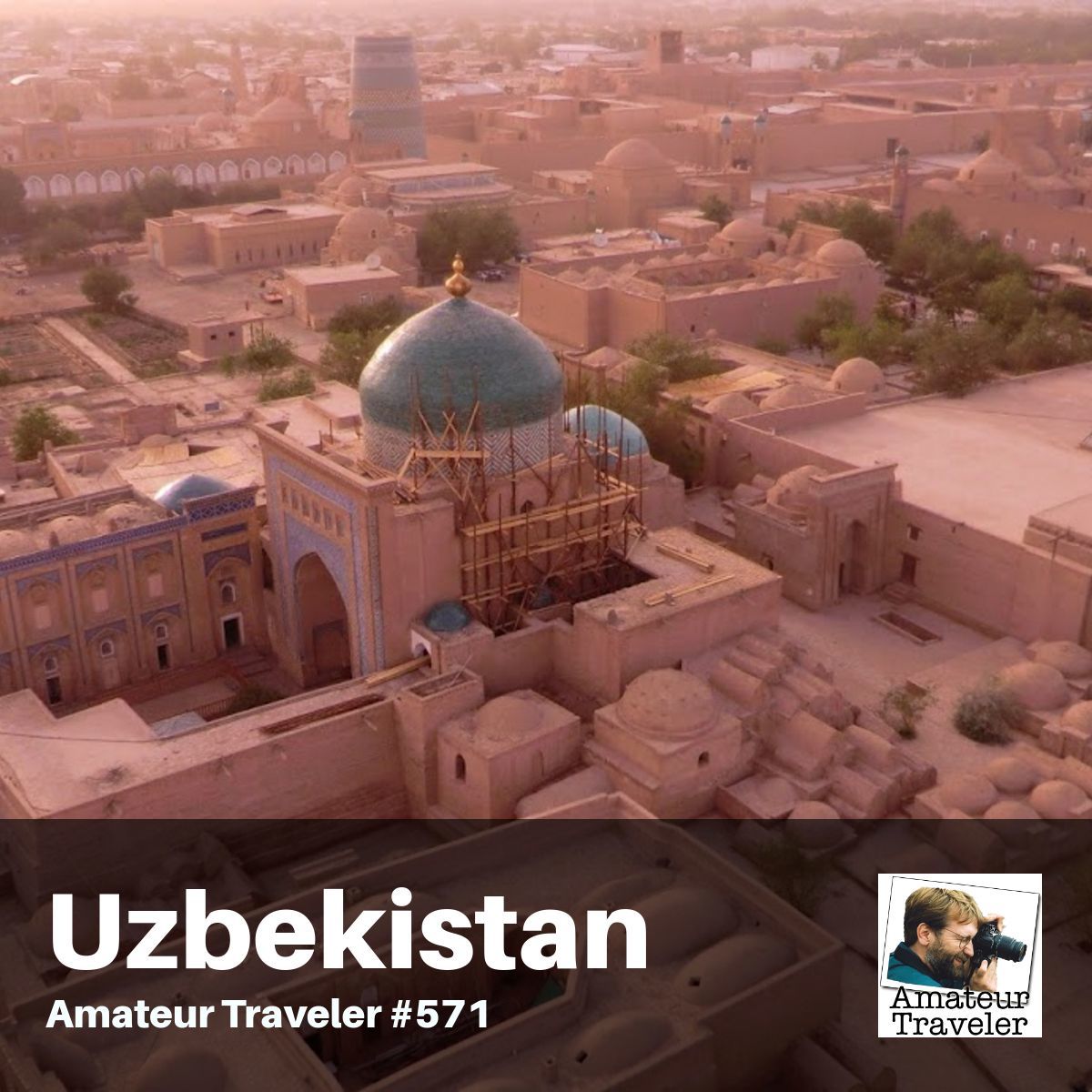 Travel to Uzbekistan – Episode 571
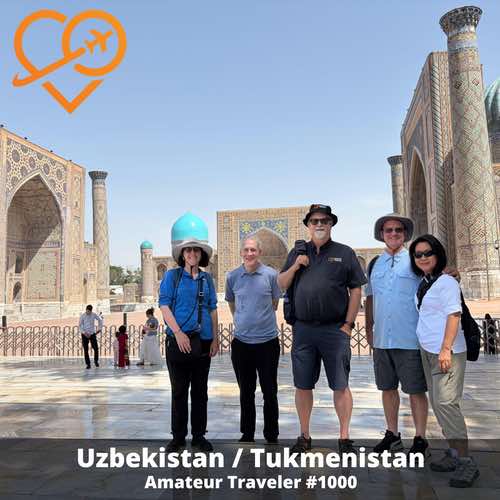 Travel to Uzbekistan and Turkmenistan – Episode 1000
 Turkmenistan – Part 2 of the Best of Uzbekistan and Turkmenistan
 Bike Travel in Central Asia (Turkmenistan, Uzbekistan, Kazakhstan, Kyrgyzstan) – Episode 172
by Chris Christensen
Chris Christensen is the creator of the Amateur Traveler blog and podcast. He has been a travel creator since 2005 and has won awards including being named the "Best Independent Travel Journalist" by Travel+Leisure Magazine.+Chris Christensen | @chris2x | facebook
Leave a Reply
Tags: article, g adventures, uzbekistan