Canals, barges, locks, chateaus, vineyards, aqueducts, and a French chef. That is a pretty good start to describing a European Waterways cruise on the Briare Canal in France.
This was not my first trip with European Waterways. My wife and I had previously cruised with them on the Canal du Midi in southwestern France before COVID, and she had been clear that it was time to get back on one of their boats. When I asked her what trip she wanted to do this year, her answer was basically: get back to European Waterways, preferably in Bordeaux or Burgundy.
If you ask her why, she would probably start with this: eight passengers, five crew, including a French chef.
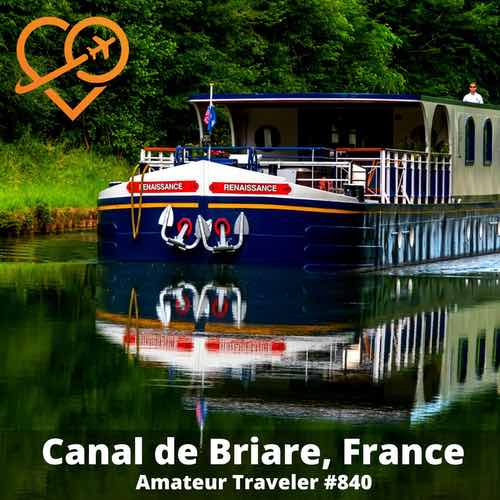
That is the essence of the experience. This is not a large river cruise. This is a luxury hotel barge, in this case, the Renaissance, moving slowly through the French countryside along the Briare Canal.
Table of contents: ()
- What Is a Luxury Hotel Barge?
- The Crew
- The Route: Montargis to Châtillon-sur-Loire
- Montargis
- Château de la Bussière (Fisherman’s Castle)
- Fresh Bread and a Bakery Run
- Montargis
- Rogny-les-Sept-Écluses
- Moret-sur-Loing
- Château Rosa Bonheur
- Sancerre
- Briare and the Canal Bridge
- Cooking Demonstration on Board
- Château du Rattely
- Life on Board the Renaissance
- Who Is This Trip For?
What Is a Luxury Hotel Barge?
The word “barge” may set the wrong expectation. It certainly did the first time my wife heard it. The Renaissance was originally a working barge, but it was converted in 1997 into a luxury hotel barge.
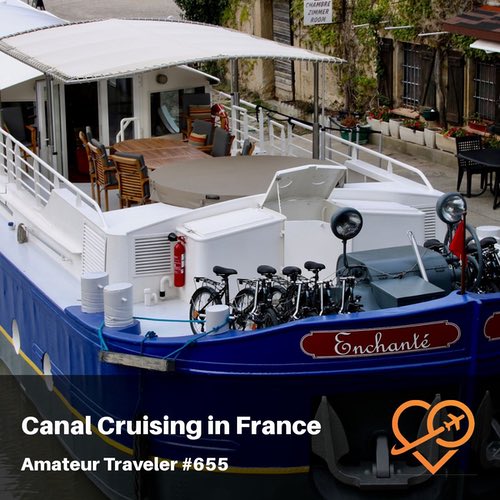
The boat has two decks. On the main deck are the dining room, lounge area, outdoor dining space, and hot tub. Forward of that are the galley, the pilot’s area, and crew quarters. Downstairs are four guest cabins, each with an en suite bathroom. The boat carries up to eight passengers.
The Renaissance is about 128 feet long and 16.5 feet wide. That size is not accidental. It is essentially the maximum size that can fit through the locks of the Briare Canal. At times, the boat fills the locks so completely that there is almost no space left from side to side or from bow to stern.
This is a luxury experience, and the fare reflects that. It is just under $10,000 per person on this boat, though European Waterways also offers larger boats that carry 12 passengers, which cost less per person. In our case, European Waterways hosted my wife and me on the cruise. We paid our airfare, hotels before and after, and the tip.

The Crew
One of the things that makes this kind of trip work is the crew. On the Renaissance, we had five crew members. Craig, the captain, also served as tour guide. He is English but grew up in France. Luke, also English, was the pilot. Thomas, the chef, was French. Robin and Dani, from Ireland and South Africa, were the hostesses.
By the end of a week on a small boat, you feel like you know the crew. You are eating with them, traveling with them, asking them questions, watching them work the locks, and seeing how much they do to create the experience. By the end of the trip, I think at least some of the crew had been invited to visit just about everyone’s home if they ever came to the United States.

The Route: Montargis to Châtillon-sur-Loire
The cruise begins in Paris, where guests meet at the Hotel Westminster. We did not stay there, but we met the group there and then drove by van a couple of hours to Montargis.
The Briare Canal connects the Loire and the Seine. Construction began in 1604 under Henry IV of France, who wanted to improve the grain trade and reduce food shortages by making it easier to move goods between river systems. The canal took nearly 40 years to build and was hand-dug by thousands of laborers.
The Renaissance cruised from Montargis to Châtillon-sur-Loire. If you drove that same distance by car, it would take roughly 45 minutes. By barge, it takes a week, which is very much the point.
The boat only travels during the day. There is no reason to rush. The canal is lined with towpaths, once used by animals pulling boats and now used as walking and cycling paths. In many places, you can get off at one lock, walk to the next, and meet the boat there because the boat moves slowly and the locks take time.
Craig called it “a really fast, slow-paced trip,” which sounds contradictory until you do it.

Montargis
Montargis is an old walled town sometimes called “the Venice of the Gâtinais.” It has canals, bridges, flowers, and a lovely historic core. It is also a four-flower town, part of a French system that rates towns based on the beauty of their public gardens and floral displays.
We did not explore Montargis in depth on the first day because it was the weekend and some places would have been closed. But we did draw a crowd as the Renaissance began to move through town. Only a few large boats go through these canals each week, and because the Renaissance fills the locks so completely, watching it pass is something of a local attraction.

fresh cheese and zucchini cannoli
The first day was mainly about settling in, learning the rhythm of the locks, and enjoying the first of many memorable meals. Dinner began with fresh cheese and zucchini cannoli with herbs and balsamic, followed by duck filet with roasted potatoes, grilled turnips, and cherry jus. Then came the cheese course, with three French cheeses and wine.
Meals on board are generous. There is an open bar, wine with lunch and dinner, and later in the week, several of us started making strategic decisions: maybe skipping a course, saving cheese for breakfast, or choosing not to have both wines at dinner.

Château de la Bussière (Fisherman’s Castle)
Our first major excursion was to Château de la Bussière, a privately owned castle sometimes called the Fisherman’s Castle. It is still owned by the same family that held it before the French Revolution.
The setting is beautiful, with a moat that reflects the castle, making it particularly photogenic. The grounds include a large dovecote that once held around 1,000 doves. Craig explained that the number of doves was tied to the amount of land owned, with roughly one dove per hectare.

Inside, the fishing theme becomes obvious. There are fishing rods, reels, nets, and fish-related items everywhere. Upstairs, rooms are set up to show historic life in the château, including servant spaces and old household tools.
This was a good example of the kind of place European Waterways likes to include. It is not one of the major tourist sights you would already know about. It is smaller, quieter, and more personal.

Fresh Bread and a Bakery Run
Each morning, Craig went out to get fresh bread and pastries from a local bakery. Guests who were up early could join him.
I tried to join every time it was offered. It was a fun way to see a small town that we might otherwise barely visit, and there was always the reward of fresh bread at breakfast.
Craig also explained that some bakeries had not survived COVID and then the later rise in fuel costs. A baguette is expected to cost around one euro, and when fuel prices rose, bakeries struggled because they use a lot of energy, but customers are sensitive to bread prices.

Montargis Fisherman’s Quarter
Montargis
On Tuesday, we returned to Montargis. We made a brief stop to see the remains of a Roman theater sitting in a farmer’s field, then continued to the Mazet factory.
Mazet Factory

Craig works on a Paris-Brest
Mazet is known for pralines and has a long history. We put on hairnets and aprons and learned to assemble a Paris-Brest, the circular pastry created to commemorate the Paris-Brest-Paris bicycle race. The pastry is shaped like a bicycle wheel and filled with praline-flavored cream. The best part, of course, was eating it.

8 passengers and a surprising array of sweets
Then we sampled a remarkable number of praline sweets, including varieties with chocolate, salt, rose, mint, and other flavors. It was a dirty, thankless job, but someone had to do it.

Francis Xavier and a samurai
Montargis Church and the Green Man
We also visited the church in Montargis, which has newer-style stained glass, painted in more detailed scenes than older stained glass made from separate pieces of colored glass. One window included a samurai warrior, depicting Francis Xavier’s visit to Japan.

The Green Man
Craig also introduced us to the Green Man, a figure found in many medieval churches in France and England. It is usually a human face surrounded by leaves, or foliage emerging from the mouth, nose, or eyes. Some interpret it as a symbol of nature, fertility, or rebirth. Others see possible traces of older pagan traditions, though historians are cautious about that explanation. Once you know to look for the Green Man, it becomes a little treasure hunt in old churches.

Fisherman’s Quarter
Fisherman’s Quarter
One of the oldest and most scenic neighborhoods of Martargis is the Fisherman’s Quarter. The Fishermen’s Quarter dates back at least to the early 16th century. The Fishermen’s Quarter dates back at least to the early 16th century. It is located just off the canal and is filled with half-timbered houses and canals, with flower boxes displayed prominently.

Rogny-les-Sept-Écluses
Later, we cruised to Rogny-les-Sept-Écluses, or Rogny of the Seven Locks. The old flight of seven locks is no longer in use, but it remains as a monument to the original canal and is lit at night. The “new” locks that we would use date back to major work done on the canal in the 1800s.

As we cruised toward Rogny, a jazz trio came on board and played as we moved through the canal and locks. The music was mostly in French, but jazz travels well across languages.

Moret-sur-Loing
On Wednesday, we visited Moret-sur-Loing, a beautiful walled town associated with the painter Alfred Sisley. It still has old towers, a gristmill, and a washerwoman’s walkway along the walls.

Moret-sur-Loing is also known for sucre d’orge, a barley sugar candy said to have been created by Benedictine monks in the 1600s. Some of the group bought it and shared it. I do not usually think of barley as the basis for a confection, but it was surprisingly good.
The church in town also had a useful map showing which parts were built in which centuries. Many of these French churches were built and expanded over long periods, so the building itself becomes a history lesson.

Château Rosa Bonheur
Château Rosa Bonheur
One of the most unexpected highlights of the trip was visiting Château Rosa Bonheur. I was not very familiar with the French painter Rosa Bonheur before this trip, but she was a highly successful 19th-century artist known especially for painting animals. One of her best-known works, “The Horse Fair,” hangs at The Met in New York. When she sold that painting, she bought a château. We visited that château.
Her studio has been preserved almost as if she might walk back in and pick up her work. There are unfinished paintings, animal studies, and works in progress. She had animals on the property, including a lion, and some of her paintings of that lion are especially striking.
Rosa Bonheur was a contemporary of the Impressionists, but she did not paint in their style, and her fame faded somewhat in the 20th century. The château is now being restored and interpreted by women who are preserving her legacy.
We also had lunch there with one of the women involved in the restoration. It was one of those stops I might not have chosen on my own, but I was very glad European Waterways included it.

Sancerre
Another highlight was our visit to Sancerre, a hilltop wine town, and the surrounding area known for Sauvignon Blanc. I had known Sancerre as a wine for decades, but I had never been to the region.
We visited Hubert Brochard and went up into the vineyards with the owner. From there, we could see how compact the region is and how varied the soils are.
There are three main soil types in Sancerre: terre blanche, or white earth, which is clay and limestone; caillottes, small stones and limestone; and flint, which produces more mineral-driven wines. The soil helps shape the style of the wine.

In the winery, I also learned something interesting about how the weather affects winemaking. In a balanced year like 2023, they may use stainless steel because the wine does not need to change. In a wet year like 2024, with more acidity and a need for more body, oak can help. In a hot year like 2025, when the wine has more body and needs more acidity, cement can be useful because it breathes more than stainless steel and allows some oxygen exchange.
That visit gave me a better understanding of how winemaking decisions respond to each year’s conditions. The area is getting more and more hot, dry years because of climate change, which puts pressure on the winemaking business. The area is at least less affected than some, like Bordeaux, by the shift in consumer tastes away from alcohol in general, and even more so from full-bodied red wines.

Briare and the Canal Bridge
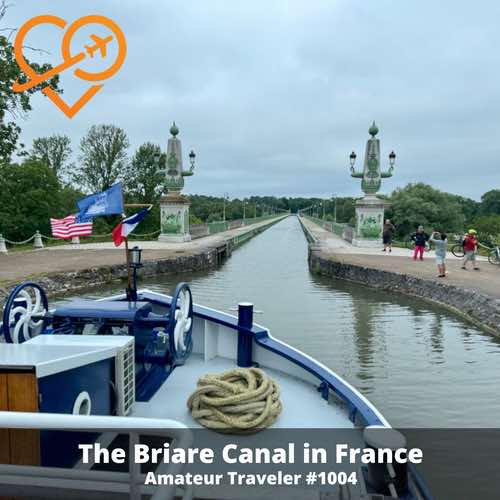
Briare is known for its canal bridge over the Loire River. You are in a canal, and then the canal crosses the river on a bridge. The bridge is often associated with Gustave Eiffel, though it was not actually designed by him. His company was involved in part of the construction, but others designed and built it.
The bridge is lit at night, so we walked over to see it after dark. It used to be the longest canal bridge in the world and is now the second longest.
The next morning, we crossed it by barge. To celebrate, Craig brought out a bottle of champagne and a saber, then sabered it as we crossed. There was also a second attempt by another passenger, which required a second bottle before succeeding.
Cooking Demonstration on Board
That afternoon, Thomas gave a cooking demonstration on board. He made lobster ravioli, and guests had a chance to help. He also made chocolate spheres that would later be filled with ice cream for dessert.
One of the pleasures of this cruise is that food is not just served to you. You also get little glimpses into the work behind it.

Château du Rattely
Our final excursion was to Château du Rattely, a château whose construction began in 1270. Today, it is a private art center.
We watched a pottery demonstration and saw some of the art on display. The château also has an old dovecote with a wooden ladder that spins around a central axis, allowing access to the nesting spaces. The ladder is hundreds of years old and still works.
The pottery studio sometimes fires a wood kiln, which is unusual because most pottery studios now use natural gas. A wood kiln changes the pottery through the ash it produces, but it requires enormous effort to operate. It can take about 15 hours to reach 1,300 degrees Celsius and about two days to cool down. At those temperatures, a log thrown in the fire is consumed in seconds.

Life on Board the Renaissance
The pace on board is relaxed. You can walk or bike along the towpaths, sit in the lounge with a book, work on a journal, watch the countryside pass, or sit in the hot tub as the canal slides by.
The cabins can be configured with two single beds or one double. They have air-conditioning, which would be more important in hotter weather. The bathrooms have heated towel racks, which I appreciated because it was the first week of a longer trip and I was washing clothes as we went.
Each room also came with a water bottle, hat, and European Waterways bag.
There is a chalkboard each day with the schedule and another with the lunch and dinner menus. There are books and DVDs on board, though I never turned on the screen in our room. There is also Starlink internet, which gave us good connectivity most of the time.

author and his happy wife
Who Is This Trip For?
You do need some mobility for this trip. You do not have to walk huge distances unless you choose to, but you do need to manage stairs on the boat and some walking during excursions.
This trip is for someone who wants a relaxed, intimate, food-focused, history-rich journey through the French countryside. It is not inexpensive, and it is not fast-paced. You need to enjoy slowing down. That combination made for a memorable week on the Renaissance with European Waterways.

 Cruising the Briare Canal in France with European Waterways – Episode 1004
 Cruising the Canal de Briare and the Loire Valley of France – Episode 840
 Canal Cruising in France – Episode 655
 Cruising on the Canal du Midi – A Luxury Barge Cruise in Southern France including Carcassonne
by Chris Christensen
Chris Christensen is the creator of the Amateur Traveler blog and podcast. He has been a travel creator since 2005 and has won awards including being named the "Best Independent Travel Journalist" by Travel+Leisure Magazine.+Chris Christensen | @chris2x | facebook
Leave a Reply
Tags: article, barge cruise, burgundy, european waterways, france, loiret